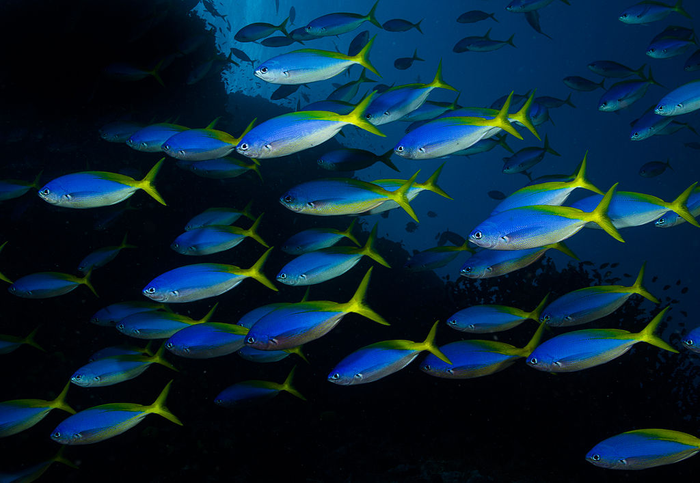
Researchers from the University of Adelaide have found that the way fish interact in groups is being upset by ocean acidification and global warming.

“Fish show gregarious behaviour and cluster in shoals which helps them to acquire food and for protection against predators,” said project leader Professor Ivan Nagelkerken from the University of Adelaide’s Environment Institute and Southern Seas Ecology Laboratories.
“Many gregarious tropical species are shifting poleward under current ocean warming and interacting in new ways with fish in more temperate areas.”
Under controlled laboratory conditions the researchers evaluated how species interacted and behaved in new ways with changing temperature and acidification.
The rising concentration of carbon dioxide in the atmosphere is driving up ocean surface temperatures and causing ocean acidification. Although warming and acidification are different phenomena, they interact to the detriment of marine ecosystems.
“We found that tropical and temperate fish species tend to move to the right when coordinating together in a shoal especially when spooked by a predator, but this bias significantly diminished under ocean acidification,” said University of Adelaide PhD student Angus Mitchell who performed the experiments.
“Mixed shoals of tropical and temperate species became less cohesive under future climate conditions and showed slower escape responses from potential threats.”
Professor David Booth from the University of Technology, Sydney collaborated on the study.
“Our findings highlight the direct effect of climate stressors on fish behaviour and the interplay with the indirect effects of new species interactions,” he said.
The team of researchers published their findings in the journal Global Change Biology.
“Strong shoal cohesion and coordinated movement affect the survival of a species: whether to acquire food or evade predators,” said Professor Nagelkerken.
“If the ability for fish to work together is detrimentally affected it could determine the survival of particular species in the oceans of the future. Tropical species may initially fare poorly when moving into new temperate areas.”
IMAGE CREDIT: Creative Commons




Leave a Reply