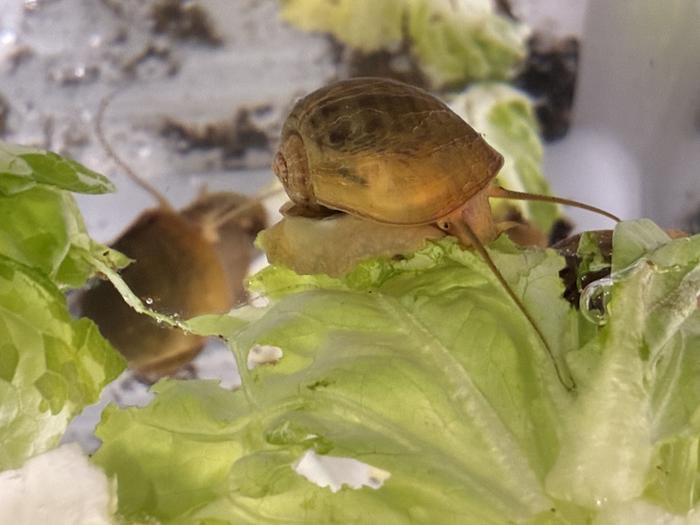
To a gardener, snail slime is one thing: the silvery trail left across a paving stone overnight. To the snail, it is at least five. The grove snail Cepaea nemoralis, a common European species with a banded shell, produces a whole toolkit of secretions, each suited to a different task, and a study published in August in Science explains how a single animal manages to make them all.
The five secretions examined in the study could hardly behave more differently. One is a lubricant that lets the snail glide. Another is an adhesive that anchors the shell to a surface. A third is a protective mucus containing calcite, a crystalline form of calcium carbonate. A fourth is a highly sticky yellow mucus that stretches a long way and resists tearing. The fifth is a bubbly froth thought to put off predators.
One Recipe, Adjusted
Mariella Gabler and colleagues set out to learn what distinguishes these materials, combining proteomic analysis, which catalogs the proteins present in a sample, with materials testing and imaging. The contacts listed for the study are based at the Max Planck Institute of Colloids and Interfaces in Germany.
The surprise was how much the five have in common. Their protein composition is similar across the board, and in each the main structural ingredient is collagen VI, a member of the family of fibrous proteins that give animal tissues their strength. The snail does not appear to run five separate chemical factories. It works from one base recipe.
What changes from one mucus to the next is the amount of collagen and the addition of a mineral ingredient, amorphous calcium carbonate. This is the same compound that hardens into shell, held in a disordered, non-crystalline state. Varying those two ingredients is enough to turn a slippery film into a glue or a tough, stretchy thread.
Calcium’s Double Role
Calcium turns out to be the dial the snail uses, and it does two different jobs depending on whether the mucus is wet or dry. In wet mucus, it serves as a source of ions that link the protein chains to one another, a process known as cross-linking that stiffens and strengthens a gel. In dry mucus, it acts as a precursor from which mineral can form. Between those two roles, a single organism can switch among distinct mechanical functions without changing the underlying protein scaffold.
That economy is what interests materials scientists. Industrial adhesives, lubricants and protective coatings are generally made from different raw materials by different processes. The snail gets all three, and more, from water, one structural protein and a common mineral, at ambient temperature and with nothing more exotic than calcium to tune the result.
The authors write that snail mucus has “a high potential to serve as inspiration” for sustainable applications. They point to adhesives and other new materials, as well as medical uses such as wound healing and drug delivery, and note that the substance is already of commercial interest.
The summary of the research released by the journal’s publisher is brief. It reports no measurements of strength or stickiness and does not describe how the snail controls calcium delivery to each secretion. Those details, and any assessment of how readily the chemistry could be copied in a laboratory, are matters for the paper itself and for the work that follows it.
Endnotes
- Gabler, M., et al. (2026). “Calcium tunes snail mucus-based materials to multiple functions.” Science. https://doi.org/10.1126/science.adx7367
- American Association for the Advancement of Science (August 6, 2026). “From slippery to sticky: How snails engineer their ‘slime.’” EurekAlert! https://www.eurekalert.org/news-releases/1138472
Featured image: Snails (file photo; not the species studied). Credit: Alice Accorsi, UC Davis.



Leave a Reply