A star’s light, spread into its component colors, is a kind of biography. The pattern of bright and dark lines in a spectrum records how hot the star is, what it is made of, how fast it is moving and, with some modeling, roughly how old it is. In August, the Sloan Digital Sky Survey released more than two million of those biographies at once.
The collaboration’s twentieth public data release, known as DR20, is the latest installment from SDSS-V, the fifth phase of a project that has been surveying the sky for more than two decades. Much of the new material comes from the Milky Way Mapper, a program the collaboration describes as the most detailed spectroscopic map yet assembled of the stars in and around our galaxy. Many of those stars were visited more than once, so the catalog captures change as well as composition.
What sets this release apart is geography. SDSS-V observes with matching optical spectrographs on two continents, at Apache Point Observatory in New Mexico and at Las Campanas Observatory in Chile, and DR20 contains the survey’s first optical spectra taken from the Southern Hemisphere. For a galaxy that wraps around the entire sky, that matters. The Magellanic Clouds and long stretches of the Milky Way’s outer reaches are best seen, or only seen, from the south.
Marina Kounkel, an assistant professor at the University of North Florida and the SDSS-V survey coordinator, said in the announcement that it was exciting to put a catalog of this size and quality into public hands. The work collaboration members have already done with it, she added, only begins to show what the data can support.
Reading the Galaxy’s Fossil Record
Surrounding the Milky Way’s bright disk is a faint, thinly populated halo of ancient stars. They preserve a record of how the galaxy assembled, including the smaller satellite galaxies it swallowed along the way. DR20 includes spectra of about 250,000 halo stars gathered through three efforts: a full-sky survey of giant stars reaching more than 65,000 light-years from Earth, a sample of fast-moving stars within 3,000 light-years, and a hunt for chemically primitive relics whose iron content is less than 1 percent of the Sun’s.
That last search has already produced a headline result. A class of undergraduates at the University of Chicago, working with the survey data, identified what the collaboration calls the most pristine star yet found, an object described in Nature Astronomy as a nearly pristine star from the Large Magellanic Cloud. Alexander Ji, the Chicago astronomer who serves as deputy project scientist for the halo program, said the team has enjoyed exploring the dataset and is eager to see what other researchers do with it.
Vedant Chandra, a Harvard graduate student who led a companion study mapping the distant, metal-poor Milky Way, argued that the halo’s fossil record can only be read with a view of the whole sky. With both hemispheres covered, he said, researchers can measure the motions, distances and chemistry of halo stars everywhere, which should expose ancient stellar structures and the dynamics that shaped them.
Dead Stars and Near Neighbors
The release adds 49,000 spectra of white dwarfs, the dense embers left behind when Sun-like stars run out of fuel. That more than doubles the number of white dwarfs SDSS has made public. More than 80 percent had never been observed by the survey, and more than 40 percent lie in the southern sky. Some carry the chemical traces of planetary bodies that were torn apart and fell onto the star.
JJ Hermes, a Boston University astronomer and Milky Way Mapper survey scientist, said many of the new spectra show signs of planetary systems that outlived their host star’s death throes. Collecting a sample this large one target at a time, he noted, would have taken decades.
Closer to home, a Solar Neighborhood Census provides spectra for 280,000 stars within 250 parsecs of the Sun, about 815 light-years. It concentrates on low-mass M dwarfs and brown dwarfs, the dim objects that account for roughly three of every four stars in the galaxy. Paired with precise distances from the European Space Agency’s Gaia satellite, the census is meant to serve as a benchmark for how stellar mass, age and composition vary in our own corner of the Milky Way.
A program devoted to the galaxy’s youngest stars has quadrupled since the previous release and now covers more than 200,000 objects. Some are young, Sun-like stars still wrapped in planet-forming disks and crackling with magnetic activity. Others are massive, short-lived OB stars whose positions trace the Milky Way’s spiral arms. A separate effort matched nearly 48,000 optical spectra to X-ray sources detected by the eROSITA space telescope, tying those signals to accreting binary systems and magnetically active stars in what the collaboration calls the largest joint optical and X-ray catalog assembled so far.
Beyond the Milky Way
One study released alongside DR20 reaches into a neighboring galaxy. A team led by Maddie Lucey reports the first five carbon-enhanced metal-poor stars found in the Large Magellanic Cloud. Such stars, poor in heavy elements but unusually rich in carbon, are prized as windows onto the earliest generations of star formation. Earlier searches of the Large Magellanic Cloud had found none, hinting that the oldest stars in that smaller galaxy might differ sharply from the Milky Way’s. Lucey said the size of the SDSS-V sample made the discovery possible, and that it suggests the gap between the two galaxies is less extreme than astronomers had thought.
“Every stellar spectrum tells a story,” said Andrew Tkachenko of KU Leuven, who heads the Milky Way Mapper program. He described DR20 as another step toward a lasting spectroscopic record of the galaxy, one that should deepen understanding of the Milky Way, the Magellanic Clouds and the life cycles of stars.
SDSS-V is funded by the Alfred P. Sloan Foundation, the Heising-Simons Foundation, the National Science Foundation and its participating institutions. The data are freely available through the survey’s website, sdss.org.
Endnotes
- Ji et al. (2026). “A nearly pristine star from the Large Magellanic Cloud.” Nature Astronomy, 10, 842–857.
- Chandra et al. (2026). “Mapping the Distant and Metal-poor Milky Way with SDSS-V.” The Astrophysical Journal, 1000, 283.
- Lucey et al. (2026). “Discovery of the First Five Carbon-enhanced Metal-poor Stars in the LMC.” The Astrophysical Journal Letters, 1000, L44.
- Carnegie Institution for Science (August 6, 2026). “Charting the galaxy: SDSS-V releases latest all-sky spectra including first optical spectra from the Southern Hemisphere.” EurekAlert! https://www.eurekalert.org/news-releases/1139221
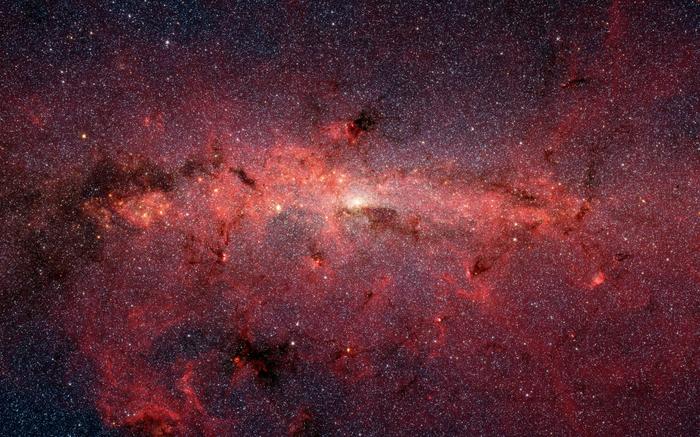
Featured image: Stars at the center of the Milky Way, seen by the Spitzer Space Telescope. Credit: NASA, JPL-Caltech, S. Stolovy (SSC/Caltech).



Leave a Reply