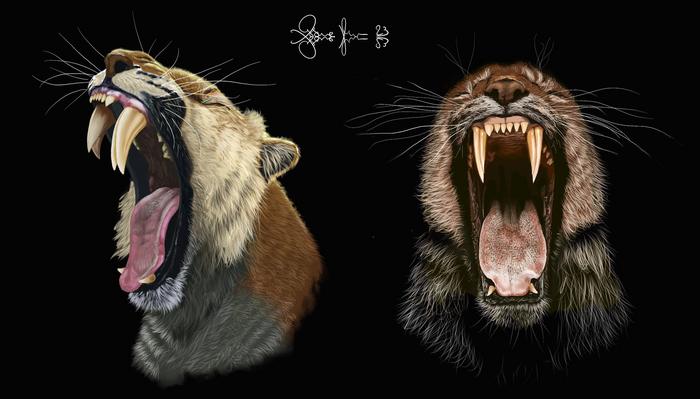
A study of 3,722 Smilodon vertebrae found spinal nerve tumors at a rate far above that seen in people, along with many developmental defects, which the authors link to shrinking populations.
For tens of thousands of years, the asphalt seeps of what is now Los Angeles worked as a natural trap. An animal that wandered into the sticky pools would become stuck, and its struggles would attract predators that then became stuck too. Among the most frequent victims was the saber-toothed cat Smilodon fatalis.
Now a study of the cats’ fossil spines suggests that some of them may have been in pain. Writing in Frontiers in Veterinary Science, a team led by veterinary surgeon Hugo Schmökel of Evidensia Academy Sweden and the University of Zürich reports an unusually high rate of rare spinal nerve tumors in Smilodon from the La Brea Tar Pits, along with many developmental abnormalities. The authors suggest the species may have become inbred shortly before it disappeared.
A predator in pain
The tumors could help explain why so many saber-toothed cats ended up in the tar. Spinal nerve tumors could have caused pain and weakness in the limbs, which the researchers argue would have made a trapped animal an especially tempting meal.
“A trapped prey animal is very attractive for a predator in pain,” Schmökel said. “A wounded or sick predator must rely on carcasses for surviving, so they’ll take bigger risks to get to them.”
That is unlikely to be the whole story, he acknowledged. “But scavenging certainly also happened.”
La Brea is one of the richest Ice Age fossil sites in the world, and Smilodon is among its most common large mammals. The cat, roughly the size of a modern lion but more heavily built, is California’s state fossil. Its abundance at the site gives researchers an unusually large sample of a single predator species from one place.
Excavations at Rancho La Brea have been under way for more than a century and have yielded millions of fossils, from mammoths and dire wolves to insects and plant remains. Most of the animals preserved there lived during roughly the last 50,000 years. Smilodon itself is best known for its upper canine teeth, which could reach nearly 18 centimeters in length.
Thousands of vertebrae
The team examined 3,722 vertebrae, representing at least 849 adult cats, from the collection of the La Brea Tar Pits Museum.
They found many signs of abnormal development. There were 32 vertebrae with incompletely developed arches, 48 fused “block” vertebrae and 226 “transitional” vertebrae, which have features of the vertebrae from two different regions of the spine.
Abnormalities of this kind are familiar to veterinarians. Transitional vertebrae at the junction of the lower back and pelvis, for example, are common in some dog breeds, including German shepherds, and are thought to be inherited. They are often harmless on their own but can contribute to spinal problems later in life.
Three vertebrae showed a different kind of change. Each had a widened foramen, one of the openings through which spinal nerves exit the spinal column, with smooth, remodeled bone surfaces. In the release, the authors describe that pattern as a strong sign of a spinal nerve tumor. In human and veterinary medicine, slow-growing tumors arising from the sheaths around nerve roots can gradually enlarge these openings as they press on the surrounding bone.
The three affected vertebrae came from different pits, so they most likely belonged to three different animals.
Hundreds of times more common
Three cases may not sound like many, but these tumors are rare. In people, spinal nerve tumors occur at roughly 0.22 to 0.38 cases per 100,000 people. Based on their sample, the authors estimate a rate of 353 cases per 100,000 Smilodon at La Brea.
The researchers propose that inbreeding could explain both the tumors and the developmental defects. As Smilodon numbers fell, fewer potential mates would have been available, and harmful genetic variants would have become more concentrated in the population. Similar spinal malformations have been seen in inbred populations of grey wolves.
The logic is familiar from genetics. Many harmful genetic variants are recessive, causing problems only when an animal inherits two copies, one from each parent. In a small population where relatives often mate, such pairings become more likely, and hidden defects begin to show up more often.
The authors stress that this remains a hypothesis. Without genetic analysis, inbreeding cannot be confirmed.
Modern conservation offers an illustration of how inbreeding can affect a big cat. The Florida panther, a small and isolated population of pumas, developed problems including heart defects and reproductive issues by the early 1990s, and wildlife managers brought in pumas from Texas in 1995 to restore genetic diversity.
Consequence, not cause
Schmökel is careful not to blame inbreeding for the extinction itself. Smilodon, a genus that had lived in the Americas for more than two million years, vanished at the end of the last Ice Age along with many other large mammals, and the causes of those extinctions are still debated.
“Reduced fitness and smaller litters don’t help a population under stress,” he said. “But inbreeding is not the cause of the crash of populations, it is a medical consequence.”
He sees a lesson for living species. In today’s world, according to Schmökel, habitat loss, pollution, hunting and climate change drive populations down, and inbreeding follows as a result.
“We must take care of living wild animals,” he said.
The study was funded by the Swiss National Science Foundation and IVC Evidensia. The authors declare no commercial or financial conflicts of interest.
Notes
- Schmökel, H., et al. “Foraminal widening indicating a spinal nerve tumor in the saber-tooth cat Smilodon fatalis from Rancho La Brea.” Frontiers in Veterinary Science, 27 July 2026. DOI: 10.3389/fvets.2026.1857385.
- Frontiers. “Saber-toothed cats’ spinal tumors may show how inbred species struggled to survive.” EurekAlert!, 27 July 2026. https://www.eurekalert.org/news-releases/1136610.


Leave a Reply