A fossil found in Mongolia in 2004 shows that zhelestids, long thought to be early placentals, were shrew-like insectivore relatives with misleading teeth.
In the early nineteenth century, the French naturalist Georges Cuvier claimed that a single bone, even a single tooth, could reveal the anatomy of an entire animal. Paleontologists have leaned on that idea ever since, because teeth are hard, durable and often the only part of an ancient mammal to survive.
A new fossil from Mongolia’s Gobi Desert shows how that approach can go wrong. Described in Nature by a team led by the American Museum of Natural History, the remarkably complete specimen overturns decades of thinking about a mysterious group of Cretaceous mammals called zhelestids.
“More than 200 years ago, French naturalist Georges Cuvier famously argued that a single tooth could allow scientists to predict the anatomy of an entire animal,” said study coauthor Maureen O’Leary, a paleontologist at Stony Brook University and a research associate at the Museum. “While teeth remain among the most informative fossils available, this work demonstrates that teeth cannot always tell us how the whole animal looked.”
A puzzle made of teeth
Zhelestids have been known for about 40 years, mostly from isolated teeth and jaw fragments found in Central Asia. Their teeth are low and rounded, suited to grinding plants, and that led researchers to propose that they were early relatives of hoofed mammals, and thus among the earliest members of the placental group that today includes humans, whales, bats, horses and most other living mammals.
That mattered because the timing of placental origins is a long-running debate. Molecular clock studies, which estimate when lineages split by measuring genetic differences among living species, suggest placental groups were already diverging before the end of the Cretaceous, about 66 million years ago. The fossil record has been much less clear. If zhelestids were Cretaceous placentals, they would help close that gap.
Living mammals fall into three groups: egg-laying monotremes such as the platypus, pouched marsupials such as kangaroos, and placentals, by far the most diverse group. During the Cretaceous, mammals were mostly small, shrew- to cat-sized animals living alongside dinosaurs, and their fossils are often fragmentary. That makes it difficult to tell which Cretaceous mammals belong to the lineages that survive today.
“Molecular models based on living animals can predict the past,” said coauthor Paul Velazco, a comparative biologist at Arcadia University. “But fossils provide the evidence needed to test those predictions.”
Two decades in the making
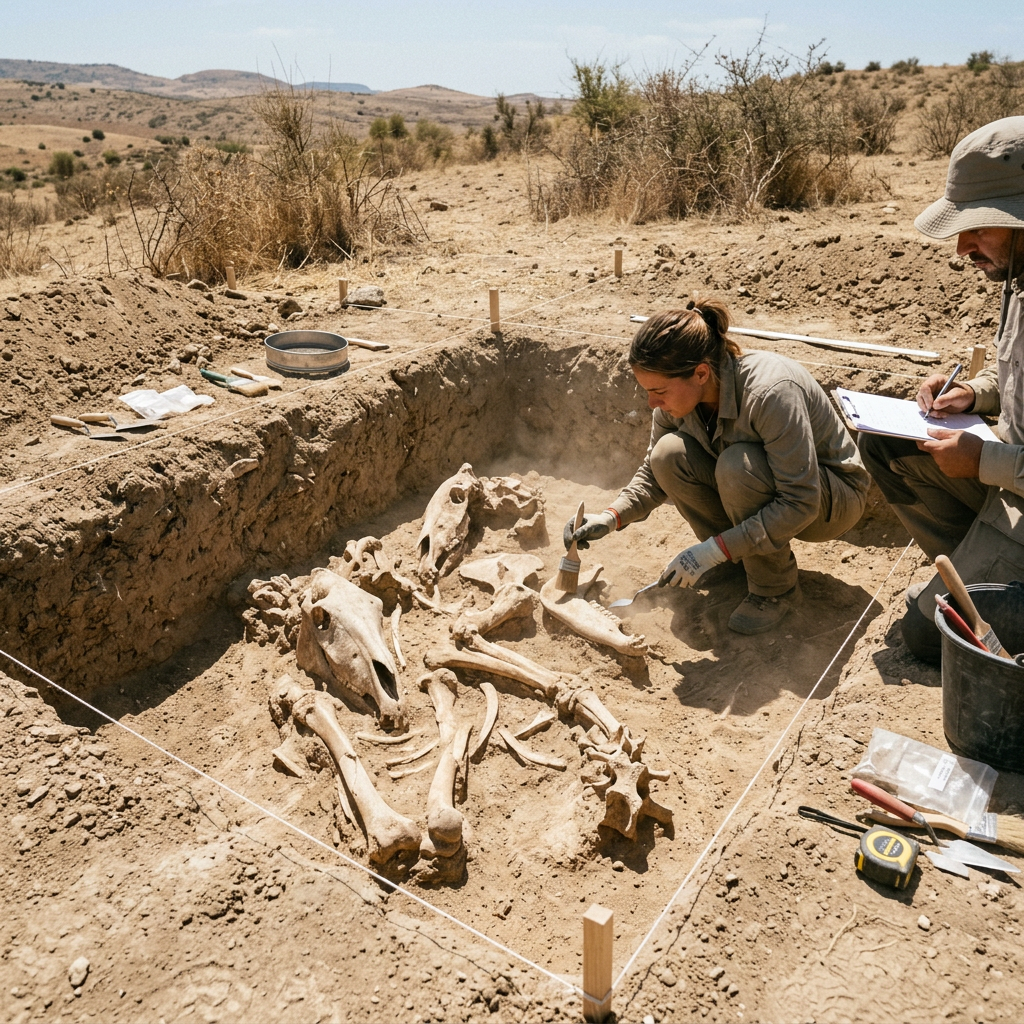
The new specimen was found in 2004 by Andres Giallombardo, then a graduate student on a Museum-sponsored expedition to the Gobi and now the study’s lead author.
“This discovery illustrates why fieldwork remains indispensable to understanding life’s history,” he said. Finding a new species so completely preserved, he added, was the thrill of a career, and it also solves a longstanding scientific problem.
The team named the animal Tamirkhan balcarceli. It measured about 6 to 7 inches from head to tail and had elongated hind limbs that gave it a rabbit-like look, which is why paleontologists have informally called zhelestids “Cretaceous rabbits.” They are not closely related to modern rabbits.
The rest of the skeleton tells a different story
Tamirkhan has the low, rounded teeth typical of zhelestids. But the rest of its skeleton points somewhere else entirely. It has ever-growing incisors and skull features shared with zalambdalestoids, a group of small, shrew-like insectivores also known from the Gobi.
Zalambdalestoids are a well-known Gobi group. Zalambdalestes, the namesake genus, was described in the 1920s from fossils collected by the American Museum’s expeditions, and it is known from relatively complete skulls showing a long snout and enlarged front teeth.
Tamirkhan’s legs reinforced the case. Study author Shawn Zack, a paleontologist at the University of Arizona, said the animal’s hind legs are long and slender with distinctive ankles, traits he described as unmistakably zalambdalestoid.
Using MorphoBank, a database of mammal anatomical characters built up over more than a decade, the team analyzed where Tamirkhan fits on the mammal family tree. They concluded that zhelestids were neither placentals nor especially placental-like, but a subset of zalambdalestoids.
The plant-grinding teeth, then, were a case of convergent evolution, in which unrelated animals independently evolve similar features because they face similar demands. The release adds that Cretaceous mammals were therefore less anatomically diverse than tooth evidence had suggested.
The Gobi’s fossil riches
The Gobi has been one of the world’s great fossil hunting grounds since the American Museum’s Central Asiatic Expeditions of the 1920s, which recovered the first dinosaur eggs recognized by science. Its Cretaceous rocks are unusual for preserving small mammals as complete skulls and skeletons rather than scattered teeth.
Michael Novacek, a curator in the Museum’s Division of Paleontology who has co-led annual expeditions to the Gobi with the Mongolian Academy of Sciences since 1990, said the region is one of the only places where such remarkably complete Cretaceous mammals are routinely recovered. “These extraordinary fossils continue to transform our understanding of mammalian evolution,” he said.
What it changes
The result does not settle when placental mammals arose, but it removes one of the main candidates for Cretaceous placentals and sharpens the mismatch between molecular estimates and the fossil record. It is also a reminder that conclusions drawn from teeth alone can be badly misleading.
The finding rests on a single specimen, and the release does not describe the phylogenetic methods or statistical support in detail. Eva Hoffman of Yale University is also a coauthor. The work was funded by the Margaret and Will Hearst Paleontological Research Fund, the Frick Laboratory Endowment at the American Museum of Natural History and the U.S. National Science Foundation.
Notes
- Giallombardo, A., et al. Nature, 29 July 2026. DOI: 10.1038/s41586-026-10861-5.
- American Museum of Natural History. “New Gobi fossil rewrites a chapter of mammal evolution.” EurekAlert!, 29 July 2026. https://www.eurekalert.org/news-releases/1137548.


Leave a Reply