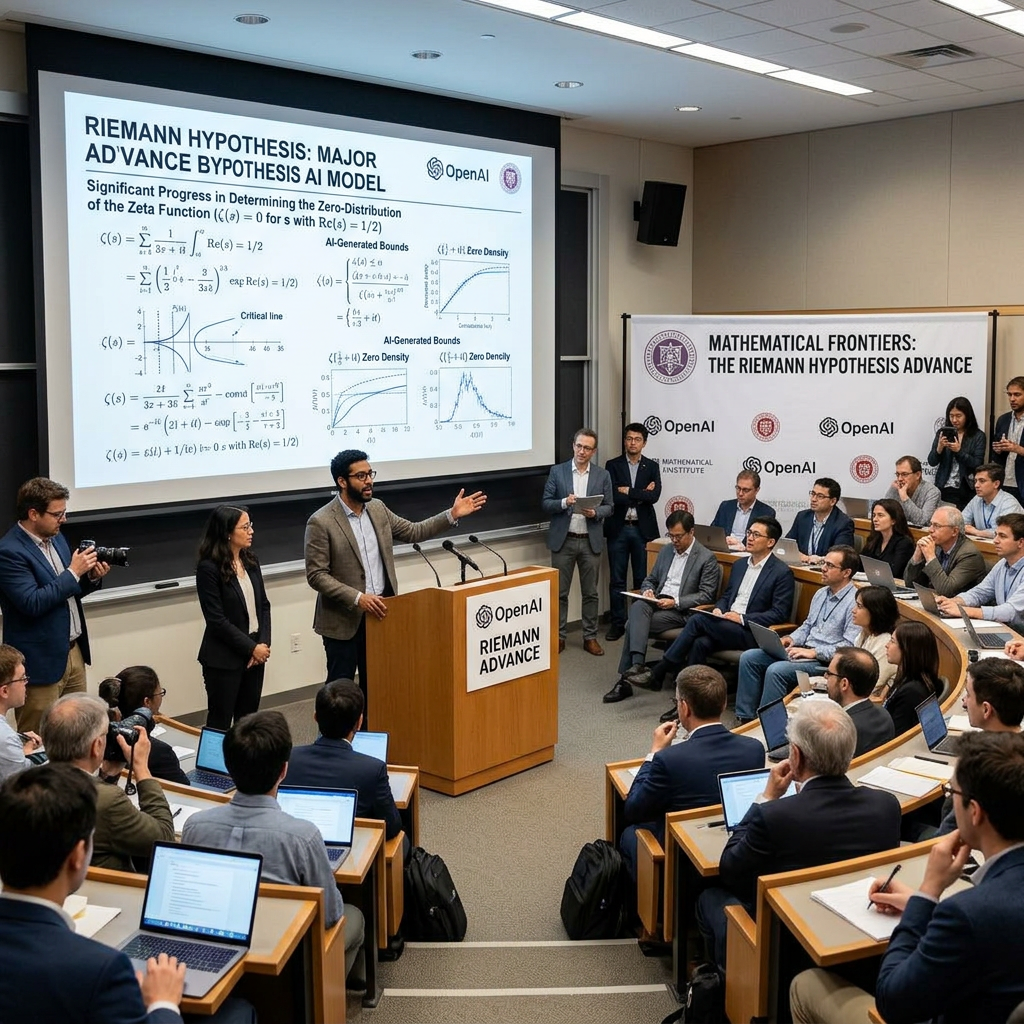
OpenAI Model Makes Major Riemann Hypothesis Advance
OpenAI’s latest mathematics model has produced a potentially historic advance toward the Riemann hypothesis, one of mathematics’ most famous unsolved problems. Among more than 700 AI-generated papers released October 6, one proves a weaker statement known as the quasi-Riemann hypothesis, showing that the Riemann zeta function has no zeros between seven-eighths and one in its critical region. The result also extends to broader families of functions and rules out elusive “Siegel zeros,” with implications across number theory. Fields Medalist James Maynard called the work groundbreaking and possibly the field’s most important result in a century. The proof still requires independent verification, but mathematicians say it combines obscure existing ideas in unusually creative ways, highlighting both AI’s growing mathematical power and the promise—and pressure—of human-AI collaboration. (Science)
Delayed Measles Complication Can Kill Years Later
A CDC report highlights the devastating delayed effects of measles through subacute sclerosing panencephalitis, or SSPE, a rare and almost invariably fatal neurological disease that can appear years after infection. Researchers reviewed 20 children hospitalized with SSPE in Quezon City, Philippines, between 2007 and 2022. Several cases followed the country’s large 2018–19 measles outbreak, suggesting more illnesses could emerge after the disease’s long latency period. Ten of 19 children with known infection ages contracted measles before reaching routine vaccination age, while the median age at SSPE hospitalization was 6.2 years. All patients experienced progressive neurological decline. Researchers stress that SSPE results from natural measles infection, not vaccination, and argue that sustained two-dose vaccine coverage, outbreak immunization campaigns and stronger surveillance are essential. (cidrap.umn.edu)
Microplastics Generate Reactive Chemicals Simply by Touching Water
Microplastics may be chemically active even without sunlight or added pollutants, according to research published in Nature. Scientists at Columbia University and University of California, Berkeley found that common plastic particles spontaneously generate reactive oxygen species when immersed in water. The effect was strongest for water-repelling plastics, including polyethylene and polypropylene, and arose from unusual electrical and molecular conditions at the plastic–water boundary. Laboratory experiments also showed that these interfaces attract biomolecules, encourage protein aggregation and can damage cells. The discovery suggests a previously overlooked pathway through which microplastics might affect organisms and ecosystems. However, the study does not establish how much damage occurs under typical human exposure conditions. Understanding the chemistry could help manufacturers design safer plastic materials. (Nature)
Patients Teach AI to Recognize Epileptic Seizures
Researchers have developed an artificial intelligence interface that lets people with epilepsy communicate with their own brain-monitoring equipment through a smartphone. In a study published in Nature Medicine, 13 hospitalized patients received information from real-time electroencephalography recordings and could report whether seizure alerts were accurate. Their feedback helped retrain a detection algorithm, reducing false alarms by approximately 80% in a subsequent simulation. Patients also asked questions about seizures, sleep and other physiological patterns, making complex medical data more accessible. The system was developed at the University of Pennsylvania and could eventually support devices for Parkinson’s disease and other conditions. However, the improved detector was assessed through simulated replay, not deployed as a continuously retrained outpatient system. Larger clinical studies must establish practical benefits and safety. (Nature)
Scientists Map the Distorted Atmosphere of Alien Planet
Astronomers have reconstructed the uneven outline of an exoplanet’s atmosphere using observations from the James Webb Space Telescope. Their target, WASP-17b, is a scorching gas giant approximately 1,300 light-years away. Rather than treating its atmosphere as a uniform ring, researchers applied a technique called transmission strings to analyze starlight filtering through different regions as the planet passed in front of its star. They found that one side of the atmosphere extends farther into space than the other. Powerful winds apparently carry heat from the permanently illuminated dayside toward the nightside, inflating the warmer evening edge. Published in Nature Astronomy, the study provides a new way to test models of alien weather and could eventually reveal atmospheric variations across many other planets. (University of Bristol)
Robotic Material Finds a Rhythm Without Central Control
Engineers have built a material whose miniature robotic components spontaneously settle into a shared rhythm, without a central controller. The experimental metamaterial combines elastic structures, sensors and actuators that allow neighboring units to influence one another. By making those interactions nonreciprocal, researchers induced small, initially disordered vibrations to merge into larger, slower waves until the structure oscillated collectively. A honeycomb array containing 37 active units and a ring containing 24 motorized units both demonstrated the effect, which the team calls wave coarsening. Published in Nature, the work offers a mechanical realization of time-crystal-like behavior that remains stable despite disturbances. Researchers hope the principle could eventually enable adaptable robots that change shape or coordinate movements through their material properties rather than detailed instructions. (University of Birmingham)
Human Ovaries Continue Changing Decades After Menopause
Human ovaries continue undergoing significant biological changes long after menopause, challenging the assumption that they become largely inactive once reproduction ends. Researchers from Northwestern University and the Buck Institute for Research on Aging analyzed ovarian tissue from 28 postmenopausal women aged 50 to 75. Mass spectrometry measured thousands of proteins and revealed age-associated changes in tissue structure, inflammation and immune signaling. Older ovaries showed molecular patterns resembling processes implicated in cellular aging and, in some respects, ovarian cancer. Published in Aging Cell, the findings suggest the postmenopausal ovary may remain relevant to broader health and disease. However, the study compared samples from women of different ages rather than following individuals over time. It neither proves that these changes cause cancer nor supports removing otherwise healthy ovaries. (Northwestern Now)


Leave a Reply