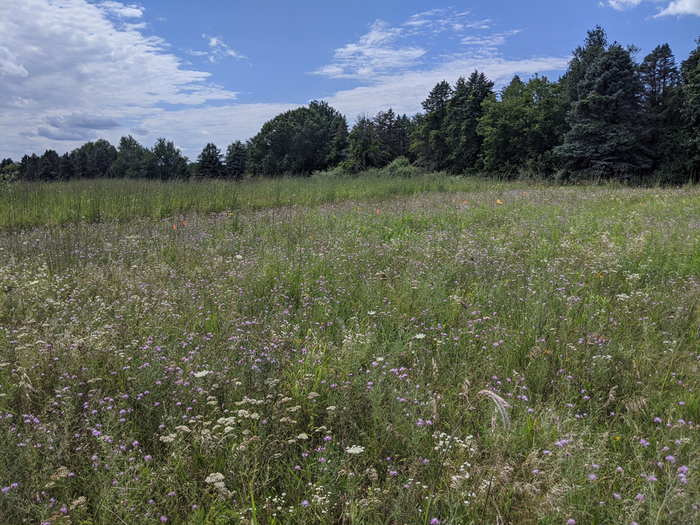
Plant-eaters whose populations rise and fall out of step with one another proved the strongest stabilizer across plants, herbivores and predators.
Ecologists have argued for decades that biodiversity helps ecosystems stay stable. The idea is intuitive: a community with many species is less likely to collapse when conditions change, because some species can compensate for others. But most of the evidence comes from studying one layer of an ecosystem at a time, usually plants. Real ecosystems are stacked. Herbivores eat plants, predators eat herbivores, and a disturbance at one level can ripple through all of them.
A new study published in the Journal of Animal Ecology takes on that whole stack. Researchers from Yokohama National University (YNU) in Japan, working with colleagues at the Chinese Academy of Sciences, Tokyo City University and Inner Mongolia University, set out to identify what stabilizes an entire food web through time. Their answer points to the animals in the middle.
“The key question we wanted to answer was … simple but largely unresolved: what actually stabilizes a whole food web through time?” said Takehiro Sasaki, a professor in YNU’s Faculty of Environment and Information Sciences and the study’s primary author.
Scaling up a familiar idea
For plant communities, ecologists have identified several stabilizing mechanisms. One of the most important is asynchrony: when different species fluctuate at different times, a decline in one is offset by a rise in another, smoothing out the total. The idea is sometimes compared to a diversified investment portfolio.
The intellectual roots run deep. In the 1990s, long-running plant experiments at the Cedar Creek reserve in Minnesota showed that more diverse grassland plots kept their total plant biomass steadier through droughts and good years alike. Around the same time, theorists formalized the so-called insurance hypothesis, the idea that a variety of species responding differently to change insures an ecosystem against collapse. Asynchrony is one of the main ways that insurance pays out.
Sasaki’s team wanted to know whether that logic scales up. “We asked whether the mechanisms known to stabilize plant communities also scale up to a more complex, multitrophic system, including plants, herbivores and predators,” he said. “In particular, we wanted to know whether stability across the food web is driven mainly by plants, by predators or by the [herbivores] that link them.”
Three years on the steppe
The researchers worked in a natural semi-arid grassland in Inner Mongolia, part of the vast Eurasian steppe. Using three years of accumulated data, they examined species diversity, community composition, the timing of which species dominated, and the stability of individual species within the plant, herbivore and predator communities. Structural equation models, a statistical approach for untangling chains of cause and effect, let them trace how each factor related to stability at each level of the food chain.
They measured food web stability in two complementary ways. An averaging approach calculated mean stability across the three trophic levels. Because different patterns can produce similar averages, they also used a multiple-threshold approach, which asks how far stability persists across all levels at once.
The herbivores’ balancing act
Within each group, asynchronous fluctuations among species helped stabilize that group. But when it came to the food web as a whole, one factor stood out.
“In our study, the strongest and most consistent predictor of multitrophic stability was not plant species dynamics nor predator species dynamics,” Sasaki said. “It was the fact that different herbivore species fluctuated at different times. When one herbivore species declined, another could increase, creating compensatory dynamics within the herbivore community.”
The researchers argue that this makes sense given where herbivores sit. In the middle of the food chain, they influence which plants are eaten and how heavily, and they supply predators with their food. When herbivore species rise and fall out of step, predators enjoy a steadier resource base and plants face more even grazing pressure. The herbivore community acts as a biological buffer between the levels above and below it.
That reframes a common view of plant-eaters. Grazers are often seen mainly as a destabilizing force on plant communities. This study finds that, as a diverse and asynchronous community, they also help hold biodiversity across the food web together.
One grassland, many questions
The authors are clear about the study’s scope. The findings come from a single semi-arid grassland over three years, and the release does not report the number of plots or species involved. The team plans to look for herbivore asynchrony in other grasslands, forests and agricultural landscapes, and under stronger climate variability. Longer monitoring, they note, will be needed to understand when herbivore buffering works and when it breaks down, a pressing question as droughts and heat waves intensify across the world’s drylands.
Sasaki sees the work as part of a broader shift in ecology. “Our ultimate goal is to move biodiversity science beyond simply asking whether biodiversity matters,” he said. “We want to identify which parts of biodiversity matter most, where they matter and through what mechanisms they sustain ecosystem functioning.”
The practical stakes are conservation priorities. “If we can understand the biological architecture of stability, we can better predict which ecosystems are most vulnerable—and which components of biodiversity should be conserved to keep ecosystems functioning in a changing world,” he said.
The research team included Taiki Tachibana, Issei Nishimura, Daichi Makishima, Kousuke Tachibana, Xi Sun and Yuki Iwachido of YNU; Xiaoming Lu, Xuezhen Zhao and Yongfei Bai of the Chinese Academy of Sciences’ Institute of Botany; Kei Uchida of Tokyo City University; and Wenhuai Li of Inner Mongolia University.
Notes
- “Herbivore species asynchrony underpins multitrophic stability across plants, herbivores and predators.” Journal of Animal Ecology, 18 July 2026. DOI: 10.1111/1365-2656.70318.
- Yokohama National University. “Herbivore species dynamics is key to grassland food web stability.” EurekAlert!, 23 July 2026. https://www.eurekalert.org/news-releases/1137297.



Leave a Reply