Simulations suggest a two-step ‘flyby pre-excavation’ approach could push kilometer-scale asteroids far harder than a direct strike, if Earth has enough warning.
In June 2024, astronomers spotted an asteroid called 2024 MK, roughly the size of a large building, just 13 days before it swept past Earth. It passed safely. But the episode was a reminder of an uncomfortable fact: many asteroids large enough to cause regional or even global devastation have yet to be found, and when one is discovered on a collision course, the warning could be measured in days or weeks rather than years.
A new study from researchers at the China Academy of Launch Vehicle Technology, led by researcher Wang Xiaowei and published in Space: Science & Technology, asks what humanity could actually do in that situation for the biggest and most dangerous objects. Its conclusion, based on extensive computer simulation, is that nuclear detonation is the most effective option for large asteroids, and in extreme cases the only feasible one. How that detonation is delivered, the study argues, matters enormously.
Why big rocks need big energy
Asteroid impacts have reshaped Earth’s history, triggering catastrophic environmental change and mass extinctions. Objects tens to hundreds of meters across regularly pass close to the planet. Those larger than about 100 meters, the study notes, could cause catastrophes on a continental or global scale.
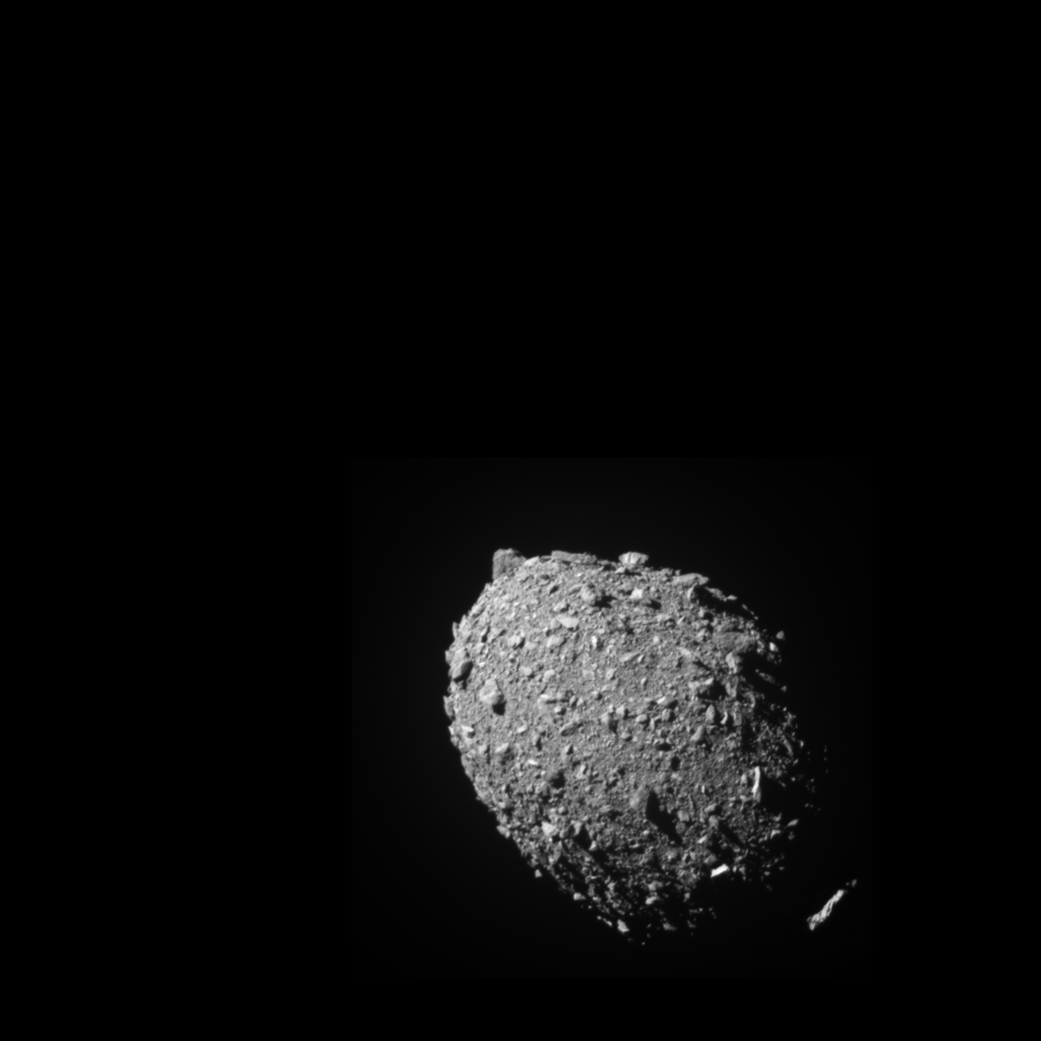
Planetary defense took a concrete step in 2022, when NASA’s DART spacecraft deliberately crashed into the small moonlet Dimorphos and measurably changed its orbit, demonstrating the kinetic impact approach. But according to the Chinese team, kinetic impactors and slow, long-term deflection methods deliver too little energy to move asteroids larger than 100 meters quickly enough, especially when warning time is short. For those, the authors argue, a nuclear device is the most effective tool.
Previous research, they note, has mostly examined a single approach: flying a device directly into the asteroid and detonating it on impact. That method couples energy weakly into the rock and gives mission planners no control over where the blast occurs. A systematic comparison of alternatives had been lacking.
Two ways to deliver a blast
The study compares two strategies. In the first, direct rendezvous impact detonation, a spacecraft strikes the asteroid’s surface at high speed, forming a shallow crater, and a nuclear device detonates within it. The system is relatively simple and could be launched immediately. But the impact point is essentially random, energy coupling is weak, and the device must survive a violent high-speed collision while detonating at precisely the right instant.
The second strategy, which the authors propose as new, is flyby pre-excavation detonation. A space transfer platform first releases a conventional penetrator that digs a deep crater in the asteroid. The platform then guides the nuclear device into that crater. The system is more complex and needs more warning time, but it allows planners to choose where to strike and to bury the detonation deep within the rock, where far more of its energy goes into pushing the asteroid.
Simulating many threats
Rather than study a single real asteroid, the team built a virtual database of potentially threatening asteroids, varying their approach speed and angles, and generated libraries of orbits for scenarios with one year and 20 years of warning by running orbital dynamics backward from a hypothetical impact. To model what a detonation would actually do to the rock, they used a hybrid simulation technique combining finite element methods with smoothed particle hydrodynamics, which can follow material as it fractures and flies apart.
For the direct approach, the key constraints were the launch rocket’s energy and how fast the spacecraft could hit the asteroid. With a maximum impact speed of 10 kilometers per second, only 30 percent of the virtual asteroids could be deflected more than 50 days ahead of impact. At 20 kilometers per second, every asteroid in the database could be deflected more than 30 days ahead, and about 16 percent more than 150 days ahead. Going faster still, to 30 kilometers per second, gave only marginal gains. The authors identify 20 kilometers per second as the more favorable design point, while noting that it makes building a device able to survive the impact considerably harder.
For the flyby approach, the question was how much maneuvering capability the transfer platform would need. Every virtual asteroid required a velocity change of less than 10 kilometers per second, and about 45 percent required less than 6. According to the study, either chemical or electric propulsion could cover most threats.
Shallow versus deep
The simulations showed a clear difference in effect. Both methods could destroy an asteroid about 100 meters across outright. For kilometer-scale bodies, which are far harder to move, burial depth made the difference. A 3-megaton detonation in a shallow crater 5 meters deep imparted a velocity change of roughly 8 to 9 centimeters per second to a 1-kilometer asteroid. In a 20-meter-deep pre-excavated crater, the same scenario produced more than 30 centimeters per second.
That might sound tiny, but small nudges add up over time. The study translates velocity changes into minimum warning times: a change of 0.5 centimeters per second needs about 4.45 years of lead time to push an asteroid clear, 3 centimeters per second needs about 560 days, 18 centimeters per second about 139 days, and a full meter per second just 60 days.
Matching the method to the warning
The authors recommend the direct impact approach for emergencies with extremely short warning, despite its technical difficulty, because it can be launched fastest. When warning time allows, they favor flyby pre-excavation as the preferred solution, citing its stronger energy coupling, lower technical difficulty and more reliable results. They present the work as providing a theoretical basis for future Chinese asteroid defense missions.
The study has clear limits. It is entirely computational and relies on a virtual asteroid population rather than observed objects. Real asteroids vary enormously in structure, from solid rock to loosely bound rubble piles, and that variation could change how they respond. The release is also not fully consistent in describing the advantage of the pre-excavation approach, calling it “several times higher” in one place and an order of magnitude in another. And any use of nuclear devices in space would face significant legal and political hurdles under international treaties.
Still, as surveys find more of the near-Earth objects that remain undiscovered, the question of what to do when one is headed our way is no longer purely hypothetical. Studies like this one help define the options before they are needed.
Notes
- “Analysis of Defense Technology for Large-Sized Near-Earth Asteroids.” Space: Science & Technology, 18 May 2026. DOI: 10.34133/space.0504.
- Beijing Institute of Technology Press. “Analysis of defense technology for large-sized near-Earth asteroids.” EurekAlert!, 23 July 2026. https://www.eurekalert.org/news-releases/1137413.



Leave a Reply