Scientists have identified the three-step protein cascade that links a light touch to sweeping changes in plant genes and growth, solving a puzzle more than 25 years old.
A plant cannot run from the wind, duck the rain or swat away a hungry insect. Rooted in place, it has to sense what is happening around it and respond in other ways, by changing how it grows, what chemicals it makes and how it defends itself. Touch is one of the most basic of those cues. Brush a leaf, and within moments a plant is already reacting.
Researchers at Lund University in Sweden have now worked out how that first reaction is wired. Writing in Nature Communications, they describe a chain of proteins that fires within a minute of mechanical stimulation and goes on to influence hundreds of genes and the plant’s longer-term growth.
A decades-old missing link
Scientists have suspected for a long time that a family of signaling proteins called MAP kinases is involved. In plants, animals and fungi alike, MAP kinase cascades act as relay systems, passing a message from one protein to the next by adding phosphate groups, a molecular on-switch, at each step. Plants use them to respond to everything from pathogens to drought.
“We have known for more than 25 years that mechanical stimulation activates MAP kinases,” said Olivier Van Aken, an associate professor in Lund’s Department of Biology, “but a crucial piece of the puzzle has been missing: what triggers the signal and how it is linked to the plant’s subsequent development.”
“We have now identified that signaling pathway,” he said.
A protein waterfall
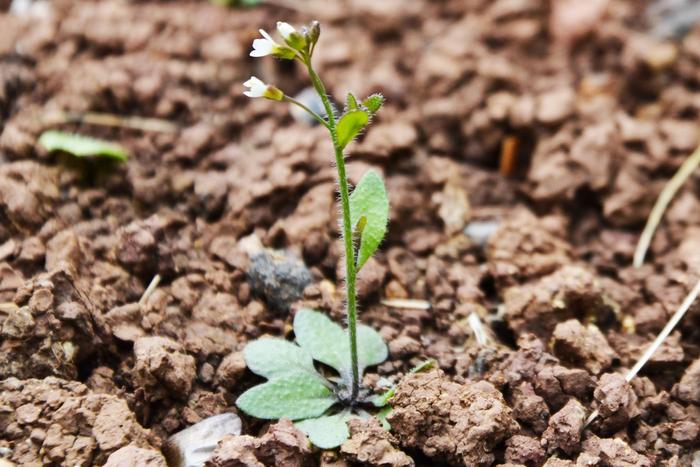
The team worked with Arabidopsis thaliana, or thale cress, a small flowering weed related to mustard and cabbage that serves as the workhorse of plant biology. They subjected the plants to several kinds of mechanical stimulation and then tracked what happened inside, combining genetic and molecular experiments with large-scale analyses of gene activity and proteins.
Three MAP kinase proteins switched on within a minute. The researchers traced the full cascade behind that activation: a set of proteins known as MAPKKK3, 4 and 5 activates MKK4 and MKK5, which in turn activate MPK3 and MPK6. The release likens the sequence to a protein waterfall, with each tier tipping the next into action. Together, the pathway drives much of the plant’s early response to touch, sending signals that alter the activity of hundreds of genes.
“It is remarkable that a signal initiated within a minute can have such widespread effects,” said first author Huy Cuong Tran, a biology researcher at Lund.
From a touch to a new shape
The cascade does not only shape the plant’s immediate response. It also affects how plants grow when they are touched again and again, a phenomenon known as thigmomorphogenesis, from the Greek for touch and shape. Plants exposed to repeated wind, brushing or contact with animals and insects often grow shorter and sturdier, with thicker stems, and can change their shape and their defenses. Trees on windswept coasts and ridgelines, stunted and bent into the prevailing wind, are a dramatic everyday example.
The term was coined in the 1970s, and gardeners have long exploited the effect without knowing its molecular basis. Brushing seedlings by hand or with a fan, for example, is a common way to keep them from growing tall and spindly before they are planted out. Plant scientists have documented that touch can switch on large numbers of genes within minutes, but the molecular link between the initial touch and those lasting changes in form had remained unclear. The Lund work fills in a central part of that connection.
Some plants respond to touch far more visibly. The sensitive plant Mimosa pudica folds its leaves within seconds of being touched, and the Venus flytrap snaps shut when trigger hairs are brushed twice in quick succession. Those dramatic responses rely on rapid electrical signals and water movement. The cascade described by the Lund team operates in a more ordinary plant, and governs the quieter, slower adjustments that nearly all plants make to the physical world around them.
From the lab to the field
The researchers emphasize that their work is fundamental research and that further studies will be needed before it can be applied in agriculture. But there are hints of where it could lead. The release points to related research showing that controlled rolling of cereal crops can reduce lodging, the costly tendency of grain crops to topple over, and help protect them against drought.
Understanding the molecular switches behind such responses could, in principle, help breeders develop crops that are naturally sturdier, or help farmers time mechanical treatments more effectively. The release does not report the specific stimulation methods or numbers of plants involved, and it remains to be seen how closely the pathway in thale cress is conserved in crops such as wheat or rice.
For PhD student Viktor Johansson, a co-author, the findings are a reminder of how much is going on in organisms that seem inert. “Plants may appear still and passive, but they are constantly monitoring what happens around them,” he said. “By understanding the molecular mechanisms behind these signals, we can better understand how plants adapt to their environment and cope with changing conditions such as climate change.”
Notes
- Tran, H. C., et al. “A sequential MAP kinase cascade regulates mechanical signalling.” Nature Communications, 2026. DOI: 10.1038/s41467-026-74994-x.
- Lund University. “Researchers solve mystery of how plants sense touch.” EurekAlert!, 29 September 2026. https://www.eurekalert.org/news-releases/1145878.
Featured image: Arabidopsis thaliana. Credit: Niek Scheepens, Goethe University Frankfurt


Leave a Reply