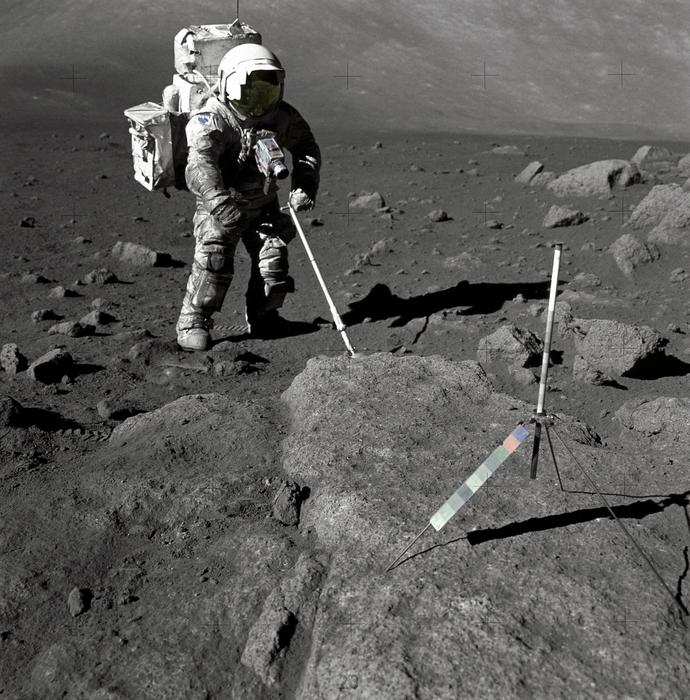
Ancient samples from the Moon’s far side are helping scientists uncover how asteroid impacts shaped the early Solar System. The findings challenge decades of thinking about when those impacts occurred and offer new insights into the conditions that influenced Earth’s evolution.
Researchers studying lunar rocks have uncovered new evidence about the timing and intensity of asteroid bombardment across the Moon’s surface, finding it declined gradually, rather than being a short, intense burst of impacts as previously thought.
Unlike Earth, where ancient geological evidence has been largely erased by erosion, volcanic activity and shifting tectonic plates, the Moon has preserved a record of impacts stretching back billions of years.
Research co-author Dr Fred Jourdan, from Curtin University’s School of Earth and Planetary Sciences and John de Laeter Centre, said lunar rocks acted as a natural archive of the Solar System’s history, allowing scientists to investigate events that occurred shortly after the planets formed.
“The Moon is like a time capsule — it has preserved a record of events” erased from Earth, Dr Jourdan explained.
“Samples collected from the Moon’s far side are particularly significant because they allow us to compare two very different parts” for the first time, he noted.
“By analysing these ancient rocks, we can better understand when major asteroid impacts occurred” and how the early Solar System evolved, Dr Jourdan stated. The far side preserves a cleaner record because it was less affected by later geological events than the near side.
“These samples are helping us rewrite parts of the Moon’s history” and suggest a long decline in asteroid impacts rather than catastrophic bombardment.
The research team analysed tiny fragments of lunar rock, revealing impact events spanning from about 4.33 to 1.13 billion years ago and reconstructing more than three billion years of lunar impact history.
Dr Jourdan said understanding the Moon’s impact history could provide important clues about Earth’s own past. “The Moon and Earth share a common history, but the evidence of early impacts has largely disappeared” from our planet.
“Because the Earth and Moon formed together, every major impact recorded on the Moon tells us something about the conditions experienced by the young Earth,” he explained.
“Studying lunar rocks allows us to look back billions of years and better understand the events that shaped the environments” of both worlds.
The findings come amid a new era of lunar exploration and science, with China’s Chang’e-6 mission being the first to return samples from the Moon’s far side.
The study was led by the State Key Laboratory of Deep Earth Processes and Resources, Guangzhou Institute of Geochemistry, Chinese Academy of Sciences.
Journal: Science Advances
DOI: 10.1126/sciadv.aee8718
Article Title: The bombardment history on the lunar farside revealed by ⁴⁰Ar/³⁹Ar geochronology of Chang’e-6 impact melt rocks
Publication Date: 23-Jul-2026
Source: EurekAlert


Leave a Reply