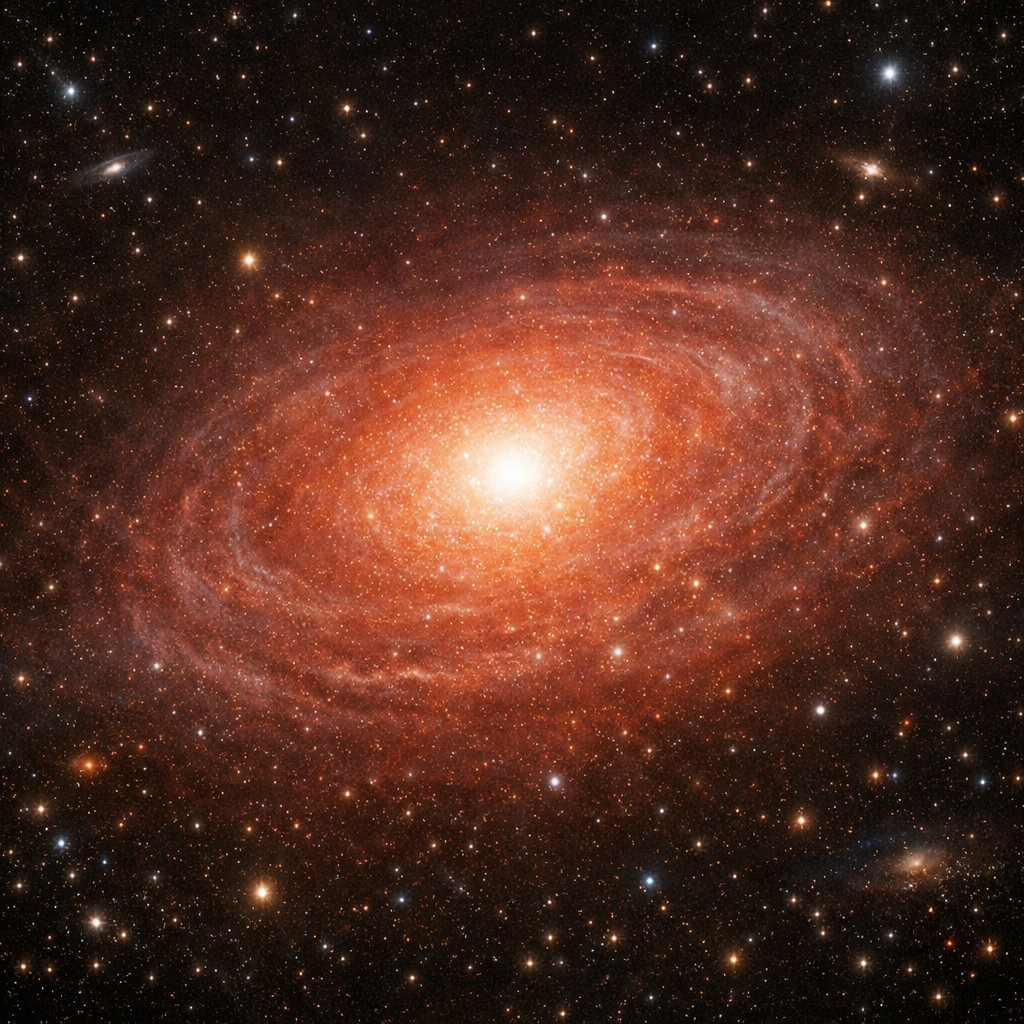
Astronomers at Durham University have discovered the most distant example ever found of a compact, star-forming structure at a galaxy’s heart, dating back more than nine billion years. The research reveals clear evidence of a “nuclear disc” — a dense, rotating disc of stars at a galaxy’s very centre — forming when the Universe was still relatively young.
Nuclear discs are common in nearby, mature galaxies, but had never been observed so far back in cosmic history. The Durham-led team made the discovery using data from the James Webb Space Telescope, whose unprecedented sensitivity allows astronomers to study distant galaxies in extraordinary detail. The galaxy in question is seen as it was just 4.5 billion years after the Big Bang, with a nuclear disc at its centre that is actively forming new stars and still growing.
Crucially, the nuclear disc appears to have been built by a long, bar-shaped structure of stars stretching across the galaxy — a familiar feature of many present-day spiral galaxies that acts like a cosmic engine, driving gas and stars toward the centre. While previous studies had shown that such bars can form early, there was no direct proof they were already reshaping galaxies at this stage of the Universe’s history. This research provides that missing evidence.
“This is a remarkable and unexpected discovery that will make astronomers revisit the idea of galaxy evolution and the influence of stellar bars in the early Universe.”
Zoe Le Conte, lead author, Durham University
Despite its great distance, the newly discovered nuclear disc already shares many properties with those found in nearby galaxies today: it is compact, rich in young stars, and shows clear signs of organised growth. Nuclear discs are also thought to act as reservoirs of gas that can eventually feed the supermassive black holes at galaxy centres, meaning the work could help scientists understand how black holes grew during the peak era of cosmic activity. The team now plans follow-up observations to study how stars and gas move within the galaxy.
Publication
The study, “A nuclear disc at Cosmic Noon: evidence of early bar-driven galaxy evolution,” by Z. A. Le Conte et al., was published in Monthly Notices of the Royal Astronomical Society (DOI: 10.1093/mnras/stag1122).



Leave a Reply