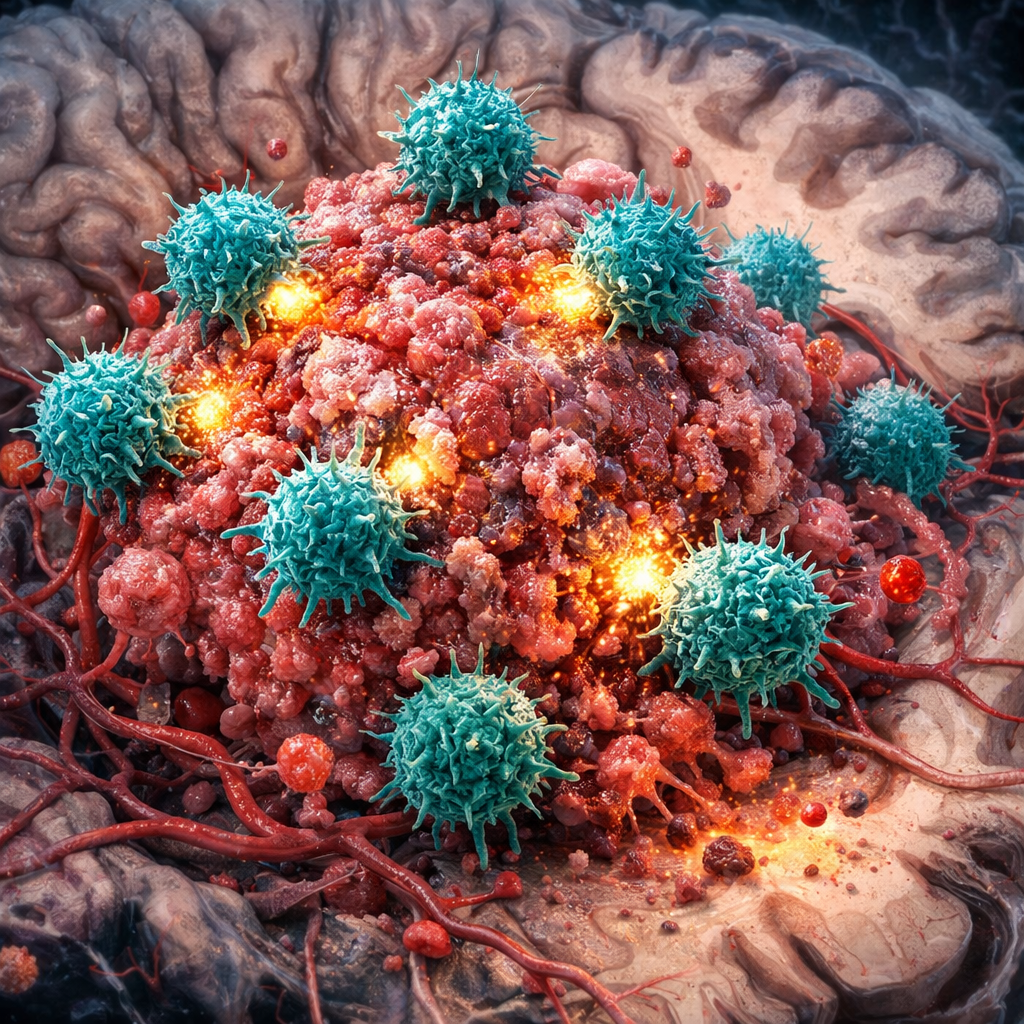
Salk Institute researchers have defined how chronic interferon exposure prompts a switch from anti-tumor activity to immunosuppression in mice, revealing a key target to sustain anti-tumor immune responses and combat immunotherapy-resistant cancer.
Cancer biology and, in turn, cancer treatment have come a long way in the last few decades. Most people recognize this progress in breakthroughs like immunotherapy, a treatment strategy first deployed in 2011 that leverages the body’s own immune cells to fight cancer and revolutionized the treatment landscape. However, progress doesn’t mean all the questions have been answered.
One of those questions is why signaling proteins called interferons, which recruit the immune system to attack cancer cells, start helping the tumor grow rather than shrink when they linger too long. A Salk Institute team discovered a novel pathway that links chronic interferon II (a family of interferon proteins) exposure to mitochondrial dysfunction that ultimately causes immunosuppression. By explaining how interferon II turns from “good” to “bad,” the foundational insights provide a path to future therapies that combat immunotherapy resistance.
Turning the Question Around
“Why interferons, which are initially anti-cancer, can become pro-cancer has been a big question in the field. Our study reveals a major reason for why interferons transition from ‘good’ to ‘bad,’ as well as how we can prevent this switch for therapeutic advantage moving forward,” said Gerald Shadel, PhD, professor and holder of the Audrey Geisel Chair in Biomedical Science at Salk.
“For this study, we turned our focus around. Instead of asking how mitochondria affect interferons, we asked how interferons affect mitochondria. And cancer is a powerful system to ask this question in, since interferons are so essential to the body’s cancer response,” Shadel said.
“Chronic interferon exposure is a major factor in immunotherapy resistance. We wondered whether cancer cells that have become resistant to anti-PD1 therapy were upregulating the immunosuppressive mitochondria-centered pathway we identified, and whether that pathway is a viable target for combating immunotherapy resistance,” said Melissa Johnson, a graduate student researcher in Shadel’s lab.
“Our study enriches our understanding of how the immune system attacks cancer cells but can also be stymied by other factors in the tumor environment, and also conveys the importance of integrating mitochondrial signaling functions into cancer studies,” Shadel said.
The study was published in Science on September 10, 2026, and was funded by federal research grants from the National Institutes of Health as well as private philanthropy.
Journal: Science
DOI: 10.1126/science.aec0002
Article Title: Chronic type II interferon promotes tumor growth via mitochondrial RNA-induced type I interferon and prostaglandin synthesis
Funding: National Institutes of Health (R01 CA228211, R01 CA216101, R01 CA285867, R21 AI151562, F31CA278581, T32GM133351, T32CA009370-39, F30HL178290), Glenn Foundation for Medical Research, Cancer Research Institute, NOMIS Foundation, George E. Hewitt Foundation for Medical Research, Fundación Alfonso Martín Escudero, Spruance Foundation II



Leave a Reply