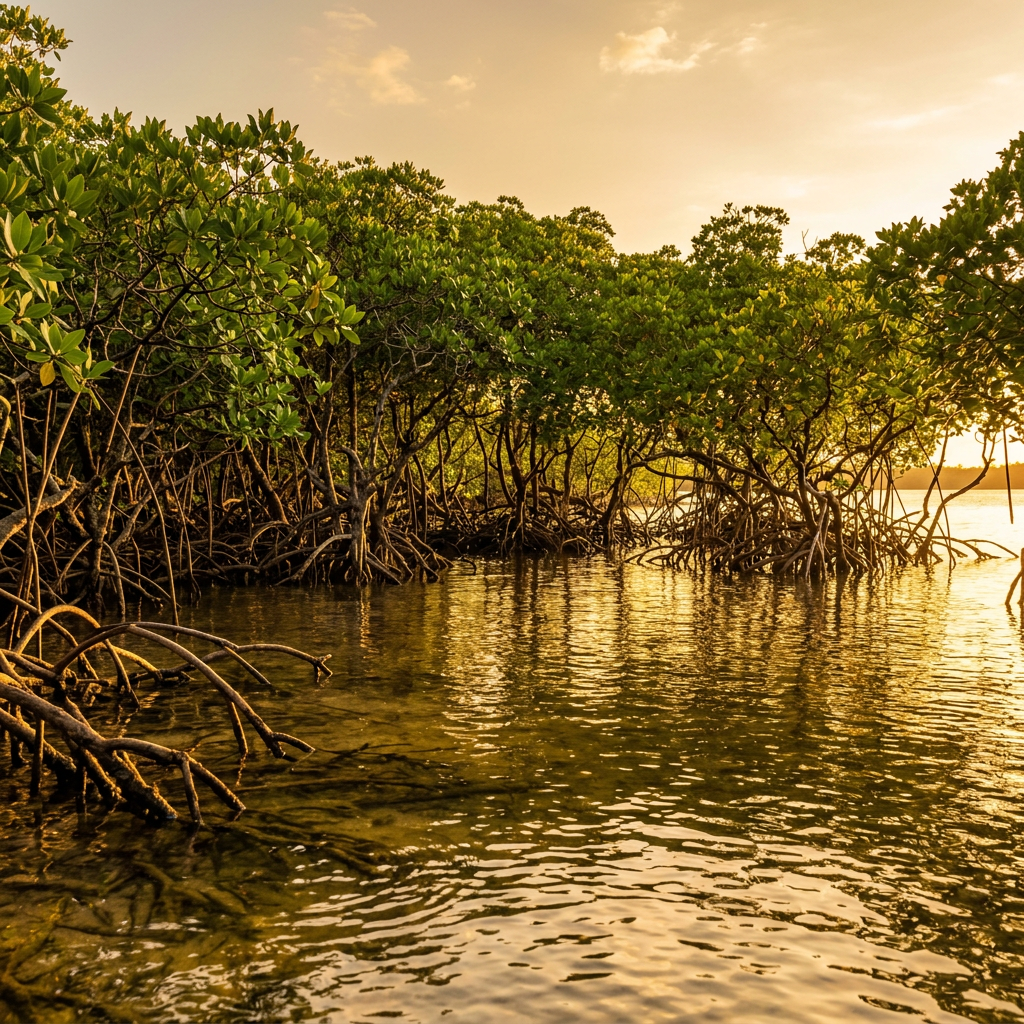
Sequencing 300 sediment samples from seven mangrove wetlands, researchers found nearly 15,000 fungal types, about a third unassignable to any known phylum, organized by climate, salinity and bacteria.
Mangrove forests grow where few trees can, in the salty, waterlogged mud of tropical and subtropical coastlines. They shelter young fish, buffer shorelines against storms and store large amounts of carbon in their sediments. Much of the work of breaking down fallen leaves and wood in that mud is done by organisms that are almost never seen: fungi.
Despite that role, mangrove sediment fungi have been poorly studied. A new survey of China’s mangroves, published in Mycology: An International Journal on Fungal Biology, offers one of the broadest looks yet at who lives there and why.
The research, led by Meng Li of Shenzhen University, concludes that the fungal communities in mangrove sediments are assembled by forces acting at three distinct scales: regional climate and geography, local soil chemistry, and microscopic interactions with bacteria and archaea.
Fungi in the mud
Fungi in mangrove sediments help decompose organic matter, especially lignocellulose, the tough combination of cellulose and lignin that makes up plant cell walls and wood. In doing so, they help recycle nutrients through the ecosystem.
Lignin in particular is notoriously hard to break down, and fungi are among the few organisms that can do it efficiently. That ability makes them central to carbon cycling in forests and wetlands, including mangroves, whose waterlogged, low-oxygen sediments can store carbon for long periods. Carbon stored in coastal ecosystems such as mangroves, salt marshes and seagrass meadows is often called “blue carbon.”
To map these communities, the team collected 300 sediment samples from seven mangrove wetlands within six national nature reserves along China’s southeastern coast. They used DNA sequencing of two genetic markers: the ITS2 region, a standard barcode for identifying fungi, and the 16S rRNA gene, used to identify bacteria and archaea. They then analyzed the data using co-occurrence networks and piecewise structural equation modeling, a statistical approach for testing how several factors influence one another.
A largely unknown community
The sequencing revealed 14,771 fungal operational taxonomic units, groups of closely related DNA sequences used as stand-ins for species. They spanned 15 phyla, 51 classes and 594 genera.
Much of that diversity is unfamiliar. About one-third of it could not be assigned to any known fungal phylum, a sign of how little is known about the fungi living in these sediments.
That is not unusual for fungi. Scientists have formally described roughly 150,000 fungal species, but estimates of the total number on Earth run into the millions, and many groups are known only from DNA detected in soil, water and sediment. Operational taxonomic units do not map neatly onto species, but they give a sense of the scale of what remains to be named.
Early-diverging fungal lineages, groups that branched off early in fungal evolution, were relatively diverse and widespread. These included Rozellomycota, a group known largely from environmental DNA, and Chytridiomycota, the chytrids, which include species that live in water and wet soils.
The chytrids include one of the most notorious fungi known, Batrachochytrium dendrobatidis, which has driven declines and extinctions of amphibians around the world. Most chytrids, however, are thought to play quieter roles, decomposing organic matter or living as parasites of algae and other microorganisms.
Geography over host trees
One might expect the identity of the mangrove trees themselves to shape the fungi beneath them. Instead, the researchers found that geographic location mattered more than the mangrove plant species.
Fungal communities grouped mainly by site, a pattern linked to mean annual temperature and to limits on dispersal. Mangroves grow in scattered patches along the coast, and the authors suggest that this patchiness probably restricts the movement of fungi over long distances, allowing communities in different places to drift apart.
Salt and nutrients
At the local level, two factors stood out: salinity and the ratio of carbon to nitrogen in the sediment.
High salinity favored fungi that tolerate osmotic stress, the pressure that salty water places on cells. High carbon-to-nitrogen ratios, which indicate organic matter that is rich in carbon but poor in nitrogen, may limit which fungi can persist. Total phosphorus showed an indirect positive association with fungal diversity, possibly through its effects on nutrient availability and on the connections within the microbial network.
Bacteria as the backbone
The researchers also examined how fungi, bacteria and archaea co-occur. The resulting network contained 777 nodes and 3,680 connections, 99 percent of them positive correlations, meaning that the organisms involved tended to be found together rather than apart.
Bacteria and archaea had higher average connectivity than fungi and formed the main backbone of the network. Some fungi, however, occupied central positions that may link fungal and prokaryotic members of the community. Co-occurrence patterns show which organisms tend to appear together, but they do not by themselves prove that the organisms interact directly.
A three-scale framework
Pulling the findings together, the authors propose a three-scale framework for how mangrove sediment fungi are assembled. At the regional scale, temperature and dispersal limits filter which fungi are present. At the local scale, salinity and nutrients filter them further. And at the microscale, interactions between kingdoms shape how communities are organized.
The authors suggest that the framework provides a basis for studying how coastal fungal communities may respond to environmental change, including warming and shifts in salinity. The study is a snapshot of one region’s mangroves, and the release does not include comments from the researchers, the full author list or details of funding.
Notes
- “Diversity, biogeography, and assembly of fungal communities in Chinese mangrove sediments.” Mycology: An International Journal on Fungal Biology, 28 September 2026. DOI: 10.1080/21501203.2026.2728463.
- Institute of Microbiology, Chinese Academy of Sciences. “Chinese mangrove sediments reveal scale-dependent assembly of fungal communities.” EurekAlert!, 30 September 2026. https://www.eurekalert.org/news-releases/1146059.



Leave a Reply