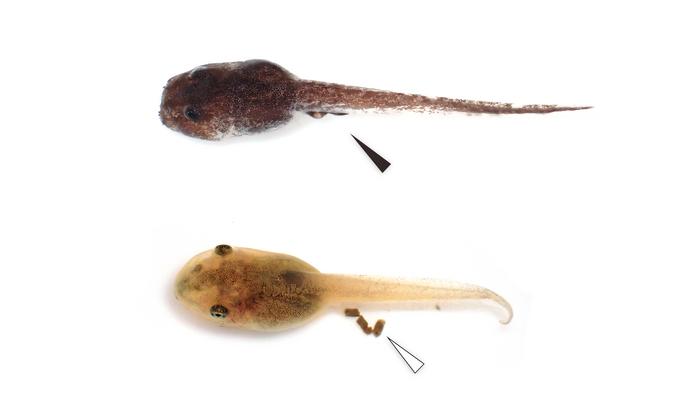
Amphibian larvae, better known as tadpoles, exhibit a behavior called social aggregation, gathering together as a way to avoid predators. These interactions reflect what biologists call association preferences — a tendency to recognize members of their own species, and in some tadpole varieties, even a preference for their own siblings. A new study from Kyoto University finds that at least one common species doesn’t bother with that distinction at all.
Association preferences and kin recognition in tadpoles have become a key topic in understanding the evolution of social behavior. Recent studies have suggested that microorganisms may influence communication through animal body odors, raising the possibility that pond water rich in microbes could also shape social behavior. But whether this sociality is innate, shaped by early-life experience, or a product of the aquatic environment has remained unclear — a question that motivated Kazuko Hase at Kyoto University to investigate how early-life social experiences and water environment influence the development of sociality in tadpoles.
Sibling, Non-Sibling, Neutral
Hase collected tadpoles of the species Bufo formosus, the Japanese common toad, from four different egg masses found around the University of Tokyo’s Botanical Gardens, treating each egg mass as a sibling group. After hatching, she raised the tadpoles using an experimental design that combined two water environments — tap water and pond water — with two rearing conditions: group rearing with 20 siblings, and solitary rearing.
After two weeks, Hase ran choice experiments that simultaneously presented the tadpoles with both sibling and non-sibling individuals to assess their social preferences. She established sibling, non-sibling, and neutral zones within the experimental tanks and tracked the tadpoles’ movements for 60 minutes, analyzing how much time they spent in each zone.
The tadpoles showed no preference for siblings, regardless of rearing conditions, indicating lower kin recognition than tadpoles of other species studied previously. Hase did find that tadpoles reared in isolation showed a reduced tendency to approach other individuals — sibling or not — and spent more time in the neutral zones, suggesting the effects of social isolation hold up across different aquatic environments. She observed no significant effects from the water environment itself.
“Unlike closely related species in which kin recognition has been confirmed during social aggregation, I was surprised to find that it is not essential for social aggregation in the Japanese common toad,” says Hase.
The study indicates that this tadpole’s social behavior is shaped more by experiences with peers than by kinship or water environment, contributing to a better understanding of how some amphibians develop sociality. “The Japanese common toad is facing the threat of extinction, so we want to help protect them,” Hase adds. “I am also delighted that these toad tadpoles that I love so much are contributing to scientific progress.”
The study, “Social isolation, rather than kinship, influences association behavior in toad tadpoles (Bufo formosus),” was published in Animal Cognition (DOI: 10.1007/s10071-026-02090-0) and was funded by the Japan Society for the Promotion of Science.



Leave a Reply