Americans’ confidence in Dr. Anthony Fauci as a source of trustworthy public health information declined over the four months from April to August 2026, according to a new survey from the Annenberg Public Policy Center (APPC) of the University of Pennsylvania. The drop follows a turbulent stretch for the former director of the National Institute of Allergy and Infectious Diseases, who appeared before the U.S. Senate Homeland Security Committee in late July but declined to answer questions, invoking his Fifth Amendment protection against self-incrimination.
Committee chair Sen. Rand Paul (R-Ky.) has repeatedly said Fauci belongs in jail and has accused him of covering up the possibility that the pandemic originated with a lab leak in Wuhan, China, blaming him for millions of pandemic-related deaths. The nationally representative survey, conducted August 4-17, 2026, captured the period during and after the committee’s August 6 vote to hold Fauci in contempt of Congress for refusing to answer its questions.
A Narrowing but Persistent Gap
In the August survey of 1,904 empaneled U.S. adults, half (50%) said they were somewhat or very confident that Fauci provided trustworthy public health information — a statistically significant decline of five percentage points from 55% in April 2026. Confidence in Fauci had been fairly stable for more than a year before that, fluctuating between 54% and 58% from February 2025 through April 2026.
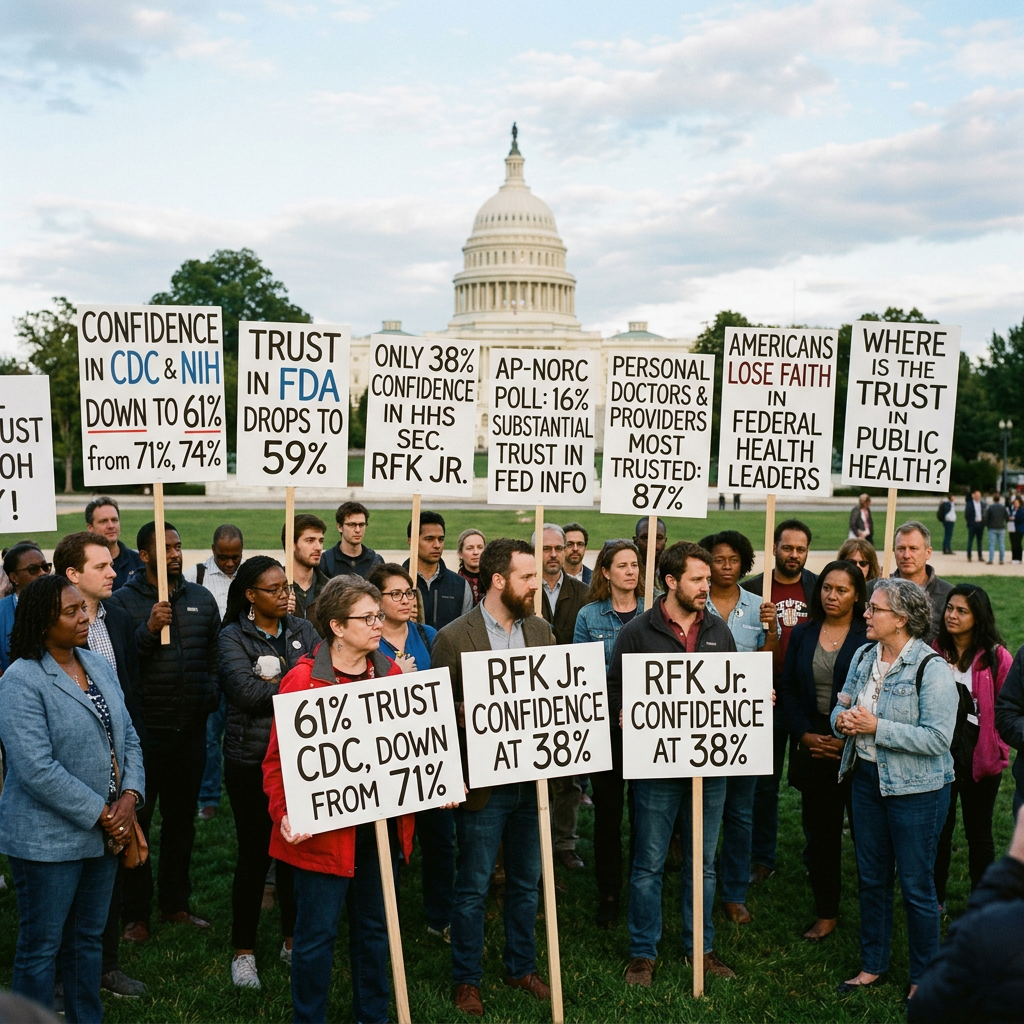
By comparison, 38% of Americans in August 2026 said they were confident that Health and Human Services Secretary Robert F. Kennedy Jr. is providing trustworthy public health information — statistically unchanged from both April 2026 (37%) and February 2025 (38%). That leaves confidence in Fauci currently 12 percentage points higher than confidence in Kennedy, though the gap has narrowed since April 2026, when it stood at 18 points.
Confidence in Fauci has fallen substantially since APPC first began asking about his guidance specifically regarding Covid-19 in 2021, when it ranged between 63% and 71%. By October 2023, after Fauci had left government office, 60% of Americans said they were confident he was providing trustworthy public health information.
Doctors Still Trusted, Agencies Less So
The same survey data show that Americans’ confidence in their own healthcare providers remains high even as trust in federal health agencies erodes. Eighty-seven percent of respondents said they were confident that their doctor, nurse, or other primary healthcare provider was providing trustworthy public health information, essentially unchanged from 88% in September 2024.
By contrast, confidence in the major federal health agencies has declined significantly since September 2024: 61% of respondents expressed confidence in the CDC, 59% in the FDA, and 61% in the NIH.
The Annenberg Science and Public Health survey was conducted for the Annenberg Public Policy Center by SSRS among a nationally representative probability sample drawn from the SSRS Opinion Panel. The August 2026 survey has an estimated margin of sampling error of ±3.2 percentage points at the 95% confidence level.



Leave a Reply