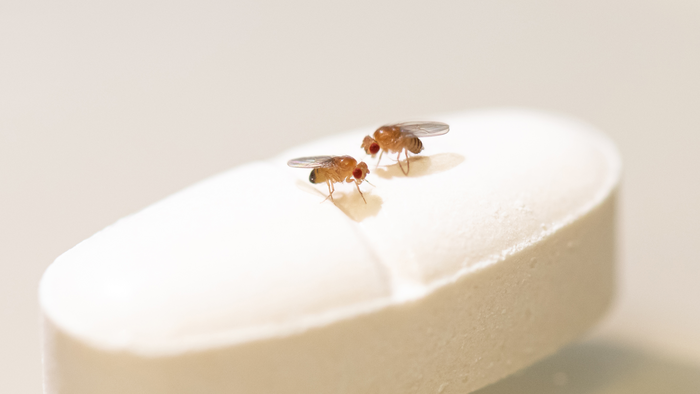
Directly activating the metabolic sensor AMPK lengthened lifespans across three distantly related species, in some cases by more than a quarter.
Every living cell keeps a running tally of its energy budget. When fuel runs low, an enzyme called AMPK notices and shifts the cell into a more frugal mode, dialing down energy-hungry processes and ramping up those that generate or conserve fuel. For years, researchers have suspected that nudging this sensor could slow ageing. A new study suggests they were right.
Writing in Aging Cell, scientists at the Medical Research Council Laboratory of Medical Sciences (MRC LMS) in London, working with Imperial College London, the University of Cologne and other collaborators, report that a drug called 991, which switches AMPK on directly, extended lifespan in fission yeast, nematode worms and fruit flies. In some cases the gain exceeded 25 percent.
“AMPK is effectively the body’s equivalent to the ‘energy saving mode’ on a mobile phone,” said Helena Cochemé, who leads the Redox Metabolism Group at MRC LMS. “The fact that we can extend lifespan in yeast, worms and flies is very exciting.”
A cleaner test of an old idea
AMPK is not a new target. Metformin, the widely prescribed diabetes drug that has attracted intense interest as a possible longevity aid, is thought to act partly through the enzyme. But metformin works indirectly, through a tangle of effects on cellular metabolism, which makes it hard to say which of its actions produce which outcomes. Compound 991 binds AMPK itself.
“By switching-on AMPK specifically using a direct activator, it is possible to achieve a much cleaner result,” said David Carling, who leads the Cellular Stress Group at MRC LMS, adding that the approach also means “avoiding potential side-effects.”
According to Cochemé, the work is the first to show that targeting AMPK directly with a drug “can have longevity benefits in living organisms.”
Why yeast, worms and flies
The three organisms sit on very different branches of the tree of life, and that is the point. A single-celled fungus, a tiny roundworm and an insect share AMPK, but little else in their day-to-day biology. An intervention that works across all three is more likely to be tapping something fundamental.
“If a treatment works successfully in three such distantly related species, then these results give us more confidence,” Cochemé said, “that in the longer-term, the effects possibly translate to mammals and eventually perhaps humans.”
Speed matters too. Laboratory worms live about three weeks and flies about three months, against roughly three years for mice, which means experiments that would take years in mammals can be run in weeks. The short lifespans, Cochemé said, let the team make progress “much more rapidly and efficiently than in mammalian systems.”
The road to mice, and beyond
The team’s next target is a mammal. “Now that we have very solid, convincing evidence from the laboratory model organisms,” Carling said, “the next step will be to show that we can also improve health and extend lifespan in mice.”
There is reason for cautious optimism about safety. “Direct AMPK activators have already been used safely in clinical trials for the treatment of specific metabolic diseases,” Carling noted. “This opens the door for using AMPK activators to treat a range of human diseases in the future.”
Filipe Cabreiro, who leads the Host-Microbe Co-Metabolism Group at MRC LMS and works with a laboratory at the University of Cologne, was blunt about how far that future lies. “The field is still a long way from anti-ageing clinical trials in humans,” he said. “This is because ageing is not technically classified as a disease.”
That regulatory reality shapes what any eventual trial would look like. Rather than aiming to lengthen life outright, researchers would likely target healthspan, the years lived free of chronic illness. “But improving health in older age would be hugely beneficial from a societal and healthcare perspective,” Cabreiro said, “since ageing is a major risk factor for so many diseases, such as heart disease, diabetes, cancer and dementia.”
The release does not report doses or species-by-species figures beyond the headline gain, and results in invertebrates have a long history of failing to carry over to mammals. Still, for Cabreiro the prize is clear: “The ability to make individuals healthier for longer, for instance by pharmacologically targeting energy balance through AMPK, would be a major biomedical breakthrough.”
Notes
- Direct Pharmacological Activation of AMPK Extends Lifespan in Yeast, Worms and Flies. Aging Cell, 30 September 2026. DOI: 10.1111/acel.70721.
- MRC Laboratory of Medical Sciences. “Experts significantly extend lives of animals by activating ‘energy saver’ mode.” EurekAlert!, 29 September 2026. https://www.eurekalert.org/news-releases/1145921.
Featured image: Drosophila fruit fly (from the Scientific Inquirer media library).


Leave a Reply