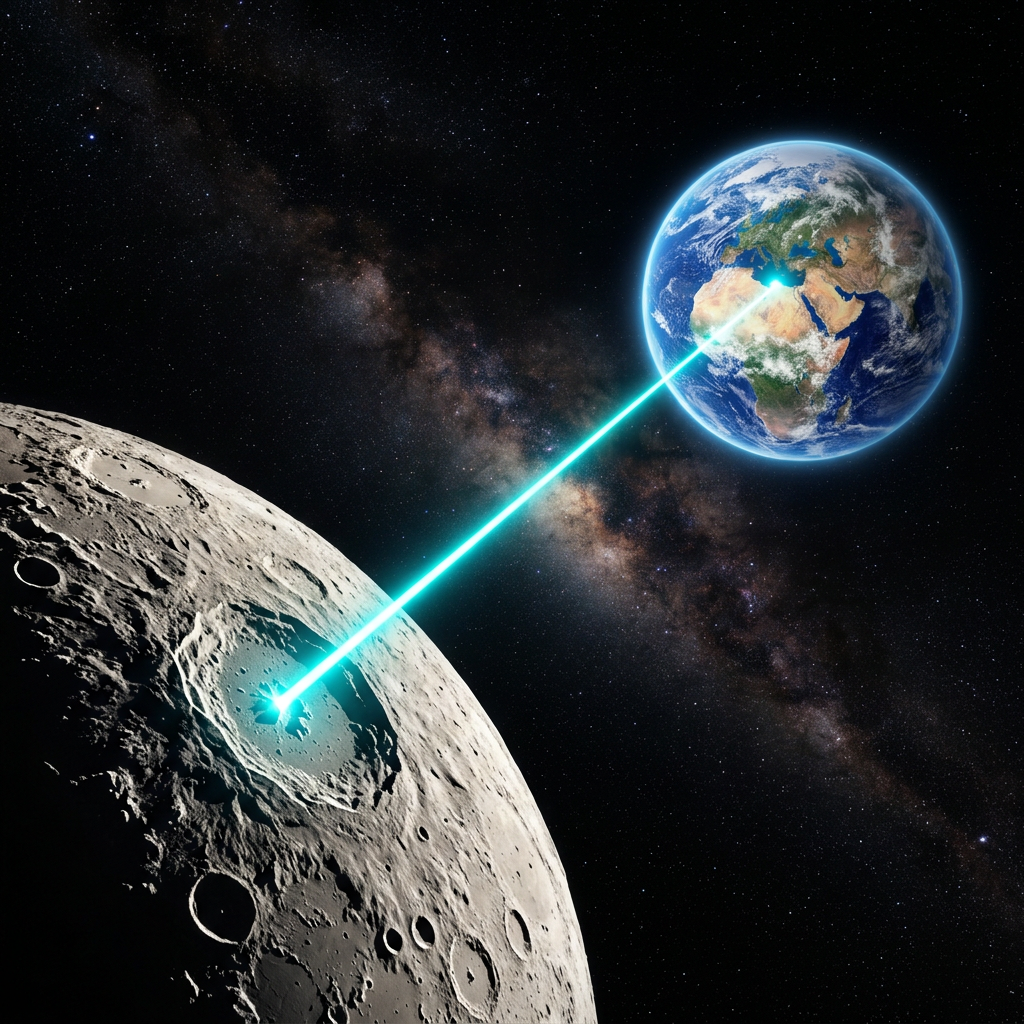
For decades, physicists have wondered whether it might be possible to build a “neutrino laser” — a device that would emit a coherent, intense beam of neutrinos, the famously elusive particles that pass through ordinary matter almost undetected. Such a device could open new avenues in fundamental physics and technology. Now, a team of MIT physicists has shown that this idea, however appealing, runs into a fundamental roadblock.
In a paper published in Physical Review Letters, the researchers, led by Wolfgang Ketterle, show that a proposed mechanism for “superradiant” neutrino emission — in which a large collection of atomic nuclei would emit neutrinos in a coordinated, amplified way, analogous to how atoms emit photons in an optical laser — cannot work as envisioned.
A quantum amplifier
In an ordinary laser, atoms are stimulated to emit photons in phase with one another, producing a beam of light that is far more intense and coherent than the sum of the individual emissions. Some physicists have proposed that a similar “superradiant” amplification might be possible for neutrino emission from certain nuclear decays, potentially producing a beam of neutrinos with vastly enhanced intensity.
Instant recoil
The MIT team’s analysis shows that the mechanism fails because of the recoil imparted to atomic nuclei when they emit a neutrino. Unlike photon emission, which carries negligible momentum relative to atomic scales, neutrino emission imparts a substantial recoil kick to the emitting nucleus. This recoil rapidly destroys the phase coherence between emitting nuclei that would be required for superradiant amplification, before any collective enhancement can build up.
An anti-memory
“It’s almost like an anti-memory effect,” said Joe Formaggio, a physicist at MIT not directly involved in the theoretical derivation but familiar with the result. The recoil effectively erases the information needed to keep the emitting nuclei synchronized, preventing the buildup of a coherent neutrino beam.
The researchers say their analysis applies broadly to proposed superradiant neutrino sources and should discourage further pursuit of this particular approach to producing an intense, coherent neutrino beam, though other avenues for neutrino-beam technology remain open to exploration.
Journal: Physical Review Letters
DOI: 10.1103/8x7k-rwx2
Article Title: Fundamental impossibility of a superradiant neutrino laser
Publication Date: 2-Sep-2026
Institution: Massachusetts Institute of Technology
Source: EurekAlert




Leave a Reply