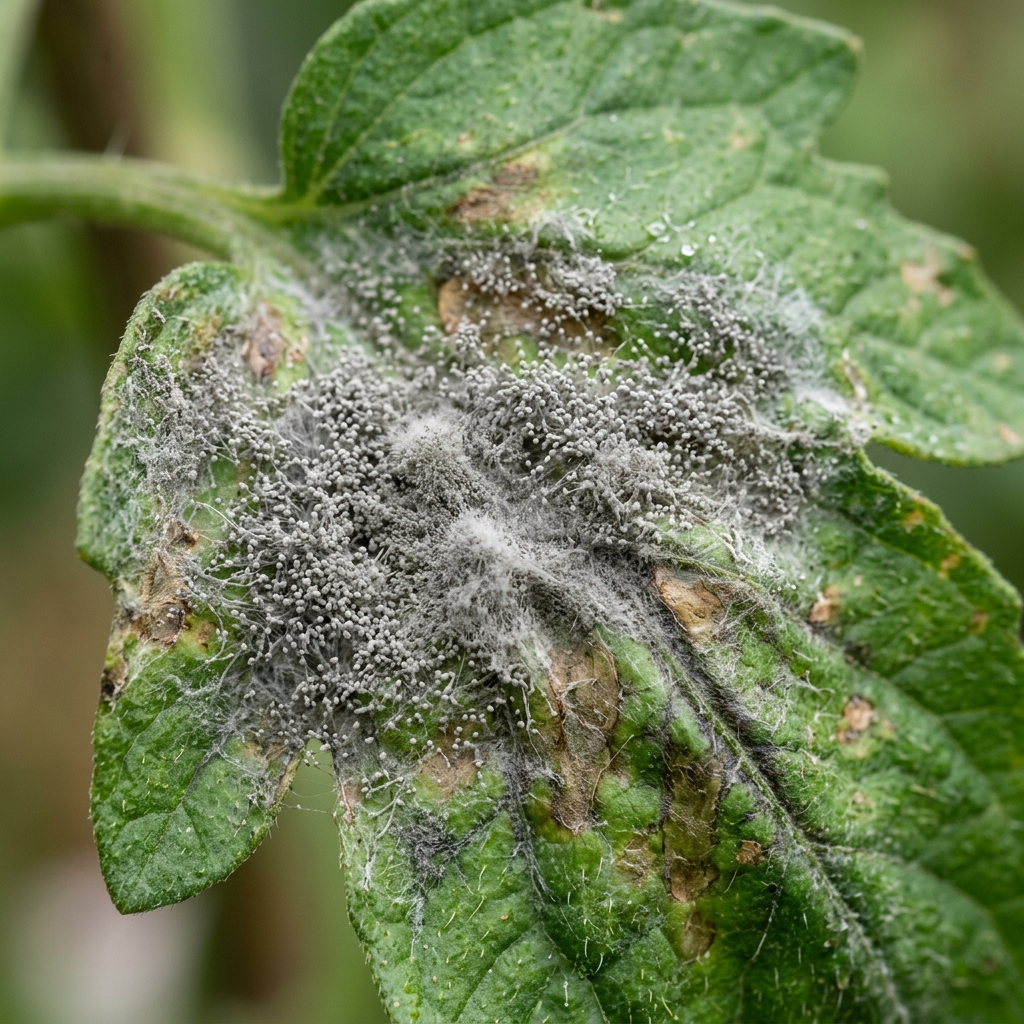
Even if you haven’t heard of Botrytis cinerea, you’ve likely seen it — slowly growing in your store-bought blueberries, tomatoes or even on your beautiful orchids. Commonly known as gray mold, the fungus attacks hundreds of plants. For years, scientists have unsuccessfully tried to breed crops that could resist the fungus. New research from the University of California, Davis, suggests decades of crop breeding strategies may have overlooked a crucial piece of the puzzle: the pathogen itself.
Two related studies led by Dan Kliebenstein, professor in the UC Davis Department of Plant Sciences, show the problem may lie in a fundamental misunderstanding of how plants and the pathogen interact. The studies were published in the Proceedings of the National Academy of Sciences.
An unexpected defense
Scientists had long assumed that when different plants are attacked by a fungus, they mount a broadly similar defense — the same basic response with minor variations.
“It’s like they might do little decorations on the Christmas tree, but it’s always a Christmas tree,” Kliebenstein said. The team’s findings challenge that assumption. For some plants, it’s not a Christmas tree at all. It’s a saguaro cactus.

Each plant mounted a response that was fundamentally its own, whether comparing closely related crops or distant ones. That finding alone helps explain why decades of resistance breeding have yielded only modest results.
“It’s why we could never figure out how to move information from one plant to help another become resistant, because what one plant is doing doesn’t actually do anything for the other plant,” Kliebenstein said.
A human-like pathogen
The second study yielded more surprising results. Rather than having a universal “master key” to infect any plant it encounters, gray mold appears to sense what it’s growing on and adjusts its attack accordingly.
“The pathogen is like a human,” Kliebenstein said. “At some level, it knows it’s attacking a strawberry, and there’s one set of things it should do. If it’s attacking a tomato, it knows it’s attacking a tomato and it decides to do something completely different.”
In a sense, Kliebenstein said the fungus is “tasting” the difference between a strawberry and a tomato — reading the plant’s own chemical defenses and flavors — then countering them.
Reframing the problem
The two studies could shift how scientists approach disease prevention, Kliebenstein said.
“They suggest that everything we’ve been trying on the plant or fungus side is probably always going to be doomed to fail, and instead we should be looking at how the pathogen knows what it’s attacking,” he said.
If researchers can identify the genes the fungus uses to recognize which plant it’s attacking, they might be able to confuse the fungus chemically or genetically. A disoriented pathogen could allow the plant’s own natural defenses to take over.
“We’ve been hitting ourselves against a brick wall and we just never thought about this,” Kliebenstein said. “Now we might have realized — oh, if we take two steps to the right, the brick wall ends.”
It’s a strategy that could, in theory, work across many crops at once, in contrast to current approaches that must be engineered one plant at a time.
The stakes are significant. Gray mold causes an estimated 5% to 10% crop loss across many fruits and vegetables, affecting everything from grapes and lettuce to soybeans and cut flowers.



Leave a Reply