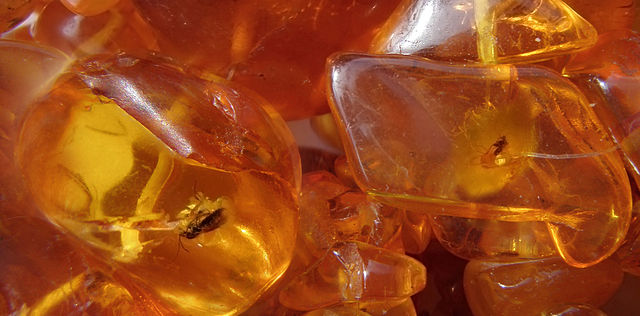
A beetle preserved in Kachin amber combines unprecedented double-branched antennae with intact light organs, suggesting firefly relatives used complex signals far back in the Cretaceous.
On summer evenings, fireflies turn fields and forests into a light show, flashing coded signals to find mates. But their glow and their other ways of communicating had to start somewhere, and tracing that history is difficult. Light organs, delicate antennae and the other soft structures involved in signaling rarely survive as fossils.
A newly described fossil offers an unusually complete glimpse. Preserved in amber for about 100 million years, the beetle has both elaborately branched antennae and intact light-emitting organs on its abdomen. The find, reported in Proceedings of the Royal Society B, suggests that firefly relatives had already developed sophisticated sensory and signaling systems by the middle of the Cretaceous period.
The study was carried out by Li Yanda, a Ph.D. student at the University of Bristol, and Professor Cai Chenyang of the Nanjing Institute of Geology and Palaeontology of the Chinese Academy of Sciences.
A beetle frozen in resin
Fireflies are not flies at all but beetles, members of the order Coleoptera, the largest order of animals on Earth. Together with several related families, including the glowworm beetles, they belong to a group known as the lampyroids.
The new beetle, named Icaroramus, comes from Kachin amber in Myanmar. Amber is fossilized tree resin, and because resin can engulf small creatures whole, it can preserve fine details that would otherwise vanish, from hairs and antennae to soft tissues. Kachin amber, roughly 99 million years old, has yielded an extraordinary range of insects and other animals.
The use of Myanmar amber in research has also been controversial, because of concerns that mining and trade in the region have been linked to armed conflict and human rights abuses. Some scientific societies and journals have called for restrictions on publishing studies based on amber acquired from the region since 2017. The release does not say when or how this specimen was obtained.
Analyses of the beetle’s features place Icaroramus in Cretophengodidae, an extinct family of lampyroid beetles.
An antenna unlike any other
The most remarkable feature of Icaroramus is its antennae. Each has twelve segments, and segments four through eleven each bear two distinct pairs of side branches. According to the authors, that arrangement is unprecedented among beetles.
The researchers suggest that the unusual structure may have arisen through a partial reactivation of the genetic program that controls how antennae are divided into segments.
Branched or feathery antennae are common in insects that rely on smell to find mates. The large surface area gives them more room for sensory receptors, helping them detect faint traces of airborne sex pheromones. Male moths with feathery antennae can track the scent of a female from a considerable distance.
Based on this, the authors infer that Icaroramus relied heavily on chemical cues to locate mates. They also suggest that its two different types of branches may have handled separate olfactory functions.
Living lampyroids show that scent and light can go together. In glowworm beetles of the family Phengodidae, for instance, males often have feathery antennae, while the wingless, larva-like females glow.
Why glow?
The fossil’s light organs raise a different question: what was the light for? The fossil alone cannot confirm how the organs were used. But the combination of features offers a clue.
Most modern fireflies use light for courtship, and many have relatively simple antennae. Icaroramus, by contrast, combines elaborate light organs with antennae built for detecting scent. If it found mates mainly by smell, its glow may have served another purpose.
The authors think the light most likely acted as a warning signal to predators, a strategy known as aposematism, advertising that the beetle was distasteful or toxic. Many living fireflies contain defensive chemicals, and a leading hypothesis holds that bioluminescence in the group first evolved as a warning, with courtship displays coming later. A role in attracting mates, however, cannot be ruled out.
Fireflies produce light through a chemical reaction in which an enzyme, luciferase, acts on a molecule called luciferin. The reaction is highly efficient, releasing almost all of its energy as light rather than heat.
An early start for complex signals
Taken together, the authors argue, the fossil shows that lampyroid beetles already had specialized sensory structures and functional bioluminescence about 100 million years ago. It suggests that several communication strategies, chemical and visual, emerged early in the evolution of fireflies and their relatives.
The interpretations about how Icaroramus used its antennae and light organs are inferences from anatomy, not direct observations of behavior. The release contains no comments from the researchers. The work was funded by China’s National Key Research and Development Program.
Notes
- “A firefly relative that smelled and glowed: evidence for complex signalling systems in Cretaceous lampyroids.” Proceedings of the Royal Society B: Biological Sciences, 29 July 2026. DOI: 10.1098/rspb.2026.0295.
- Chinese Academy of Sciences Headquarters. “Cretaceous beetle fossil reveals early evolution of firefly sensory and signaling systems.” EurekAlert!, 30 July 2026. https://www.eurekalert.org/news-releases/1138329.


Leave a Reply