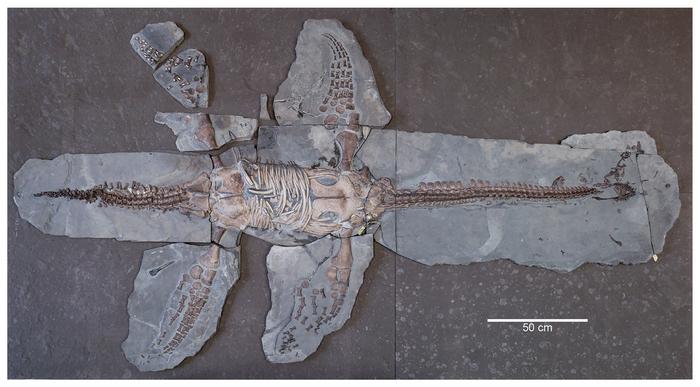
A nearly complete specimen of Plesiopterys wildi from Germany provides fresh insights into plesiosaur diversity and regional specialisation
A newly described plesiosaur fossil from southern Germany is providing crucial evidence about the diversification of these ancient marine reptiles during the Early Jurassic. Published in PeerJ Life and Environment, the study details the discovery and analysis of an exceptionally well-preserved Plesiopterys wildi specimen, which offers new clues about the evolution and geographic distribution of plesiosaurs in Europe nearly 180 million years ago.
Unearthed from the Lower Jurassic Posidonienschiefer Formation near Holzmaden, the fossil—referred to as MH 7—is one of the most complete articulated plesiosaur skeletons found in the region. Unlike ichthyosaurs and marine crocodile relatives, which dominate the fossil record of this formation, plesiosaurs are comparatively rare. The new discovery, therefore, provides a rare glimpse into the biodiversity of these long-necked marine reptiles.
Key Findings:
- A pivotal new specimen of Plesiopterys wildi – MH 7 represents a subadult individual, refining the known characteristics of this species and confirming its validity as a distinct taxon.
- Stepwise evolution towards cryptoclidids – Phylogenetic analysis positions Plesiopterys wildi as an early-diverging plesiosauroid, closely related to Franconiasaurus brevispinus, suggesting a gradual evolutionary transition towards more derived cryptoclidids of the Late Jurassic.
- Possible regional endemism – The discovery supports the idea that plesiosaur species may have been regionally distinct within the epicontinental seas of Early Jurassic Europe, reinforcing patterns of paleobiogeographical segregation.
“The Holzmaden specimen gives us an unprecedented look at Plesiopterys wildi in a more mature stage of development, allowing us to refine our understanding of this species and its place in plesiosaur evolution,” said lead author Miguel Marx from Lund University. “It also suggests that distinct plesiosaur communities may have evolved in different regions of the European seas during the Early Jurassic.”
Sign up for the Daily Dose Newsletter and get every morning’s best science news from around the web delivered straight to your inbox? It’s easy like Sunday morning.
Implications for Plesiosaur Evolution and Biogeography
The findings highlight the Early Jurassic as a crucial period for plesiosaur evolution, as early forms diversified and set the stage for later groups that would dominate marine ecosystems. The presence of unique plesiosaur species in different parts of Europe reinforces the hypothesis that early members of this group may have been geographically restricted.
“Our research reinforces that plesiosaurs were already evolving specialized adaptations and distinct regional lineages much earlier than we used to believe,” added co-author Sven Sachs. “This has important implications for understanding how marine reptiles responded to environmental changes in the Jurassic seas.”
IMAGE CREDIT: DOI: 10.7717/peerj.18960/fig-3




Leave a Reply