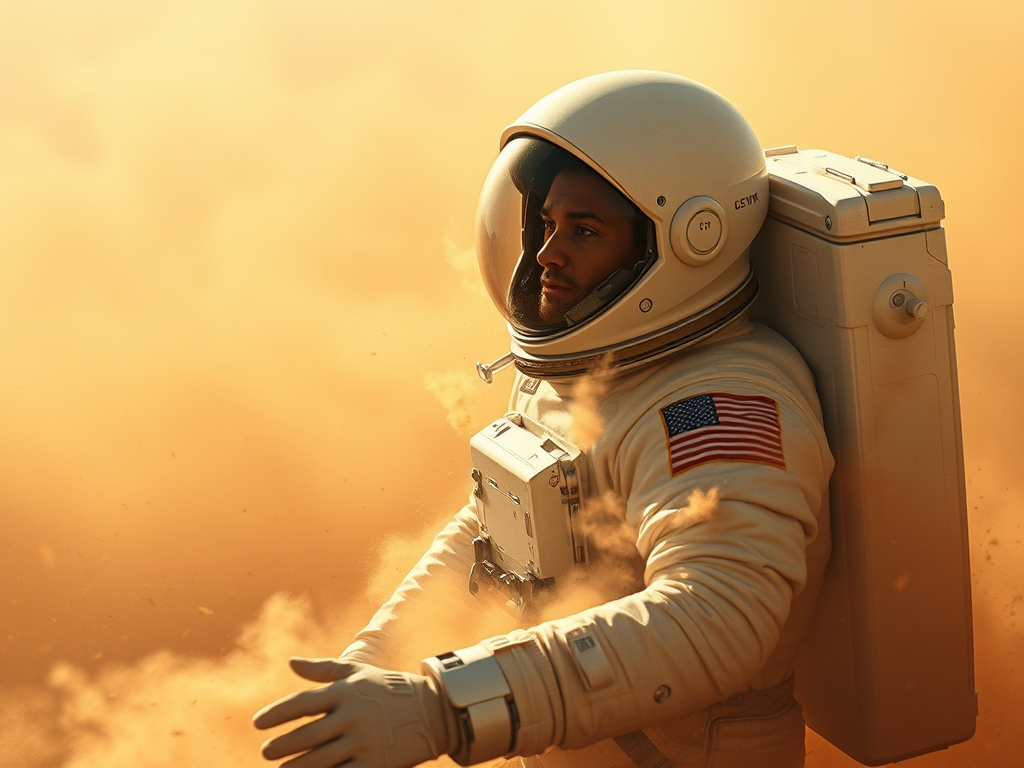
Don’t breathe in the dust on Mars.
That’s the takeaway from new research from a team of scientists, including researchers from the University of Colorado Boulder. The findings suggests that long-term exposure to Martian dust could create a host of health problems for future astronauts—leading to chronic respiratory problems, thyroid disease and more.
The study, published in the journal GeoHealth, is the first to take a comprehensive look at the chemical ingredients that make up Martian dust, and their possible impacts on human health. It was undertaken by a team from the worlds of medicine, geology and aerospace engineering.
“This isn’t the most dangerous part about going to Mars,” said Justin Wang, lead author of the study and a student in the Keck School of Medicine at the University of Southern California in Los Angeles. “But dust is a solvable problem, and it’s worth putting in the effort to develop Mars-focused technologies for preventing these health problems in the first place.”
Wang, a CU Boulder alumnus, noted that Apollo era astronauts experienced runny eyes and irritated throats after inhaling dust from the moon. Apollo 17’s Harrison Schmitt likened the symptoms to hay fever.
But scientists know a lot less about the potential harms of Martian dust. To begin to answer that question, Wang and his colleagues drew on data from rovers on Mars and even Martian meteorites to better understand what makes up the planet’s dust. The group discovered a “laundry list” of chemical compounds that could be dangerous for people—at least when inhaled in large quantities and over long periods of time.
They include minerals rich in silicates and iron oxides, metals like beryllium and arsenic and a particularly nasty class of compounds called perchlorates.
In many cases, those ingredients are present in only trace amounts in Mars dust. But the first human explorers on Mars may spend around a year and a half on the surface, increasing their exposure, said study co-author Brian Hynek.
Sign up for the Daily Dose Newsletter and get every morning’s best science news from around the web delivered straight to your inbox? It’s easy like Sunday morning.
“You’re going to get dust on your spacesuits, and you’re going to have to deal with regular dust storms,” said Hynek, a geologist at the Laboratory for Atmospheric and Space Physics (LASP) at CU Boulder. “We really need to characterize this dust so that we know what the hazards are.”
Into the bloodstream
One thing is clear, he added: Mars is a dusty place.
Much of the planet is covered in a thick layer of dust rich in tiny particles of iron, which gives the planet its famous red color. Swirling dust storms are common and, in some cases, can engulf the entire globe.
“We think there could be 10 meters of dust sitting on top of the bigger volcanoes,” said Hynek, a professor in the Department of Geological Sciences. “If you tried to land a spacecraft there, you’re going to just sink into the dust.”
Wang found his own way to Martian dust through a unique academic path. He started medical school after earning bachelor’s degrees from CU Boulder in astronomy and molecular, cellular and developmental biology, followed by a master’s degree in aerospace engineering sciences. He currently serves in the Navy through its Health Professions Scholarship Program.
He noted that the biggest problem with Martian dust comes down to its size. Estimates suggest that the average size of dust grains on Mars may be as little as 3 micrometers across, or roughly one-ten-thousandth of an inch.
“That’s smaller than what the mucus in our lungs can expel,” Wang said. “So after we inhale Martian dust, a lot of it could remain in our lungs and be absorbed into our blood stream.”
An ounce of prevention
In the current study, Wang and several of his fellow medical students at USC scoured research papers to unearth the potential toxicological effects of the ingredients in Martian dust.
Some of what they found resembled common health problems on Earth. Dust on Mars, for example, contains large amounts of the compound silica, which is abundant in minerals on our own planet. People who inhale a lot of silica, such as glass blowers, can develop a condition known as silicosis. Their lung tissue becomes scarred, making it hard to breath—symptoms similar to the “black lung” disease that coal miners often contract. Currently, there is no cure for silicosis.
In other cases, the potential health consequences are much less well-known.
Martian dust carries large quantities of highly oxidizing compounds called perchlorates, which are made up of one chlorine and multiple oxygen atoms. Perchlorates are rare on Earth, but some evidence suggests that they can interfere with human thyroid function, leading to severe anemia. Even inhaling a few milligrams of perchlorates in Martian dust could be dangerous for astronauts.
Wang noted that the best time to prepare for the health risks of Martian dust is before humans ever make it to the planet. Iodine supplements, for example, would boost astronauts’ thyroid function, potentially counteracting the toll of perchlorates—although taking too much iodine can also, paradoxically, lead to thyroid disease. Filters specifically designed to screen out Martian dust could also help to keep the air in living spaces clean.
“Prevention is key. We tell everyone to go see their primary care provider to check your cholesterol before it gives you a heart attack,” Wang said. “The best thing we can do on Mars is make sure the astronauts aren’t exposed to dust in the first place.”

Leave a Reply