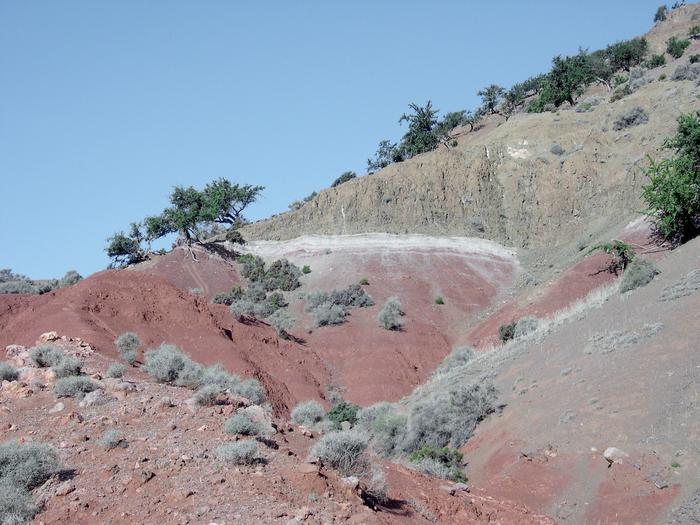
201.6 million years ago, one of the Earth’s five great mass extinctions took place, when three-quarters of all living species suddenly disappeared. The wipeout coincided with massive volcanic eruptions that split apart Pangaea, a giant continent then comprising almost all the planet’s land. Millions of cubic miles of lava erupted over some 600,000 years, separating what are now the Americas, Europe and North Africa. It marked the end of the Triassic period and the beginning of the Jurassic, the period when dinosaurs arose to take the place of Triassic creatures and dominate the planet.
The exact mechanisms of the End Triassic Extinction have long been debated, but most prominent: Carbon dioxide surfaced by the eruptions built up over many millennia, raising temperatures to unsustainable levels for many creatures, and acidifying the oceans. But a new study says the opposite: cold, not warmth was the main culprit. The study presents evidence that instead of stretching over hundreds of thousands of years, the first pulses of lava that ended the Triassic were stupendous events lasting less than a century each. In this condensed time frame, sunlight-reflecting sulfate particles were spewed into the atmosphere, cooling the planet and freezing many of its inhabitants. Gradually rising temperatures in an environment that was hot to begin with—atmospheric carbon dioxide in the late Triassic was already three times today’s level—may have finished the job later on, but it was volcanic winters that did the most damage, say the researchers.
“Carbon dioxide and sulfates act not just in opposite ways, but opposite time frames,” said lead author Dennis Kent of the Columbia Climate School’s Lamont-Doherty Earth Observatory. “It takes a long time for carbon dioxide to build up and heat things, but the effect of sulfates is pretty much instant. It brings us into the realm of what humans can grasp. These events happened in the span of a lifetime.”
The Triassic-Jurassic extinction has long been thought tied to the eruption of the so-called Central Atlantic Magmatic Province, or CAMP. In a groundbreaking 2013 study, Kent and colleagues provided perhaps the most definitive link. Kent, who studies paleomagnetism, identified a consistent polarity reversal in sediments just below the initial CAMP eruptions, which showed they all happened at the same time across what are now widespread parts of the world. Colleagues then used radioactive isotopes to date the start of volcanism to 201,564,000 years ago, give or take a few tens of thousands of years. Scientists were unable to say how big the initial eruptions were, but it was assumed by many that the massive CAMP deposits must have taken many millennia to build up.
In the new study, Kent and colleagues correlated data from CAMP deposits in the mountains of Morocco, along Nova Scotia’s Bay of Fundy, and New Jersey’s Newark Basin. Their key evidence: the alignments of magnetic particles in the rocks that recorded the past drifting of Earth’s magnetic pole at the time of the eruptions. Due to a complex set of processes, this pole is offset from the planet’s unchanging axis of rotation—true north—and to boot, changes position by a few tenths of a degree each year. (The reason that compasses do not point exactly north.) Because of this phenomenon, magnetic particles in lavas that were emplaced within a few decades of each other will all point in the same direction, while ones emplaced, say, thousands of years later will point 20 or 30 degrees in a different direction.
Sign up for the Daily Dose Newsletter and get every morning’s best science news from around the web delivered straight to your inbox? It’s easy like Sunday morning.
What the researchers found was five successive initial CAMP lava pulses spread over about 40,000 years—each with the magnetic particles aligned in a single direction, indicating the lava pulse had emerged in less than 100 years, before drift of the magnetic pole could manifest itself. They say that these huge eruptions released so many sulfates so quickly that the sun was largely blocked out, causing temperatures to plunge. Unlike carbon dioxide, which hangs around for centuries, volcanic sulfate aerosols tend to rain out of the atmosphere within years, so resulting cold spells don’t last very long. But due to the rapidity and size of the eruptions, these volcanic winters were devastating. The researchers compared the CAMP series to sulfates from the 1783 eruption of Iceland’s Laki volcano, which caused widespread crop failures; just the initial CAMP pulses were hundreds of times greater, they say.
In sediments just below the CAMP layers lie Triassic-era fossils: large terrestrial and semiaquatic relatives of crocodiles, strange tree lizards, giant, flat-headed amphibians, and many tropical plants. Then they disappear with the CAMP eruptions. Small feathered dinosaurs had been around for tens of millions of years before this, and survived, eventually to thrive and get much larger, along with turtles, true lizards, and mammals, possibly because they were small and could survive in burrows.
“The magnitude of the environmental effects are related to how concentrated the events are,” said study coauthor Paul Olsen, a paleontologist at Lamont-Doherty. “Small events spread out over [tens of thousands of years] produce much less of an effect than the same total volume of volcanism concentrated in less than a century. The overarching implication being that the CAMP lavas represent extraordinarily concentrated events.”
IMAGE CREDIT: Paul Olsen/Lamont-Doherty Earth Observatory.
.
Leave a Reply