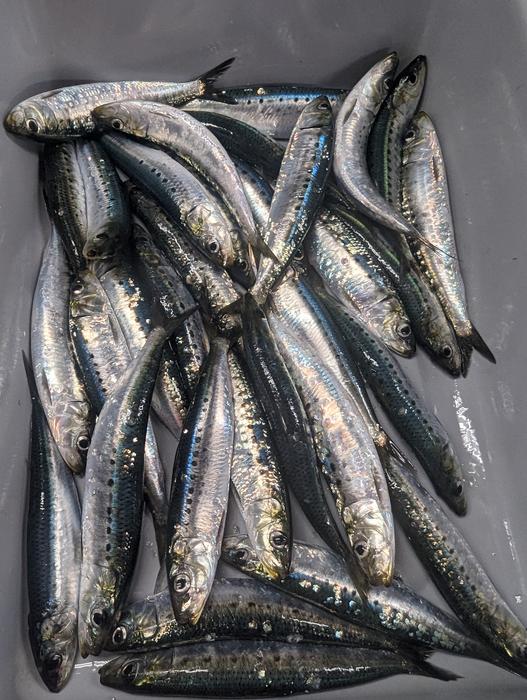
When research scientist Gary Longo first saw the results of his genomic analysis of sardines, he thought he must have mixed up his samples.
Besides the Pacific sardines common on the West Coast, many of the fish appeared to be another species. “It was a total shock,” he said. Then he compared their genetic code to other known species. “That was the ‘aha moment’ when we realized we were looking at a second species of sardine.”
The analysis shows that of the 345 sardine samples collected during NOAA Fisheries’ 2021 and 2022 Coastal Pelagic Species Surveys, all of the fish in 2021 were Pacific sardines, but those collected in 2022 were a mix of Pacific sardines and Japanese sardines.
Examination of another 825 sardines collected the following year found the same result: many were Japanese sardines. Known only from the west side of the North Pacific Ocean near Asia, the Japanese species had not been documented on the West Coast before.
The scientists from NOAA Fisheries and other institutions reported the surprise appearance today in the journal Molecular Ecology. Both species look so similar that only genetic examination can tell them apart. The scientists took advantage of recent advances in genomic sequencing to examine data from millions of genetic markers and constructed full mitochondrial genomes for sardine to verify the identification. .
In 2022 and 2023, Japanese sardines were found from Washington State to southern California and were sometimes schooling together with Pacific sardines. The Japanese sardines were 1 to 3 years old, typical adult age classes for sardines.
Sign up for the Daily Dose Newsletter and get every morning’s best science news from around the web delivered straight to your inbox? It’s easy like Sunday morning.
Curious if the Japanese sardines had been missed in previous surveys, the researchers took advantage of the genetic resources archive at the Southwest Fisheries Science Center. They sequenced tissue samples from past coastal pelagic species surveys. Analyses of sardines collected from 2013–2021 found no sign of Japanese sardines, suggesting that their cross-ocean travel is a more recent development.
Pacific sardines are currently at low abundance throughout the California Current. This may have made the detection of the Japanese sardine more likely.
More Questions than Answers
The 2022 NOAA Fisheries survey first collected the Japanese species, suggesting that they arrived on the West Coast about that time. The following year’s survey in 2023 found more, but it’s not clear how long the Japanese species continued to move east across the ocean. Scientists are currently examining samples from this year’s survey.
Sardines are key forage fish across the globe, with two species occurring in the North Pacific. Earlier genetic studies hypothesized that Pacific and Japanese sardines diverged about 200,000 to 300,000 years ago. Glacial periods turned much of the North Pacific very cold, separating the two populations.
Though there have been many examples of western Pacific species arriving on the West Coast, these have mostly been associated with floating debris carried by the North Pacific Current. In this case, the authors suggest that marine heatwaves that warmed the North Pacific over the last decade opened a corridor of favorable habitat. The Japanese sardines may have followed the corridor across the ocean.
“Small coastal pelagic fish such as sardines are good indicators of change,” Longo said. “Often they are the first ones we see responding to shifting temperatures because they have short generation times, are highly mobile, and can use a variety of habitats.” The scientists suggested that the sardines may be at the “leading edge” of further changes to come.
“It leaves us with many more questions than we can possibly answer right away,” said Matthew Craig, a research scientist at the Southwest Fisheries Science Center and coauthor of the new study. “A lot of fish distributions change as ocean conditions change. Now the question is whether Japanese sardines will die out over time, or will they persist in this new part of their range.”
Next Steps for Sardine Analysis
Longo and Craig are now back in the laboratory, examining about 700 new samples from the 2024 Coastal Pelagics Species Survey, which just concluded. The team will sequence DNA from the fish in the coming weeks, helping trace the continuing presence of Japanese sardines in the California Current Ecosystem.
Scientists do not know if the two sardine species can interbreed. This is a key question that would help determine how these two sardine species may interact along the West Coast. That would then inform how the presence of Japanese sardine may impact sardine management in the California Current ecosystem.
The research highlights the value of long-term monitoring. The results may change our understanding of sardine distribution and dispersal in the Pacific, and impacts of changing ocean conditions.
“This is one of those remarkable discoveries that never would have happened if scientists had not been out there, looking,” said Kristen Koch, director of the science center. “The long-term records from earlier surveys also help us understand how unusual it is.”
IMAGE CREDIT: Kelsey James/NOAA Fisheries
.



Leave a Reply