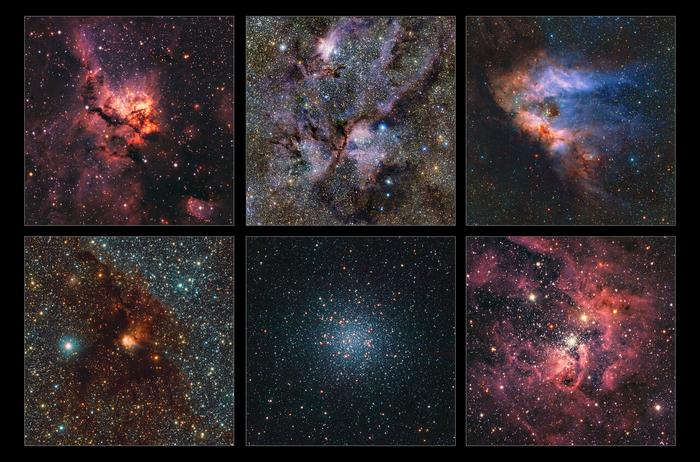
Astronomers have published a gigantic infrared map of the Milky Way containing more than 1.5 billion objects ― the most detailed one ever made. Using the European Southern Observatory’s VISTA telescope, the team monitored the central regions of our Galaxy over more than 13 years. At 500 terabytes of data, this is the largest observational project ever carried out with an ESO telescope.
“We made so many discoveries, we have changed the view of our Galaxy forever,” says Dante Minniti, an astrophysicist at Universidad Andrés Bello in Chile who led the overall project.
This record-breaking map comprises 200 000 images taken by ESO’s VISTA ― the Visible and Infrared Survey Telescope for Astronomy. Located at ESO’s Paranal Observatory in Chile, the telescope’s main purpose is to map large areas of the sky. The team used VISTA’s infrared camera VIRCAM, which can peer through the dust and gas that permeates our galaxy. It is therefore able to see the radiation from the Milky Way’s most hidden places, opening a unique window onto our galactic surroundings.
This gigantic dataset covers an area of the sky equivalent to 8600 full moons, and contains about 10 times more objects than a previous map released by the same team back in 2012. It includes newborn stars, which are often embedded in dusty cocoons, and globular clusters –– dense groups of millions of the oldest stars in the Milky Way. Observing infrared light means VISTA can also spot very cold objects, which glow at these wavelengths, like brown dwarfs (‘failed’ stars that do not have sustained nuclear fusion) or free-floating planets that don’t orbit a star.
The observations began in 2010 and ended in the first half of 2023, spanning a total of 420 nights. By observing each patch of the sky many times, the team was able to not only determine the locations of these objects, but also track how they move and whether their brightness changes. They charted stars whose luminosity changes periodically that can be used as cosmic rulers for measuring distances. This has given us an accurate 3D view of the inner regions of the Milky Way, which were previously hidden by dust. The researchers also tracked hypervelocity stars — fast-moving stars catapulted from the central region of the Milky Way after a close encounter with the supermassive black hole lurking there.
Sign up for the Daily Dose Newsletter and get every morning’s best science news from around the web delivered straight to your inbox? It’s easy like Sunday morning.
The new map contains data gathered as part of the VISTA Variables in the Vía Láctea (VVV) survey and its companion project, the VVV eXtended (VVVX) survey. “The project was a monumental effort, made possible because we were surrounded by a great team,” says Roberto Saito, an astrophysicist at the Universidade Federal de Santa Catarina in Brazil and lead author of the paper published today in Astronomy & Astrophysics on the completion of the project.
The VVV and VVVX surveys have already led to more than 300 scientific articles. With the surveys now complete, the scientific exploration of the gathered data will continue for decades to come. Meanwhile, ESO’s Paranal Observatory is being prepared for the future: VISTA will be updated with its new instrument 4MOST and ESO’s Very Large Telescope (VLT) will receive its MOONS instrument. Together, they will provide spectra of millions of the objects surveyed here, with countless discoveries to be expected.
IMAGE CREDIT: ESO/VVVX survey

Leave a Reply