A new approach for delivering miniature research tools into the interior of egg cells and embryos has been developed at the Marine Biological Laboratory (MBL), resolving a major bottleneck to using the gene-editing tool CRISPR-Cas9 in many research organisms. A paper detailing the new approach, called VitelloTag, has been accepted by the journal Development.
Usually, scientists use a long, thin, glass needle to inject research “cargo” into eggs or embryos, a technique called microinjection that takes significant time and skill. And sometimes, nature resists. The egg cells of cephalopods, for instance, have a tough, protective coating called a chorion, and glass needles just shatter and break when they hit the surface.
“You have to create gourmet, super-sharp needles for microinjecting in some organisms, and they still break,” said Zak Swartz, assistant scientist at MBL and senior author of the VitelloTag paper.
Other species have very fragile embryos, or such a short spawning season that the window for delivering CRISPR-Cas9 into their eggs is exasperatingly brief. Doing so by microinjection ends up having a very low success rate.
The new delivery approach was inspired by a yolk protein found in most animals, called vitellogenin, which provides a source of energy to the growing egg.
“The exciting thing biologically, and the basis for this tool, is that vitellogenin is synthesized outside of the ovary,” Swartz said. “In the chicken, for instance, it’s produced in the liver, and then it is carried through circulation until it reaches the ovary, where it is imported into the egg cell. We wanted to use that biology to create a tool by which we could deliver cargo into egg cells.”
Sign up for the Daily Dose Newsletter and get every morning’s best science news from around the web delivered straight to your inbox? It’s easy like Sunday morning.
Vitellogenin is a big protein, but the team isolated the tiny part of it that binds to the receptor on the egg cell surface. “This is, conveniently, a very small tag (about 10 amino acids) that you can add different cargo to, such as Cas9,” Swartz said. “So, you can have your eggs sitting in a little petri dish, pipette in this VitelloTag attached to Cas9, and the eggs will just soak it up en masse, rather than having to microinject them one by one,” he said.
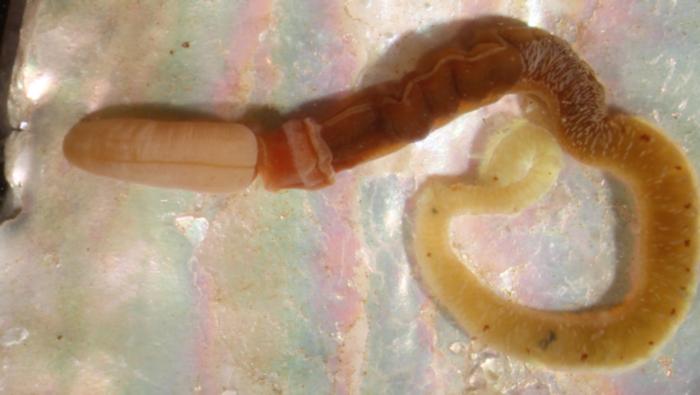
The team has used VitelloTag successfully in two distantly related species that are important for developmental biology: the sea star (Patiria miniata) and the acorn worm (Saccoglossus kowalevskii). And since their paper went online, “we’ve been getting a lot of interest from people in different institutions, who want to try it in their own particular critter,” Swartz said.
Vitellogenin is highly conserved across animal species, so their tool may work “as is” with many other organisms. “But the nice thing is, we’ve developed a pipeline where we can make customized versions of VitelloTag that may work in a species, if our first iteration doesn’t,” Swartz said.
Microinjection will still be the method of choice for delivering CRISPR-Cas9 in many organisms. Penetrance (the percent of cells that successfully take up the CRISPR cargo) can be as high as 90 percent with microinjection, whereas with VitelloTag, the team achieved about 30 percent penetrance in the sea star and acorn worm.
“But if you can rapidly add VitelloTag to a dish of 500 eggs and get 30 percent penetrance, you’re still doing good,” Swartz said. “And for an animal like the acorn worm, where injection is just so hard, VitelloTag has a lot to offer. You are going to get way better numbers than you ever could before.”
IMAGE CREDIT: Chris Lowe



Leave a Reply