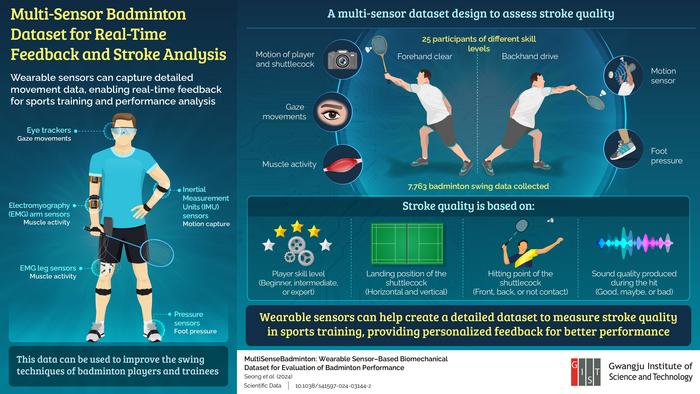
In sports training, practice is the key, but being able to emulate the techniques of professional athletes can take a player’s performance to the next level. AI-based personalized sports coaching assistants can make this a reality by utilizing published datasets. With cameras and sensors strategically placed on the athlete’s body, these systems can track everything, including joint movement patterns, muscle activation levels, and gaze movements.
Using this data, personalized feedback is provided on player technique, along with improvement recommendations. Athletes can access this feedback anytime, and anywhere, making these systems versatile for athletes at all levels.

Now, in a study published in the journal Scientific Data on April 5, 2024, researchers led by Associate Professor SeungJun Kim from the Gwangju Institute of Science and Technology (GIST), South Korea, in collaboration with researchers from Massachusetts Institute of Technology (MIT), CSAIL, USA, have developed a MultiSenseBadminton dataset for AI-driven badminton training.
“Badminton could benefit from these various sensors, but there is a scarcity of comprehensive badminton action datasets for analysis and training feedback,” says Ph.D. candidate Minwoo Seong, the first author of the study.
Sign up for the Daily Dose Newsletter and get every morning’s best science news from around the web delivered straight to your inbox? It’s easy like Sunday morning.
Supported by the 2024 GIST-MIT project, this study took inspiration from MIT’s ActionSense project, which used wearable sensors to track everyday kitchen tasks such as peeling, slicing vegetables, and opening jars. Seong collaborated with MIT’s team, including MIT CSAIL postdoc researcher Joseph DelPreto and MIT CSAIL Director and MIT EECS Professor Daniela Rus and Wojciech Matusik. Together, they developed the MultiSenseBadminton dataset, capturing movements and physiological responses of badminton players. This dataset, shaped with insights from professional badminton coaches, aims to enhance the quality of forehand clear and backhand drive strokes. For this, the researchers collected 23 hours of swing motion data from 25 players with varying levels of training experience.
During the study, players were tasked with repeatedly executing forehand clear and backhand drive shots while sensors recorded their movements and responses. These included inertial measurement units (IMU) sensors to track joint movements, electromyography (EMG) sensors to monitor muscle signals, insole sensors for foot pressure, and a camera to record both body movements and shuttlecock positions. With a total of 7,763 data points collected, each swing was meticulously labeled based on stroke type, player’s skill level, shuttlecock landing position, impact location relative to the player, and sound upon impact. The dataset was then validated using a machine learning model, ensuring its suitability for training AI models to evaluate stroke quality and offer feedback.
“The MultiSenseBadminton dataset can be used to build AI-based education and training systems for racket sports players. By analyzing the disparities in motion and sensor data among different levels of players and creating AI-generated action trajectories, the dataset can be applied to personalized motion guides for each level of players,” says Seong.
The gathered data can enhance training through haptic vibration or electrical muscle stimulation, promoting better motion and refining swing techniques. Additionally, player tracking data, like that in the MultiSenseBadminton dataset, could fuel virtual reality games or training simulations, making sports training more accessible and affordable, potentially transforming how people exercise.
In the long run, the researchers speculate that this dataset could make sports training more accessible and affordable for a broader audience, promote overall well-being, and foster a healthier population.
IMAGE CREDIT: SeungJun Kim at Gwangju Institute of Science and Technology (GIST)
If you enjoy the content we create and would like to support us, please consider becoming a patron on Patreon! By joining our community, you’ll gain access to exclusive perks such as early access to our latest content, behind-the-scenes updates, and the ability to submit questions and suggest topics for us to cover. Your support will enable us to continue creating high-quality content and reach a wider audience.
Join us on Patreon today and let’s work together to create more amazing content! https://www.patreon.com/ScientificInquirer




Leave a Reply