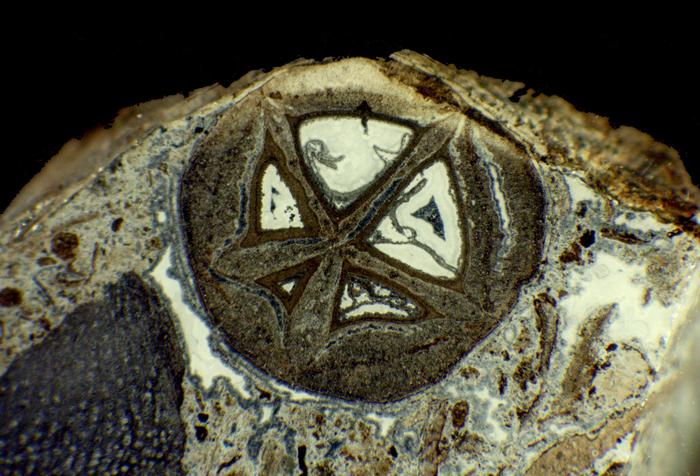
Early in the 1970s, a paleontologist working on the outskirts of an Indian village found small, bead-like fossils embedded in the gray chert dotting the surrounding fields. The site was notorious for turning up plant fossils that were difficult to identify, including the fruit of an extinct species resignedly given the name “Enigmocarpon.” The new fossils proved just as frustratingly intractable; more of them were discovered in India over the next several decades, but scientists had little luck deciding what type of plant they belonged to.
Now, researchers say they’ve solved the mystery. Using CT scanning technology, Steven Manchester, curator of paleobotany at the Florida Museum of Natural History, created 3D reconstructions of the original fossil specimens and others collected since. He showed these to a colleague, who noticed something odd about the five triangular seeds inside.
“When I showed him the 3D images, he said “those aren’t seeds. Those are pyrenes,” Manchester recalled of his conversation with courtesy curator of botany at the Florida Museum, Walter Judd.

Pyrenes are woody dispersal pods that give seeds an extra layer of protection. Examples include the hard stones at the cores of cherries, peaches, dates and pistachios, which prevent the seeds from being digested along with the rest of the fruit.
Distinguishing a seed from a pyrene, especially when they’re the size of snowflakes, requires close scrutiny. Traditional methods of paleobotany, which involve incrementally dissolving fossils in acid and observing each new layer under a microscope, had proven insufficient.
“If we had specimens that fractured at just the right plane, I would have been able to recognize them, but with the material we had on hand, I couldn’t tell,” Manchester said.
There are only a few plant groups that produce pyrenes, fewer still with fruits that contain five seeds arranged in a pentagram. Through a process of elimination, Manchester and Judd determined the fossils belonged to an extinct species in Burseraceae, the Frankincense family.
Fossilized wood, leaves, fruits and flowers from this family have been found elsewhere in India, often sandwiched between thick slabs of basalt created by one of the largest volcanic eruptions in Earth’s history.
At the time, India was an island off the southeast coast of Africa. India’s continental plate was slowly inching toward Europe and Asia, and as it rafted past Madagascar, it broke the seal on a thin layer of Earth’s crust. Rivers of liquid rock poured onto a landscape the size of California and Texas combined. The eruptions occurred intermittently for nearly a million years, and they repeatedly killed any vegetation that grew during the interludes.
“The fossils were preserved at times of quiet between the eruptions,” Manchester said. “Ponds and lakes formed on the relatively fresh lava flows, and vegetation, including wood and seeds, were washed into them and covered by sediment.”
The shield volcano responsible for the destruction was active just before and after the asteroid impact that drew the curtains on the Cretaceous, and both are thought to have contributed to the extinctions that followed.
Most fossils from the Frankincense family have, up until now, been recovered from rocks that postdate the asteroid impact. The original fruits discovered in the 1970s were fossilized before that event. This makes them the oldest Burseraceae fossils discovered to date, which has important implications for the family’s origin. Scientists have a good idea of when plants in the group initially evolved, but it’s still unclear where they came from.
Ancient species of Burseraceae are a common component of fossil beds in southern England, the Czech Republic and parts of North America. Beginning roughly 50 million years ago, however, Earth’s climate began a long cooling process that ultimately resulted in the most recent Ice Ages. As temperatures fell, species in the Frankincense family seemed to reverse their preference for hemispheres. Today, there are more than 700 Burseraceae species, and most of them grow south of the equator.
The ancestors of modern Burseraceae species are thought to have first appeared somewhere in the north. Alternatively, a few early species may have had a global distribution but became isolated as continents drifted apart.
The fossils from India suggest the southern hemisphere may have been the real birthplace of the family.
“It could be that we just don’t have rocks of the right age in Europe to indicate that they were there, but this shows that we can’t dismiss the southern hemisphere as a point of origin,” Manchester said.
IMAGE CREDIT: Steven Manchester
Sign up for the Daily Dose Newsletter and get the morning’s best science news from around the web delivered straight to your inbox? It’s easy like Sunday morning.

Leave a Reply