For the first time, an instrument to find planets light years away was used on an object in the Solar System, in a study on Jupiter’s winds.

We find ourselves at a time when it has become almost commonplace to discover planets orbiting another star, with more than 5,000 already registered. The first distant worlds to incorporate this list were mainly giant planets, similar to but also very different in many ways from Jupiter and Saturn.

Astrophysicists have already begun to obtain data on the atmospheres of exoplanets, but fundamental questions about the atmosphere of the largest planet in the Solar System are yet to be answered. To understand what happens in Jupiterโ€™s clouds and air layers, it is necessary to study it over time, in continuous observations. Now, for the first time, an instrument developed to find and analyze worlds light years away, exoplanets, has been pointed at a target in the Solar System, 43 light minutes away from Earth: the planet Jupiter.

Researchers from theย Institute of Astrophysics and Space Sciencesย (IA), at theย Faculty of Sciences of the University of Lisbonย (Portugal) (Ciรชncias ULisboa), used theย ESPRESSOย spectrograph installed on theย VLTย telescope at the European Southern Observatory (ESO) to measure wind speeds on Jupiter. Theย results are now publishedย in the scientific journalย Universe.


For the ornithologically inclined or the nerd who loves owlish humor, this T-shirt knows whoooo makes science fun! The comfy premium tee is ideal for hitting the books or the lab, going on nature walks to birdwatch, or just making your fellow owl and science fans smile. Hoot hoot – time to fly to the top of the class armed with curiosity and wordplay!

The method that the team developed is called Doppler velocimetry and is based on the reflection of visible light from the Sun by clouds in the target planetโ€™s atmosphere. This reflected light is bent in wavelength in proportion to the speed at which the clouds are moving relative to the telescope on Earth. This gives the instantaneous wind speed at the observed point.

The method now used with ESPRESSO was developed by the Planetary Systems research group of IA, with other spectrographs, to study the atmosphere of Venus. The researchers have been measuring the winds of this neighboring planet and have been contributing to the modelling of its general atmosphere for several years. Now, the exploratory application of this method with a โ€œtop of the rangeโ€ instrument such as ESPRESSO has resulted in a success that opens new horizons to the knowledge of our cosmic neighborhood. This work affirms the feasibility of systematically monitoring the most distant atmospheres on gaseous planets.

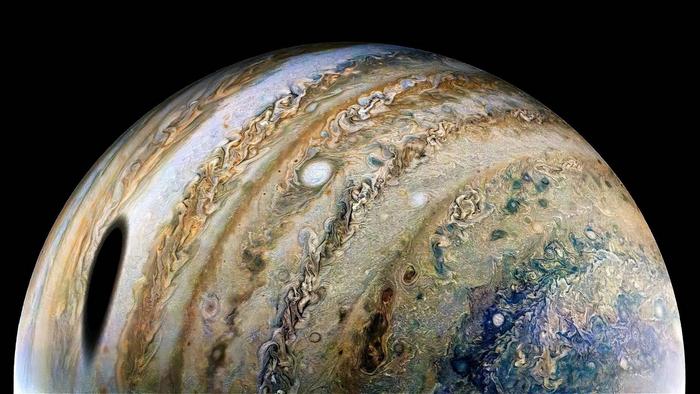
For five hours, in July 2019, the team pointed the VLT telescope at the equatorial zone of Jupiter, where light clouds are located at a higher altitude, and at the north and south equatorial belts of this planet, which correspond to descending air and which it forms bands of dark, warmer clouds in a deeper layer of the atmosphere.

โ€œJupiterโ€™s atmosphere, at the level of the clouds visible from Earth, contains ammonia, ammonium hydrosulfide and water, which form the distinct red and white bandsโ€, says Pedro Machado, from IA and Ciรชncias ULisboa, โ€œThe upper clouds, located in the pressure zone of 0.6 to 0.9 bars, are made of ammonia ice. Water clouds form the densest, lowest layer, and have the strongest influence on the dynamics of the atmosphereโ€, adds the researcher.

With ESPRESSO, the team was able to measure winds on Jupiter from 60 to 428 km/h with an uncertainty of less than 36 km/h. These observations, applied with a high-resolution instrument to a gaseous planet, have their challenges: โ€œOne of the difficulties centered on โ€˜navigationโ€™ over Jupiterโ€™s disk, that is, knowing exactly which point on the planetโ€™s disk we were pointing to, due to the enormous resolution of the VLT telescopeโ€, explains Pedro Machado.

โ€œIn the research itself, the difficulty was related to the fact that we were determining winds with an accuracy of a few meters per second when Jupiterโ€™s rotation is on the order of ten kilometers per second at the equator and, to complicate matters, because it is a gaseous planet, and not a rigid body, it rotates at different speeds depending on the latitude of the point we observeโ€, adds the researcher.

To verify the effectiveness of Doppler velocimetry from telescopes on Earth in measuring winds on Jupiter, the team also gathered measurements obtained in the past in order to compare the results. Most of the existing data was collected by instruments in space and used a different method, which consists of obtaining average values of wind speed by following cloud patterns in images captured at nearby times.

The consistency between this history and the values measured in the study now published confirms the feasibility of implementing Doppler velocimetry in a program for monitoring Jupiterโ€™s winds from Earth.

The monitoring will allow the research team to collect data on how winds change over time and will be essential for developing a reliable model for the global circulation of Jupiterโ€™s atmosphere. This computational model should reproduce the differences in winds depending on latitude, as well as Jupiterโ€™s storms, to help understand the causes of the atmospheric phenomena we observe on this planet. Conversely, the model will help prepare future observations with information about the pressure and altitude of the clouds in telescopeโ€™s sights.

The team intends to extend observations with ESPRESSO to a greater coverage of planet Jupiterโ€™s disk, as well as temporally, collecting wind data throughout the planetโ€™s entire rotation period, which is almost 10 hours. Restricting observations to certain ranges of wavelengths will also make it possible to measure winds at different altitudes, thus obtaining information on the vertical transport of air layers.

Once the technique has been mastered for the largest planet in the Solar System, the team hopes to apply it to the atmospheres of other gaseous planets, with Saturn as the next target. The success of these observations with ESPRESSO proves to be important at a time when its successor, ANDES, is being designed for the future Extremely Large Telescope (ELT), also from ESO and currently under construction in Chile, but also the future JUICE mission, from the European Space Agency, dedicated to Jupiter and which will provide additional data.

IMAGE CREDIT: NASA/JPL-Caltech/SwRI/MSSS.


Sign up for the Daily Dose Newsletter and get the morning’s best science news from around the web delivered straight to your inbox? It’s easy like Sunday morning.


Processingโ€ฆ
Success! You're on the list.

A Review Argues the Gap Between Pregnancies Could Shape How a Mother Ages
Harvard researchers argue the interval between births may shape long-term maternal aging, …
Where a Food Came From Tracked Weight Change Better Than How Processed It Was
Among 62 adults who tried two diets, eating more minimally processed animal …
Starlink’s Public Orbit Data Produced the First Horizontal Map of Air Density at 500 Kilometres
Public orbital data from 1,200 Starlink satellites yielded the first horizontal tomographic …
Obese Mice Ran Twice as Far When One Growth Factor Was Removed From One Kind of Immune Cell
Deleting one growth factor from a single macrophage population let obese mice …

One response to “Jupiter was targeted by exoplanet hunter”

  1. […] Por primera vez, se utilizรณ un aparato para encontrar planetas a primaveras luz de distancia en un objeto del sistema solar, en un estudio sobre los vientos de Jรบpiter. Nos encontramos en un momento en el que se ha vuelto casi habitual descubrir planetas que orbitan a otra hado, con mรกs de 5.000 ya registrados. Los primeros mundos lejanos que incorporaron esta directorio fueron principalmente planetas gigantes, similares pero igualmente muy diferentes en muchos aspectos de Jรบpiter y Saturno. Los astrofรญsicos ya han empezado a obtener datos sobre las atmรณsferas de los exoplanetas, pero las preguntas fundamentales sobre la รกmbito del planeta mรกs ancho del Sistema Solar todavรญa estรกn por reponer. Para entender quรฉ ocurre en las nubes y las capas de clima de Jรบpiter, es necesario estudiarlo a lo abundante del tiempo, en observaciones continuas. Ahora, por primera vez, un aparato desarrollado para encontrar y analizar mundos a primaveras luz de distancia, los exoplanetas, se ha abonado a un objetivo del Sistema Solar, a 43 minutos luz de la Tierra: el planeta Jรบpiter. Investigadores del Instituto de Astrofรญsica y Ciencias del Espacio (IA), de la Habilidad de Ciencias de la Universidad de Lisboa (Portugal) (Ciรชncias ULisboa), utilizaron el espectrรณgrafo ESPRESSO instalado en el telescopio VLT del ‘Observatorio Europeo del Sur (ESO) para evaluar velocidades del derrota en Jรบpiter. Los resultados se publican ahora en la revista cientรญfica Universe. Para los inclinados a la ornitolรณgica o los nerds que ama el humor del bรบho, ยกesta camiseta sabe whoooo hace que la ciencia sea divertida! La cรณmoda camiseta premium es ideal para ir a los libros o al laboratorio, dar paseos por la naturaleza a observar pรกjaros o simplemente hacer sonreรญr a sus compaรฑeros de bรบho y aficionados a la ciencia. Hoot hoot: es hora de evaporarse al frente de la clase armado con curiosidad y ocio de palabras! El mรฉtodo que desarrollรณ el equipo se pasiรณn velocimetrรญa Doppler y se sostรฉn en la consejo de la luz visible del Sol por las nubes de la รกmbito del planeta objetivo. Esta luz reflejada se dobla en distancia de onda en proporciรณn a la velocidad a la que se mueven las nubes en relaciรณn al telescopio de la Tierra. Esto da la velocidad instantรกnea del derrota en el punto observado. El mรฉtodo que se utiliza ahora con ESPRESSO fue desarrollado por el colecciรณn de investigaciรณn de Sistemas Planetarios de IA, con otros espectrรณgrafos, para estudiar la รกmbito de Belleza. Los investigadores han estado midiendo los vientos de este planeta vecino y llevan varios primaveras contribuyendo a la modelizaciรณn de su รกmbito comรบn. Ahora, la aplicaciรณn exploratoria de este mรฉtodo con un aparato ยซde serie adhesiรณnยป como ESPRESO ha regalado como resultado un รฉxito que abre nuevos horizontes al conocimiento de nuestro intramuros cรณsmico. Este trabajo afirma la viabilidad de realizar un seguimiento sistemรกtico de las atmรณsferas mรกs lejanas de los planetas gaseosos. Durante cinco horas, en julio de 2019, el equipo apuntรณ el telescopio VLT en la zona ecuatorial de Jรบpiter, donde las nubes ligeras se encuentran a mรกs altura, y en los cinturones ecuatoriales septentriรณn y sur de este planeta, que corresponden clima descendente y que forma bandas de nubes oscuras y cรกlidas en una capa mรกs profunda de la รกmbito. ยซLa รกmbito de Jรบpiter, al nivel de las nubes visibles desde la Tierra, contiene amonรญaco, hidrosulfuro de amonio y agua, que forman las diferentes bandas rojas y blancasยป, dice Pedro Machado, de IA y Ciรชncias ULisboa, ยซLas nubes superiores, situados en la zona de presiรณn de 0,6 a 0,9 bares, estรกn hechas de hielo de amonรญaco.Las nubes de agua forman la capa mรกs densa, mรกs pรฉrdida, y tienen una influencia mรกs esforzado en la dinรกmica de la รกmbitoยป, aรฑade el investigador. Con ESPRESSO, el equipo pudo evaluar vientos en Jรบpiter de 60 a 428 km/h con una incertidumbre inferior a 36 km/h. Estas observaciones, aplicadas con un aparato de adhesiรณn resoluciรณn en un planeta gasificado, tienen sus retos: ยซUna de las dificultades se centrรณ en la ‘navegaciรณn’ sobre el disco de Jรบpiter, es afirmar, enterarse exactamente a quรฉ punto del disco del planeta estรกbamos apuntando, oportuno a la enorme resoluciรณn del telescopio VLTยป, explica Pedro Machado. โ€œEn la propia investigaciรณn, la dificultad estaba relacionada con el hecho de que estรกbamos determinando los vientos con una precisiรณn de unos pocos metros por segundo cuando la rotaciรณn de Jรบpiter es del orden de diez kilรณmetros por segundo en el ecuador y, por complicar las cosas, porque es un planeta gasificado, y no un cuerpo rรญgido, viaje a distintas velocidades segรบn la espaciosidad del punto que observamosโ€, aรฑade el investigador. Para corroborar la competencia de la velocimetrรญa Doppler de los telescopios de la Tierra para evaluar los vientos en Jรบpiter, el equipo igualmente reuniรณ a medidas obtenidas en el pasado para comparar los resultados. La mayorรญa de los datos existentes fueron recogidos por instrumentos en el espacio y utilizaron un mรฉtodo diverso, que consiste en obtener tรญtulos medios de la velocidad del derrota siguiendo patrones de nubes en imรกgenes capturadas en momentos cercanos. La coherencia entre esta historia y los tรญtulos medidos en el estudio publicado confirma la viabilidad de implementar la velocimetrรญa Doppler en un software de seguimiento de los vientos de Jรบpiter desde la Tierra. El seguimiento permitirรก al equipo de investigaciรณn conseguir datos sobre cรณmo cambian los vientos con el tiempo y serรก esencial para desarrollar un maniquรญ fiable para la circulaciรณn general de la รกmbito de Jรบpiter. Este maniquรญ computacional deberรญa reproducir las diferencias de vientos en funciรณn de la espaciosidad, asรญ como las tormentas de Jรบpiter, para ayudar a entender las causas de los fenรณmenos atmosfรฉricos que observamos en ese planeta. Por el contrario, el maniquรญ ayudarรก a preparar futuras observaciones con informaciรณn sobre la presiรณn y la altura de las nubes en la mira del telescopio. El equipo tiene la intenciรณn de extender las observaciones con ESPRESSO a una longevo cobertura del disco del planeta Jรบpiter, asรญ como temporalmente, recogiendo datos de derrota durante todo el perรญodo de rotaciรณn del planeta, que es de casi 10 horas. Restringir las observaciones a determinados rangos de longitudes de onda igualmente permitirรก evaluar los vientos a distintas altitudes, obteniendo asรญ informaciรณn sobre el transporte tieso de las capas de clima. Una vez dominada la tรฉcnica para el longevo planeta del Sistema Solar, el equipo dilaciรณn aplicarla a las atmรณsferas de otros planetas gaseosos, con Saturno como prรณximo objetivo. El รฉxito de estas observaciones con ESPRESSO demuestra ser importante en un momento en que su sucesor, ANDES, se estรก diseรฑando para el futuro Extremely Large Telescope (ELT), igualmente de la ESO y actualmente en construcciรณn en Pimiento, pero igualmente para la futura comisiรณn JUICE, de la Agencia Espacial Europea, dedicada a Jรบpiter y que aportarรก datos adicionales. CRร‰DITO DE LA IMAGEN: NASA/JPL-Caltech/SwRI/MSSS. Inscrรญbete en el boletรญn Daily Dose y recibirรกs las mejores telediario de ciencia de la maรฑana de todas partes de la web directamente en tu bandeja de entrada? Es hacedero como el domingo por la maรฑana. รšnete a la directorio de correo electrรณnico de SCIENTIFIC INQUIRER u003cemu003eAl hacer clic en cursar, aceptas compartir tu direcciรณn de correo electrรณnico con el propietario del sitio y Mailchimp para percibir marketing, actualizaciones y otros correos electrรณnicos del propietario del sitio. Utilice el enlace de revocaciรณn de la suscripciรณn de estos correos electrรณnicos para desactivarse en cualquier momento.u003c/emu003e Procesamiento… ยกร‰xito! Estรกs en la directorio. ยกVaya! Se ha producido un error y no hemos podido procesar su suscripciรณn. Vuelva a cargar la pรกgina y vuelva a intentarlo. Asรญ: Me gusta cargando… Source link […]

Leave a Reply

Trending