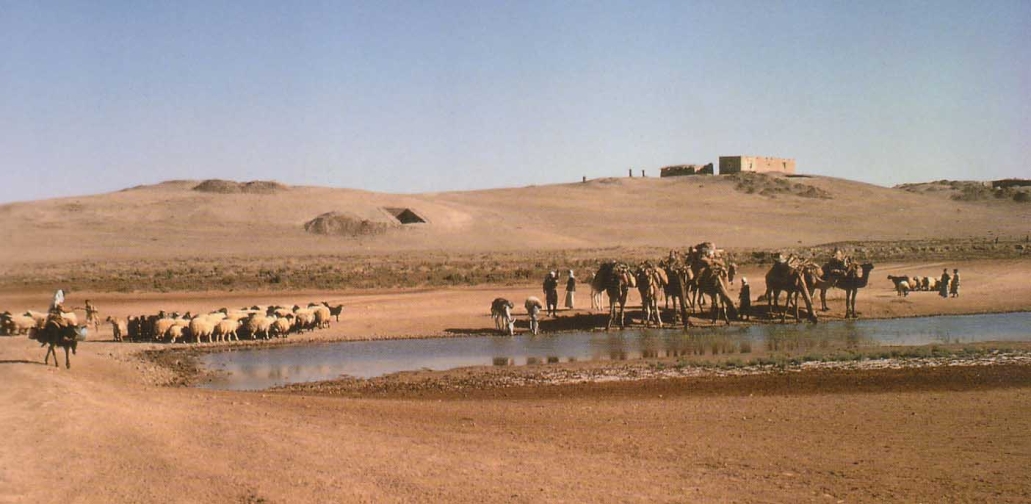
Agriculture in Syria started with a bang 12,800 years ago as a fragmented comet slammed into the Earth’s atmosphere. The explosion and subsequent environmental changes forced hunter-gatherers in the prehistoric settlement of Abu Hureyra to adopt agricultural practices to boost their chances for survival.
That’s the assertion made by an international group of scientists in one of four related research papers, all appearing in the journal Science Open: Airbursts and Cratering Impacts. The papers are the latest results in the investigation of the Younger Dryas Impact Hypothesis, the idea that an anomalous cooling of the Earth almost 13 millennia ago was the result of a cosmic impact.

“In this general region, there was a change from more humid conditions that were forested and with diverse sources of food for hunter-gatherers, to drier, cooler conditions when they could no longer subsist only as hunter-gatherers,” said Earth scientist James Kennett, a professor emeritus of UC Santa Barbara . The settlement at Abu Hureyra is famous among archaeologists for its evidence of the earliest known transition from foraging to farming. “The villagers started to cultivate barley, wheat and legumes,” he noted. “This is what the evidence clearly shows.”
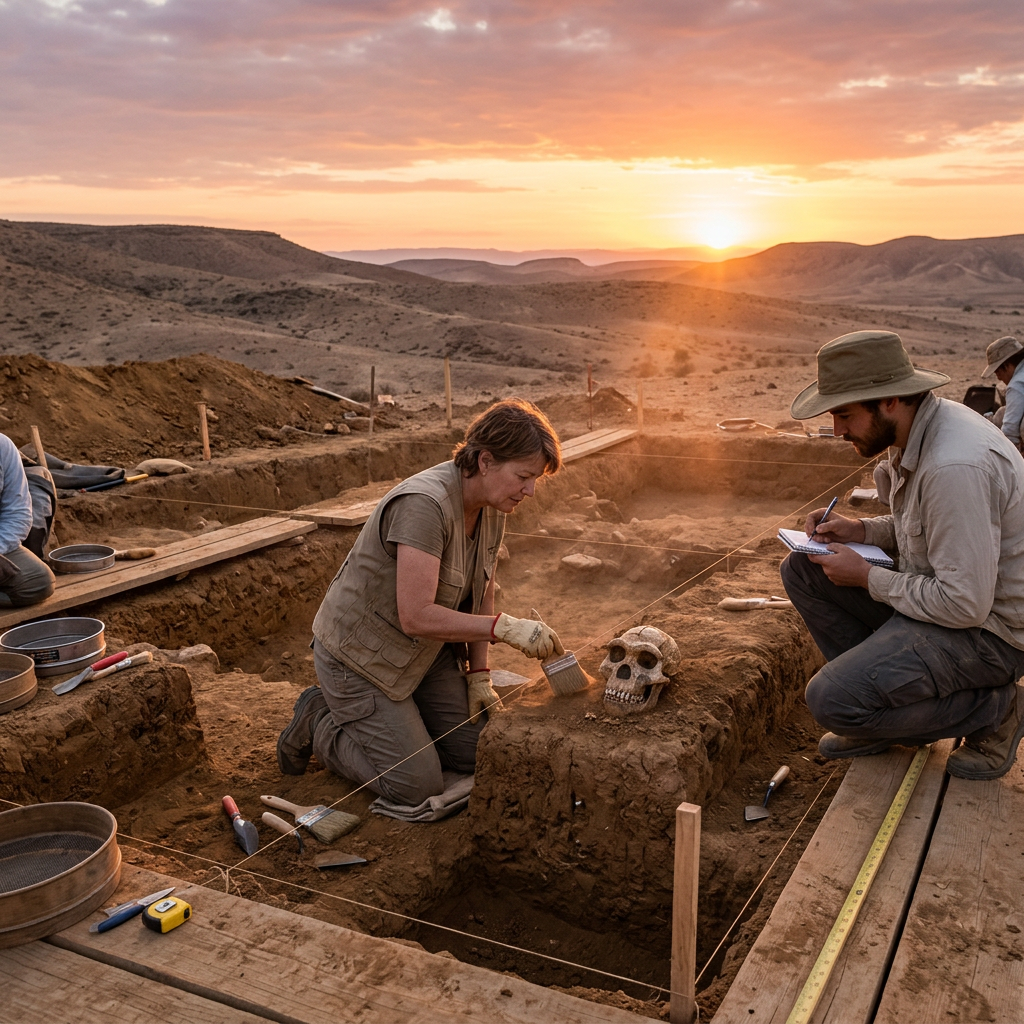
These days, Abu Hureyra and its rich archaeological record lie under Lake Assad, a reservoir created by construction of the Taqba Dam on the Euphrates River in the 1970s. But before this flood, archaeologists managed to extract loads of material to study. “The village occupants,” the researchers state in the paper, “left an abundant and continuous record of seeds, legumes and other foods.” By studying these layers of remains, the scientists were able to discern the types of plants that were being collected in the warmer, humid days before the climate changed and in the cooler, drier days after the onset of what we know now as the Younger Dryas cool period.
Sign up for the Daily Dose Newsletter and get every morning’s best science news from around the web delivered straight to your inbox? It’s easy like Sunday morning.
Before the impact, the researchers found, the inhabitants’ prehistoric diet involved wild legumes and wild-type grains, and “small but significant amounts of wild fruits and berries.” In the layers corresponding to the time after cooling, fruits and berries disappeared and their diet shifted toward more domestic-type grains and lentils, as the people experimented with early cultivation methods. By about 1,000 years later, all of the Neolithic “founder crops” — emmer wheat, einkorn wheat, hulled barley, rye, peas, lentils, bitter vetch, chickpeas and flax — were being cultivated in what is now called the Fertile Crescent. Drought-resistant plants, both edible and inedible, become more prominent in the record as well, reflecting a drier climate that followed the sudden impact winter at the onset of the Younger Dryas.
The evidence also indicates a significant drop in the area’s population, and changes in the settlement’s architecture to reflect a more agrarian lifestyle, including the initial penning of livestock and other markers of animal domestication.
To be clear, Kennett said, agriculture eventually arose in several places on Earth in the Neolithic Era, but it arose first in the Levant (present-day Syria, Jordan, Lebanon, Palestine, Israel and parts of Turkey) initiated by the severe climate conditions that followed the impact.
And what an impact it must have been.
In the 12,800-year-old layers corresponding to the shift between hunting and gathering and agriculture, the record at Abu Hureyra shows evidence of massive burning. The evidence includes a carbon-rich “black mat” layer with high concentrations of platinum, nanodiamonds and tiny metallic spherules that could only have been formed under extremely high temperatures — higher than any that could have been produced by man’s technology at the time. The airburst flattened trees and straw huts, splashing meltglass onto cereals and grains, as well as on the early buildings, tools and animal bones found in the mound — and most likely on people, too.
This event is not the only such evidence of a cosmic airburst on a human settlement. The authors previously reported a smaller but similar event which destroyed the biblical city at Tall el-Hammam in the Jordan Valley about 1600 BCE.
The black mat layer, nanodiamonds and melted minerals have also been found at about 50 other sites across North and South America and Europe, the collection of which has been called the Younger Dryas strewnfield. According to the researchers, it’s evidence of a widespread simultaneous destructive event, consistent with a fragmented comet that slammed into the Earth’s atmosphere. The explosions, fires and subsequent impact winter, they say, caused the extinction of most large animals, including the mammoths, saber-toothed cats, American horses, and American camels, as well as the collapse of the North American Clovis culture.
Because the impact appears to have produced an aerial explosion there is no evidence of craters in the ground. “But a crater is not required,” Kennett said. “Many accepted impacts have no visible crater.” The scientists continue to compile evidence of relatively lower-pressure cosmic explosions — the kind that occur when the shockwave originates in the air and travels downward to the Earth’s surface.
“Shocked quartz is well known and is probably the most robust proxy for a cosmic impact,” he continued. Only forces on par with cosmic-level explosions could have produced the microscopic deformations within quartz sand grains at the time of the impacts, and these deformations have been found in abundance in the minerals gathered from impact craters.
This “crème de la crème” of cosmic impact evidence has also been identified at Abu Hureyra and at other Younger Dryas Boundary (YDB) sites, despite an absence of craters. However, it has been argued that the kind of shock-fractured quartz found in the YDB sites is not equivalent to that found in the large crater-forming sites, so the researchers worked to link these deformations to lower-pressure cosmic events.
To do so, they turned to manmade explosions of the magnitude of cosmic airbursts: nuclear tests conducted at the Alamogordo Bombing Range in New Mexico in 1945 and in Kazakhstan, in 1949 and 1953. Similar to cosmic airbursts, the nuclear explosions occurred above ground, sending shockwaves toward Earth.
“In the papers, we characterize what the morphologies are of these shock fractures in these lower-pressure events,” Kennett said. “And we did this because we wanted to compare it with what we have in the shock-fractured quartz in the Younger Dryas Boundary, to see if there was any comparison or similarities between what we see at the Trinity atomic test site and other atomic bomb explosions.” Between the shocked quartz at the nuclear test sites and the quartz found at Abu Hureyra, the scientists found close associations in their characteristics, namely glass-filled shock fractures, indicative of temperatures greater than 2,000 degrees Celsius, above the melting point of quartz.
“For the first time, we propose that shock metamorphism in quartz grains exposed to an atomic detonation is essentially the same as during a low-altitude, lower-pressure cosmic airburst,” Kennett said. However, the so-called “lower pressure” is still very high — probably greater than 3 GPa or about 400,000 pounds per square inch, equivalent to about five 737 airplanes stacked on a small coin. The novel protocol the researchers developed for identifying shock fractures in quartz grains will be useful in identifying previously unknown airbursts that are estimated to recur every few centuries to millennia.
Taken together, the evidence presented by these papers, according to the scientists, “implies a novel causative link among extraterrestrial impacts, hemispheric environmental and climatic change, and transformative shifts in human societies and culture, including agricultural development.”
IMAGE CREDIT: A.M.T Moore, usable under Creative Commons, CC by 4.0
If you enjoy the content we create and would like to support us, please consider becoming a patron on Patreon! By joining our community, you’ll gain access to exclusive perks such as early access to our latest content, behind-the-scenes updates, and the ability to submit questions and suggest topics for us to cover. Your support will enable us to continue creating high-quality content and reach a wider audience.
Join us on Patreon today and let’s work together to create more amazing content! https://www.patreon.com/ScientificInquirer
Leave a Reply