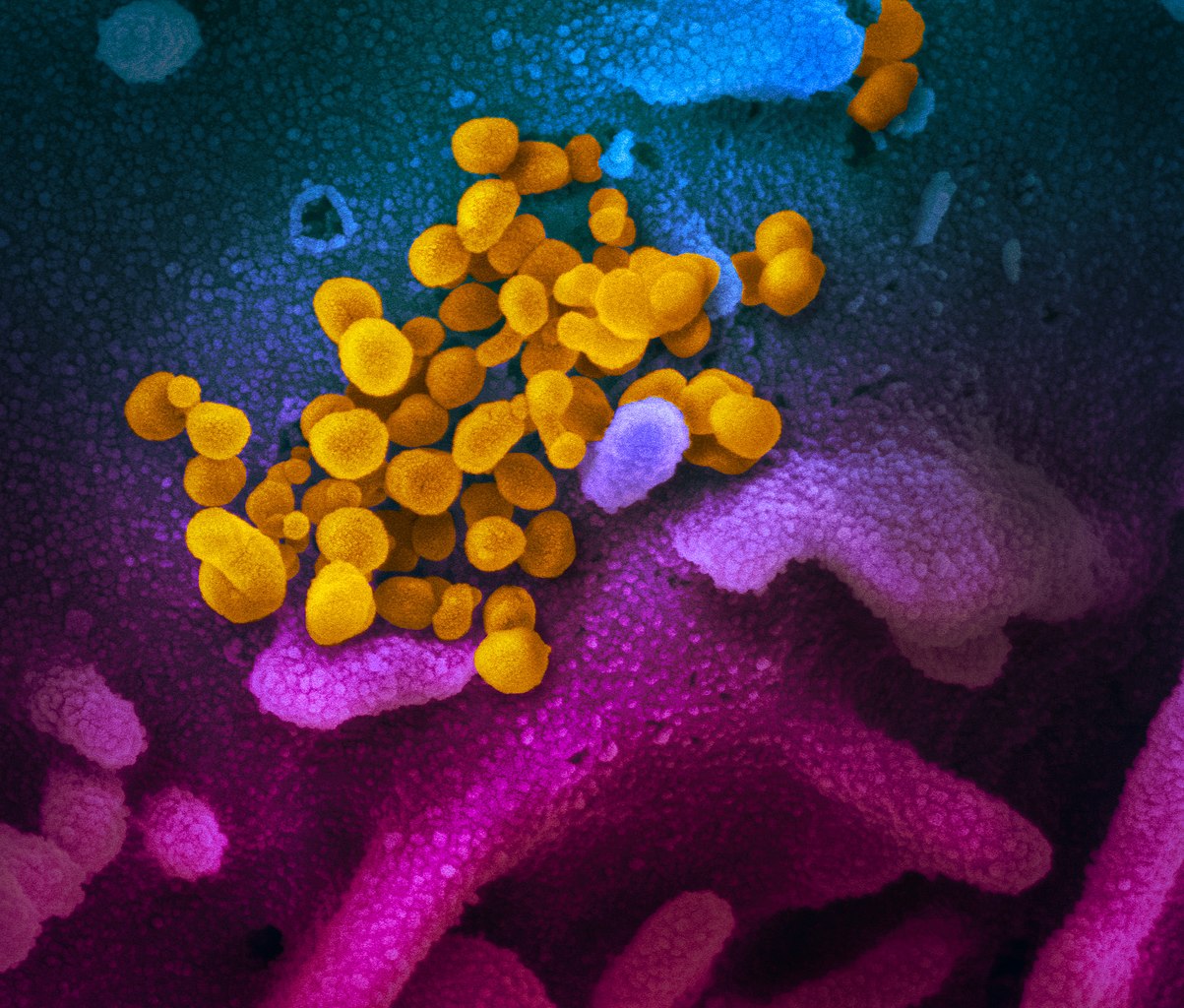
NU VARIANT OF SARS-COV-2 EMERGES.
Just when the world seems to be creeping closer to a state roughly resembling normalcy, a new variant of Sars-CoV-2, the coronavirus responsible for Covid-19, rears its ugly, spikey head. This one has caused considerable concern even at this early stage. Per Nature, “Researchers in South Africa are racing to track the concerning rise of a new variant of the coronavirus that causes COVID-19. The variant harbours a large number of mutations found in other variants, including Delta, and it seems to be spreading quickly across South Africa. A top priority is to follow the variant more closely as it spreads: it was first identified in Botswana this month and has turned up in travellers to Hong Kong from South Africa. Scientists are also trying to understand the variant’s properties, such as whether it can evade immune responses triggered by vaccines and whether it causes more or less severe disease than other variants do.” Dubbed “Nu” by the World Health Organization, the strain contains more than 30 changes to the spike protein which is essential for the coronavirus to recognize host cells. It is the main target of the body’s immune responses. Many of the changes are linked to heightened infectivity and the ability to evade infection-blocking antibodies. https://go.nature.com/3D2vVGM
NU VARIANT SHAKES FINANCIAL MARKETS.
By now, it has become obvious that it is impossible to separate the pandemic from other non-public health sectors of society. It has severely damaged economies around the world. The announcement of the Nu variant has sent global markets into a nose-dive. Per the Associated Press, “The new variant immediately stoked fears of more pandemic-related economic turmoil. ‘Investors are likely to shoot first and ask questions later until more is known,’ said Jeffrey Halley of foreign exchange broker Oanda. Oil prices plunged, with U.S. crude off 6.7% at $73.22 per barrel and the international Brent benchmark off 5.6% at $77.64, both unusually large moves for a single day. During the initial outbreak of the pandemic in 2020, oil prices plunged because travel restrictions reduced demand for fuel. Airlines shares were hammered, with Lufthansa off 12.4%, IAG, parent of British Airways and Iberia, off 14.4%, Air France-KLM down 8.9% and easyJet falling 10.9%.” https://bit.ly/3D2vQTu
MORE BAD NEWS ON THE COVID-19 FRONT.
Adding to an already rough day, Merck announced that its Covid-19 antiviral drug is less effective than initially believed. Per STAT, ‘New data, in addition to analyses by scientists at the Food and Drug Administration, may take some of the shine off Merck’s experimental Covid pill, molnupiravir. On Friday, the drug maker released full results from its study of the pill, molnupiravir, showing it reduced the risk of hospitalization by 30%, down from a decrease of 50% seen in an earlier analysis. In the 1,433-patient study, fewer patients died when they received the treatment. There were nine deaths in the placebo group in the final analysis, and one in the molnupiravir group.’ While something is better than nothing, the 20% drop in efficacy is enough to give pause. https://bit.ly/3cREM3h
HUMANS INCREASED CARIBBEAN SHARK POPULATION DECLINES.
Hollywood loves to demonize and fetishize sharks. Thanks to Steven Spielberg, they have become the ultimate ocean baddie, especially the Great White. The ironic thing is, human beings have been far more guilty of killing sharks than vice versa. A recent study in the Proceedings of the National Academy of Sciences investigated the role humans have played in the decline of shark populations around Carribean coral reefs. Per the PNAS, “We recovered shark dermal denticles from mid-Holocene (∼7 ky ago) and modern reef sediments in Bocas del Toro, Caribbean Panama, to reconstruct an empirical shark baseline before major human impact and to quantify how much the modern shark community in the region had shifted from this historical reference point. We found that denticle accumulation rates, a proxy for shark abundance, declined by 71% since the mid-Holocene. All denticle morphotypes, which reflect shark community composition, experienced significant losses, but those morphotypes found on fast-swimming, pelagic sharks (e.g., families Carcharhinidae and Sphyrnidae) declined the most. An analysis of historical records suggested that the steepest decline in shark abundance occurred in the late 20th century, coinciding with the advent of a targeted shark fishery in Panama.” But those scary looking sharks are the bad guys, right? https://bit.ly/3lbEwAA
IMAGE CREDIT: NIAID.



Leave a Reply