Researchers from the University of Leiden and Eindhoven University of Technology in the Netherlands propose that the first clear example of widespread cultural diffusion in human evolution occurred around 400,000 years ago. They propose this on the basis of changes in the archaeological record of fire use. The earliest evidence for possible fire use is sparse and can be difficult to distinguish from natural fire residues. By contrast, after 400,000 years ago, multiple different types of fire evidence are found in many sites with good preservation conditions. Interestingly, this occurs at a geologically similar time over major parts of the Old World, in Africa as well as in western Eurasia, and in different populations of hominins.
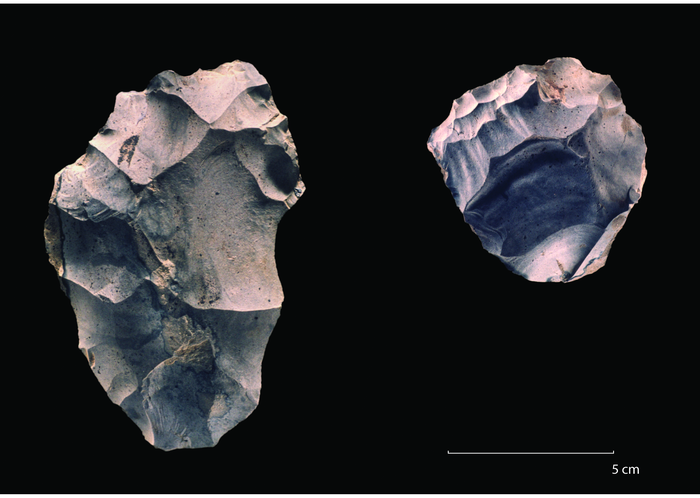
Wide distribution of a cultural behaviour could be explained in a number of ways: by independent invention in multiple places, movement of populations, or transmission of genes associated with the behaviour. Particularly given the absence of widespread environmental change, rapidity of spread, and lack of genetic or fossil evidence for movements of hominin populations in this period, the authors argue that cultural diffusion is most plausible. This interpretation is supported by the slightly later spread, over the same region and in an even more constrained time period, of a relatively complicated method for making stone tools, called the Levallois technique. This adds to current research suggesting that hominin populations were exchanging genes and that there were cultural interactions too.
Interaction with fire was key in human cultural evolution, and is a focus for research and teaching in the Human Origins Group in the Faculty of Archaeology. When Eva van Veen started her RMA with the group, it struck her that the social structures and social behaviours surrounding early fire use had not been discussed in detail. According to Eva, ‘Given how important sociality is to hominin lives, questions about the social structures surrounding early fire use are essential to understanding the full implications of widespread fire use.’ In her thesis she looked at what it takes to organise a group of people to gather the raw materials for a fire and keep it going. The discussions of her thesis stimulated Eva and a number of colleagues to think about the larger scale social tolerance and social networks involved in the spread of fire skills.
Copying of stone tool technology occurred early in human evolution, and there are indications of the smaller-scale spread of technology likely involving both diffusion and population movement, for example in the record of Acheulean handaxe technology. But around 400,000 years ago, cultural diffusion really took off. This precedes by a long time the cultural florescence associated with late Neandertals and early Homo sapiens. Our research should stimulate debate and new studies, particularly addressing the changes in cultural mechanisms for transmission that allowed this remarkably fast diffusion of fire and stone tool technology.
IMAGE CREDIT: Leiden University



Leave a Reply