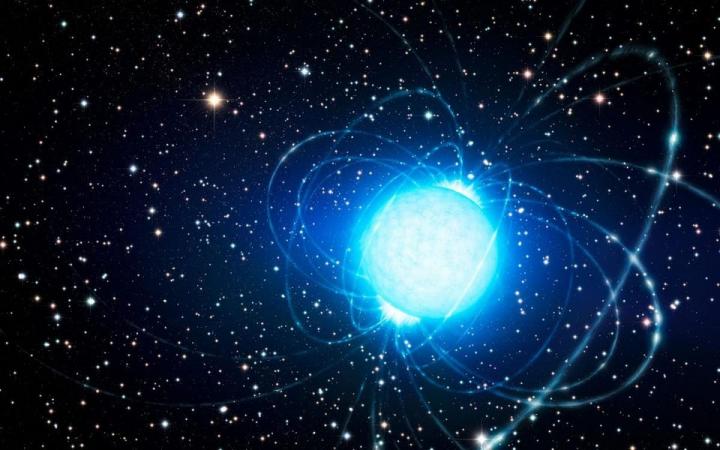
New models of neutron stars show that their tallest mountains may be only fractions of millimetres high, due to the huge gravity on the ultra-dense objects. The research is presented today at the National Astronomy Meeting 2021.
Neutron stars are some of the densest objects in the Universe: they weigh about as much as the Sun, yet measure only around 10km across, similar in size to a large city.
Because of their compactness, neutron stars have an enormous gravitational pull around a billion times stronger than the Earth. This squashes every feature on the surface to miniscule dimensions, and means that the stellar remnant is an almost perfect sphere.
Whilst they are billions of times smaller than on Earth, these deformations from a perfect sphere are nevertheless known as mountains. The team behind the work, led by PhD student Fabian Gittins at the University of Southampton, used computational modelling to build realistic neutron stars and subject them to a range of mathematical forces to identify how the mountains are created.
The team also studied the role of the ultra-dense nuclear matter in supporting the mountains, and found that the largest mountains produced were only a fraction of a millimetre tall, one hundred times smaller than previous estimates.
Fabian comments, “For the past two decades, there has been much interest in understanding how large these mountains can be before the crust of the neutron star breaks, and the mountain can no longer be supported.”
Past work has suggested that neutron stars can sustain deviations from a perfect sphere of up to a few parts in one million, implying the mountains could be as large as a few centimetres. These calculations assumed the neutron star was strained in such a way that the crust was close to breaking at every point. However the new models indicate that such conditions are not physically realistic.
Fabian adds: “These results show how neutron stars truly are remarkably spherical objects. Additionally, they suggest that observing gravitational waves from rotating neutron stars may be even more challenging than previously thought.”
Although they are single objects, due to their intense gravitation, spinning neutron stars with slight deformations should produce ripples in the fabric of spacetime known as gravitational waves. Gravitational waves from rotations of single neutron stars have yet to be observed, although future advances in extremely sensitive detectors such as advanced LIGO and Virgo may hold the key to probing these unique objects.
IMAGE CREDIT: ESO / L. Calçada




Leave a Reply