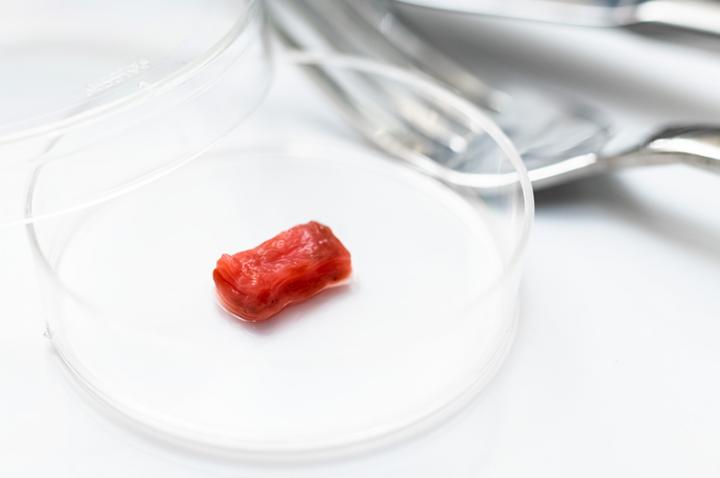
Humans are largely omnivores, and meat in various forms has always featured in the diet of most cultures. However, with the increasing population and pressure on the environment, traditional methods of meeting this fundamental food requirement are likely to fall short. Now, researchers at the University of Tokyo report innovative biofabrication of bovine muscle tissue in the laboratory that may help meet escalating future demands for dietary meat.
With global urbanization, the economics of animal husbandry are becoming unsustainable. From an environmental viewpoint, the land and water costs of modern mega-scale livestock farming are untenable, as are the greenhouse gas emissions and the overall toll on the planet. Additionally, ethical concerns against inhuman exploitation of lower species for food are increasingly being voiced.
To address future requirements, tissue engineering of cultured meat is under development at several centers worldwide. However, most biosynthetic meat products are amorphous or granular-like minced meat, lacking the grain and texture of real animal flesh. Mai Furuhashi, lead author, explains their novel process. “Using techniques developed for regenerative medicine, we succeeded in culturing millimeter-sized chunks of meat wherein alignment of the myotubes help mimic the texture and mouthfeel of steak. For this, myoblasts drawn from commercial beef were cultured in hydrogel modules that could be stacked allowing fusion into larger chunks. We determined the optimal scaffolding and electrical stimulation to promote contractility and anatomical alignment of the muscle tissue to best simulate steak meat.”
Lead author, Yuya Morimoto, describes the synthesized product. “Our morphological, functional and food feature analyses showed that the cultured muscle tissue holds promise as a credible steak substitute. Breaking force measurements showed that toughness approached that of natural beef over time. Significantly, microbial contamination was undetectable; this has implications for cleanliness, consumer acceptability and shelf-life.”
“Our method paves the way for further development of larger portions of realistic cultured meat that can supplement or replace animal sources,” claims Shoji Takeuchi, senior and corresponding author. “However, there is a long way to go before lab-grown meat is indistinguishable from the real thing and hurdles concerning consumer acceptance and cultural sensibilities are overcome. Nevertheless, this innovation promises to be a green and ethical alternative to animal slaughter in meeting our need for dietary meat.”
IMAGE CREDIT: Institute of Industrial Science, the University of Tokyo



Leave a Reply