Sediment drilled from beneath a Cold War military base in the 1960s, lost and rediscovered in a freezer, yields the first quantitative estimate of Greenland summer temperatures during a warm period 416,000 years ago.
Camp Century was a United States military base built into the Greenland Ice Sheet in 1959, part of a scheme called Project Iceworm. The project failed. But before it was abandoned, engineers drilled nearly a mile down through the ice and pulled up a core of the sediment underneath.
That sediment has now produced a finding with implications for the future of the ice sheet. Writing in Climate of the Past, researchers at the University at Buffalo report that the site was ice-free about 416,000 years ago, when summers in the region were 4.7 °C, or 8.5 °F, warmer than today.
“It’s striking that a period of moderately warmer temperatures coincided with such a substantial retreat of the ice sheet,” said John Michael Aguilar, a postdoctoral fellow at UB’s RENEW Institute and the study’s first author.
Sixty miles of retreat
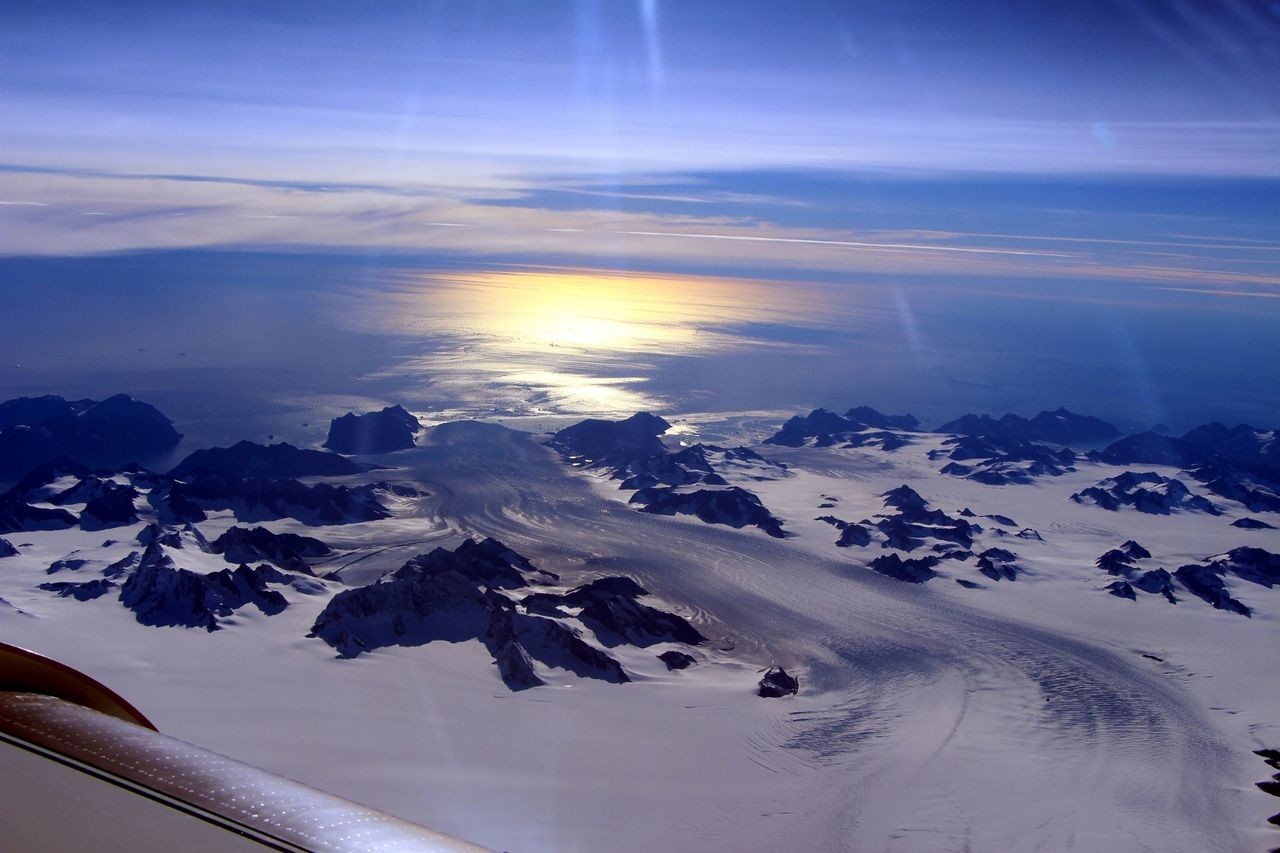
For Camp Century to have been free of ice, the margin of the Greenland Ice Sheet in that region must have retreated more than 60 miles from where it stands today. The site is in northwestern Greenland, well inside the modern ice sheet.
The researchers believe this is the first quantitative estimate of land-based summer temperatures anywhere in Greenland during this warm interval, known to geologists as Marine Isotope Stage 11. Such estimates are rare because later advances of the ice sheet scraped away most of the sediment from that time. The Camp Century core survived because it sat beneath ice rather than at a margin where it would have been eroded.
Marine Isotope Stage 11 has long interested climate scientists as a possible analogue for the present. It was an unusually long interglacial, the warm interval between ice ages, and sea level then is generally estimated to have stood several metres above today’s, which implies substantial loss of polar ice. Pinning down where that water came from has been the difficulty.
Temperatures from bacterial fats
The temperature estimate comes from molecules left behind by bacteria. Certain bacteria build fatty molecules into their cell membranes, and the particular types and proportions they produce depend on the temperature of their surroundings.
“The types and proportions of these molecules change depending on the temperature,” Aguilar said. “By comparing them with similar molecules found in modern Arctic lakes, we were able to estimate how warm it was at Camp Century.”
The method works because modern Arctic lakes provide a calibration. Researchers can measure both the molecules and the actual temperatures at many sites today, establishing the relationship between the two, then apply it to ancient samples.
Interpreting the result took far longer than running the analysis, because the land surface itself moves. Ice is heavy, and a thick ice sheet presses the crust beneath it downward; when ice melts, the land slowly rebounds. Elevation affects temperature, so comparing an ancient temperature with a modern one means accounting for how high the land stood at the time.
“The type of molecular analysis we did in this study is something we do all the time in my lab, but interpreting the results was unusually challenging,” said Elizabeth Thomas, an associate professor in UB’s Department of Earth Sciences and the paper’s corresponding author. “We had to account for how the land’s elevation changed as the ice sheet grew and melted, which affects how temperatures can be compared across time.”
“What may look like a routine analysis actually took years to figure out,” she said. “It’s been quite a journey, not unlike the journey these sediment samples took to get here.”
Why duration matters
The finding raises a puzzle. Greenland had similarly warm summers between 5,000 and 10,000 years ago, in the period following the last Ice Age, and yet Camp Century remained covered in ice throughout.
The authors’ explanation is time. The warm period 416,000 years ago may have lasted tens of thousands of years, long enough for the ice to melt back. The post-glacial warmth of the Holocene, by contrast, was comparatively brief.
Ice sheets respond slowly. They are kilometres thick, and melting one back by 60 miles requires sustained energy input over a long interval. A warm century does little; a warm epoch does a great deal. That distinction is central to interpreting what the past implies about the future.
The comparison with today
“This work gives us a better understanding of how the ice sheet responds to sustained warming and what may be possible in the future,” Thomas said.
The Intergovernmental Panel on Climate Change projects that average annual Arctic temperatures could rise by 3.3 to 10 °C by the end of this century, depending on emissions. The upper end of that range exceeds the warming that left Camp Century ice-free.
“Today’s human-caused warming is more intense than the warm period 400,000 years ago,” Thomas said. “And climate projections suggest that this warmth could persist for hundreds or thousands of years. Both the magnitude and duration of warming are important to understanding how the ice sheet will respond.”
The Greenland Ice Sheet holds enough water to raise global sea level by roughly 7 metres if it were to melt entirely. How much of it is committed to loss at a given level of warming, and over what timescale, is among the most consequential open questions in climate science, which is why evidence of what the ice sheet has actually done in past warm periods carries weight.
A core that nearly disappeared
The sediment itself has a history. Chester Langway brought it to the University at Buffalo in 1975, where it stayed until his retirement in the mid-1990s. It then went to the University of Copenhagen, where it sat for more than two decades before being rediscovered in 2018 during a freezer cleanout.
Material drilled for a Cold War military project, nearly lost twice, has turned out to hold one of the few direct records of what northwestern Greenland looked like the last time the region was warm for long enough to matter.
Collaborators from the University of Vermont contributed to the study, which was funded by the U.S. National Science Foundation.
Notes
- Aguilar, J. M., Thomas, E., et al. “Holocene-like summer climate during Marine Isotope Stage 11 in northwestern Greenland.” Climate of the Past, 2026. DOI: 10.5194/cp-22-1757-2026.
- University at Buffalo. “Greenland’s Camp Century was ice-free when summers were a few degrees warmer.” EurekAlert!, 20 October 2026. https://www.eurekalert.org/news-releases/1148537.



Leave a Reply