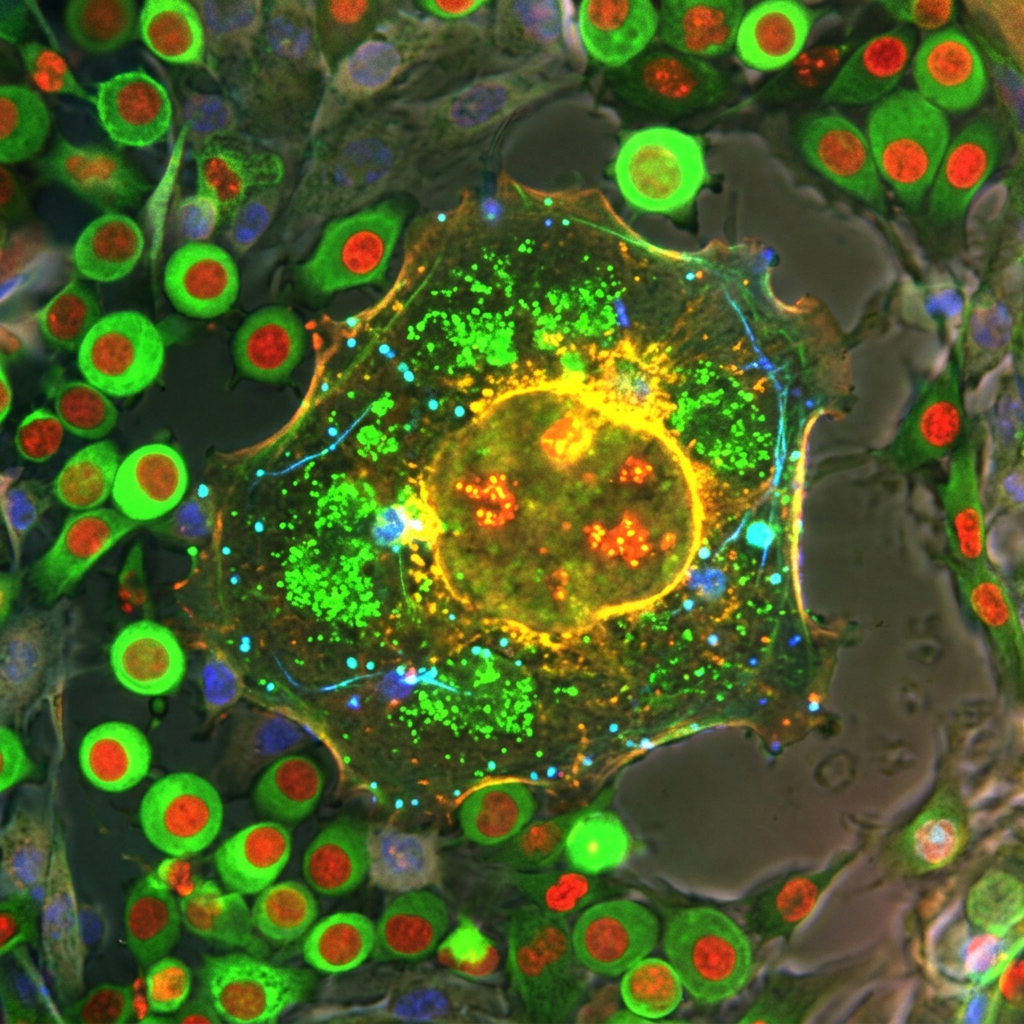
University of Surrey researchers found that SD-208 redirects compartments holding extracellular vesicles to the cell’s recycling system, cutting vesicle release in lab-grown cells.
Cells talk to one another constantly. One of the ways they do it is by releasing extracellular vesicles, microscopic packages that carry proteins and other biological signals to neighboring and distant cells.
“Cells are constantly talking to each other, and that communication keeps the body working properly,” said Patrizia Camelliti of the University of Surrey. “But when the signals go wrong, that same network can end up driving disease.”
Camelliti and colleagues now report that an experimental drug developed to fight scarring can turn down the release of these vesicles. Their study, published in the Journal of Extracellular Vesicles, suggests a possible new way to control communication between cells with drugs.
Messages in a bubble
Extracellular vesicles are a normal part of how cells communicate. But changes in this system can contribute to disease. According to the release, altered vesicle signaling has been linked to conditions including cardiovascular disease and cancer, where tumor cells can use vesicles to influence their surroundings.
Smaller vesicles of the kind studied here typically form inside cells, within compartments that fill with tiny internal vesicles. These compartments can then either fuse with the cell’s outer membrane, releasing their contents, or be sent to lysosomes, the cell’s recycling centers, where the contents are broken down. The study’s title notes that the compartments carried a marker protein called CD63, which is commonly used to identify them.
A surprise in heart cells
The drug, SD-208, is an experimental anti-fibrotic compound, meaning it is designed to reduce the build-up of scar tissue. Its name in the study’s title identifies it as an inhibitor of ALK5, a receptor for a signaling molecule called TGF-beta that is a central driver of fibrosis.
The researchers first noticed the effect on vesicles while studying heart cells from patients with hypertrophic cardiomyopathy, an inherited condition in which the heart muscle becomes abnormally thick and often scarred.
“The exciting part was that this effect – the reduced release of extracellular vesicles – emerged unexpectedly,” said Rahul Sanwlani, the study’s first author.
Hypertrophic cardiomyopathy is one of the most common inherited heart conditions, affecting roughly one in 500 people. It can cause chest pain, shortness of breath and dangerous heart rhythms, and it is a leading cause of sudden cardiac death in young athletes.
Lysosomes are small, acid-filled compartments packed with enzymes that digest worn-out proteins, damaged organelles and other cellular waste. The Belgian biologist Christian de Duve, who discovered them in the 1950s, shared the 1974 Nobel Prize in Physiology or Medicine in part for that work.
Changing the destination
SD-208 did not stop vesicles from forming. Instead, using advanced protein analysis and microscopy, the team found that the drug redirected the vesicle-containing compartments toward lysosomes, where their contents were broken down rather than released.
“When we followed where these vesicles were going inside the cell, we found that SD-208 appeared to change their destination,” Sanwlani said. “That opens up an interesting new way of thinking about how communication between cells might be controlled using drugs.”
The effect also appeared in other types of cells, including cells without the fibrotic features of the heart cells, suggesting that the drug acts on the cell’s communication machinery through a separate mechanism.
Other compounds that act on the same primary target did not reproduce the effect. That suggests the reduction in vesicle release is not simply a consequence of blocking ALK5, and that SD-208 may be doing something else as well.
A tool, and maybe a treatment
Researchers have long wanted reliable ways to switch vesicle release up or down, both to study what vesicles do and, potentially, to treat diseases in which they play a harmful role. Existing compounds used for this purpose in the laboratory can be nonspecific or toxic.
“Finding a compound that can change the outcome of these cellular messages opens up a completely new line of research for us,” Camelliti said. “Now we need to work out exactly how SD-208 does this, and whether we can eventually turn that mechanism into a treatment.”
The findings come from laboratory-grown cells, and the researchers caution that they do not show that SD-208 can treat disease in patients. The release does not say how large the reduction in vesicle release was, which other cell types were tested or who funded the work. Camelliti is the senior author of the study, and she and Sanwlani are its co-corresponding authors.
Notes
- Sanwlani, R., et al. “Pharmacological Inhibition of Small Extracellular Vesicle Secretion by ALK5i SD-208 via Lysosomal Rerouting of CD63+ Compartments.” Journal of Extracellular Vesicles, 15 September 2026. DOI: 10.1002/jev2.70362.
- University of Surrey. “An anti-fibrotic drug could be repurposed to control cell communication.” EurekAlert!, 30 September 2026. https://www.eurekalert.org/news-releases/1146072.



Leave a Reply