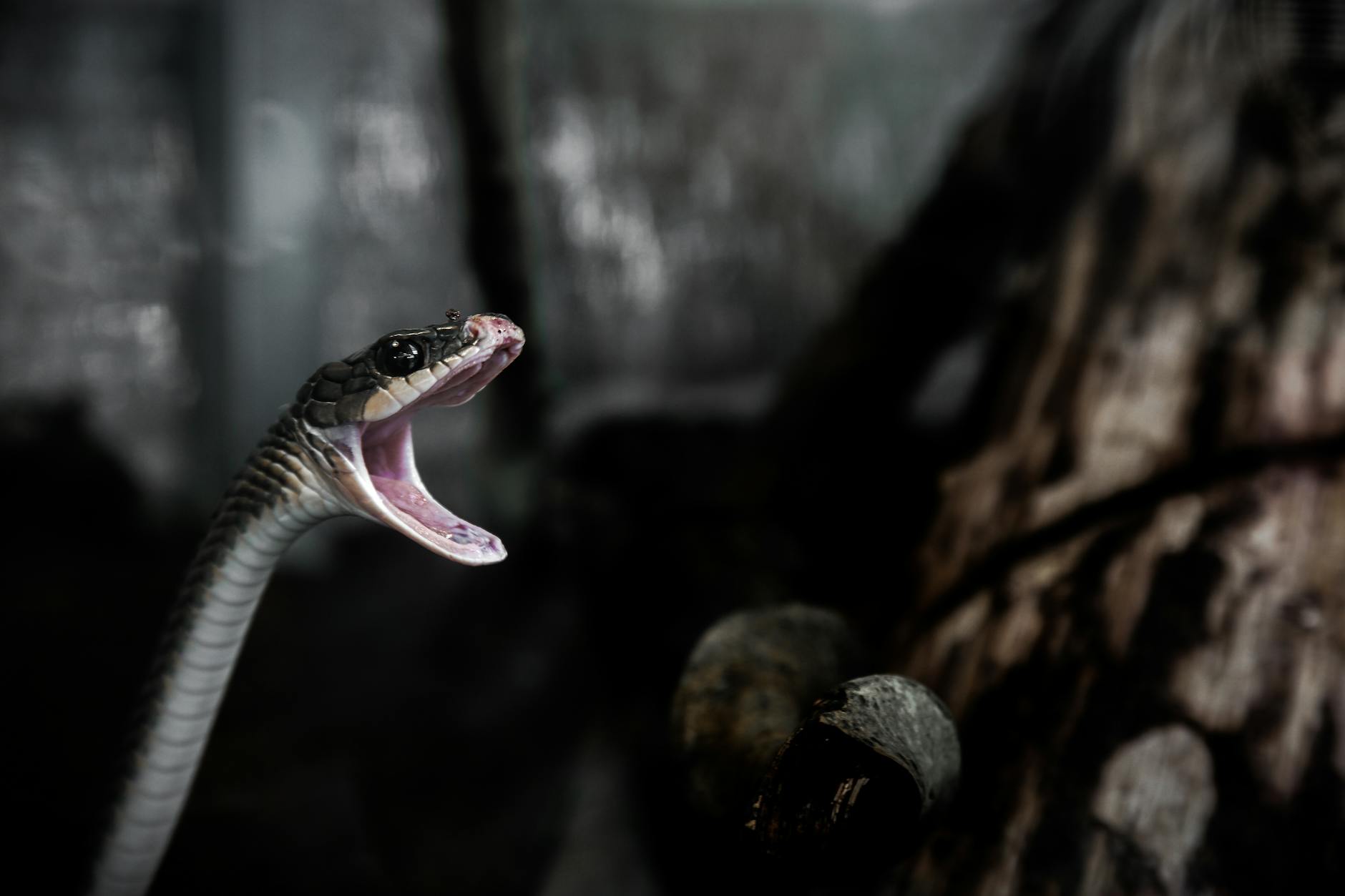
Across more than 450 species photographed in the wild by citizen scientists, venomous snakes were significantly more likely than non-venomous ones to carry colours that contrast with their habitat.
The logic of warning colouration is old and well established. A wasp’s yellow and black, a poison frog’s scarlet, a monarch butterfly’s orange — all advertise to a predator that attacking will be unpleasant, and a predator that learns the lesson leaves the next one alone. The arrangement benefits both parties, which is why it keeps evolving independently across the animal kingdom.
Snakes have been an awkward case. Many venomous species are superbly camouflaged, which is what one would expect of an ambush predator that needs to go unnoticed by its prey. Others are vividly marked. Whether those bright patterns constitute genuine warning signals, or merely happen to be bright, has been difficult to test at scale.
A study from the University of Galway, published in the Journal of Animal Ecology, tests it with a dataset nobody could have assembled a decade ago.
Conspicuous against what
The key methodological move is in the paper’s title: contextually conspicuous. The question is not whether a snake is brightly coloured in the abstract, but whether it contrasts with the specific environment it inhabits. A green snake is conspicuous on sand and invisible in foliage; brightness alone is not a signal.
Answering that requires seeing animals in their own habitats, which is why the team worked from thousands of photographs sourced through iNaturalist, the citizen science platform where naturalists upload wildlife observations with locations. Across more than 450 snake species worldwide, they measured how much each species’ colouration stood out against its natural background.
Venomous species were significantly more likely than non-venomous ones to have colours that stood out.
“Our findings show that venomous snakes stand out from their natural background more than non-venomous species, supporting the idea that warning colouration has evolved to signal danger to potential predators,” said Amy Duclaux of Galway’s School of Natural Sciences, a lead researcher on the project.
“Rather than hiding from predators, some venomous snakes appear to advertise that they’re dangerous,” she said. “Their striking colours likely evolved as warning signals that discourage attacks before they happen.”
Red and yellow, specifically
The team focused on red and yellow, the colours most commonly associated with warning signals across animals, and found them particularly effective at making snakes stand out against their backgrounds.
“We also found that red and yellow colouration is particularly effective at helping snakes stand out against their natural background, suggesting these colours play an important role in visual signalling,” Duclaux said.
There is a reason those two colours recur. Natural backgrounds — vegetation, soil, leaf litter, rock — are dominated by greens and browns, so long-wavelength reds and yellows contrast strongly almost everywhere a snake might be. A warning colour that works in one habitat and fails in another would be a poor investment; red and yellow are close to universally conspicuous.
The finding also bears on a long-standing puzzle in the literature on coral snakes and their mimics, where red and yellow banding appears repeatedly in both venomous species and harmless ones that resemble them. The folk rhymes for telling them apart exist because the resemblance is good. That mimicry only works if the warning signal is genuinely being read by predators, which is what this study’s result supports.
The honest complication
The release does not oversell the pattern: many venomous snakes are not brightly coloured at all. What the study reports is a statistical tendency across more than 450 species, not a rule.
That is as it should be, because a snake faces two audiences with opposite requirements. Its prey should not see it coming; its predators should see it clearly and leave. Which pressure dominates depends on how the snake hunts, what hunts it, and where it lives — an ambush hunter in open ground has more to lose from being conspicuous than a diurnal forager that is rarely attacked. The expected outcome of that tension is exactly what the data show: a detectable overall association, with plenty of exceptions in both directions.
The study is also correlational and comparative, as studies of this kind must be. It establishes that venom and conspicuousness travel together across species; it does not show that predators actually avoid the conspicuous ones, which would require behavioural experiments. And colour measured from photographs is colour as a camera records it — snake predators include birds, whose colour vision extends into the ultraviolet and differs substantially from both human and camera sensitivity. A signal optimised for a bird’s eye may look different to ours.
What citizen science made possible
Dr Kevin Healy, who heads Galway’s Macroecology Lab, is direct about where the data came from. “Citizen science initiatives such as iNaturalist are transforming ecological research by providing images of animals in their natural habitats at a scale that would otherwise be impossible for individual research teams to achieve,” he said.
He also explains why photographs rather than specimens were necessary. “Museum collections allow us to measure colour accurately, but photographs taken in the wild are essential for understanding how those colours appear in the environments where they evolved,” he said.
That distinction is the crux of the study’s design. A museum drawer gives a precisely measurable snake and no habitat; a wild photograph gives a less precisely measurable snake against the background that actually matters. For a question about contrast rather than colour, the trade favours the photograph.
It is also an unglamorous reminder of what large public datasets enable. Thousands of photographs of 450 species in their native habitats represents field effort no research group could fund, contributed by people who were mostly just interested in snakes.
The release lists no funding sources and no conflict-of-interest statement, and names Duclaux as a lead researcher without identifying a first or corresponding author, so the endnote below carries the paper title alone. It is dated 5 October 2026 against a publication date of 4 October.
Notes
- “Contextually conspicuous species are more likely to be venomous: Habitat-dependent aposematic colouration found throughout snakes.” Journal of Animal Ecology, 4 October 2026. DOI: 10.1111/1365-2656.70351.
- University of Galway. “Venomous snakes evolved striking colours to stand out.” EurekAlert!, 5 October 2026. https://www.eurekalert.org/news-releases/1146461.



Leave a Reply