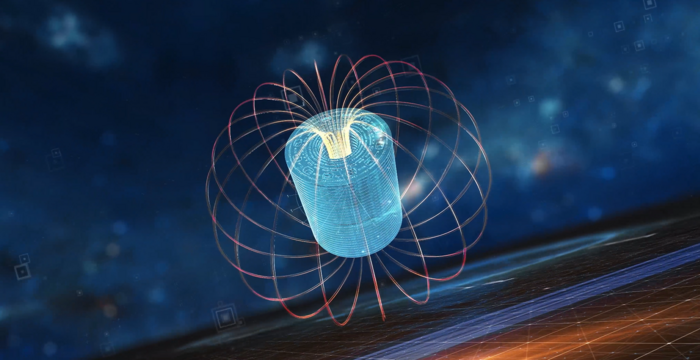
Tokyo University of Science researchers combined micromagnetic simulations with a genetic algorithm to find magnonic crystal patterns with wider band gaps than conventional designs.
Almost all of today’s computing depends on moving electric charge. Every time electrons flow through a chip’s wires and transistors, some of their energy is lost as heat. As data centers expand to meet the demands of cloud computing and artificial intelligence, that waste has become a growing concern.
The International Energy Agency has estimated that data centers used roughly 1.5 percent of the world’s electricity in 2024, and it expects that share to grow. Much of that power is ultimately released as heat, which must then be removed by cooling systems that consume still more energy.
One proposed alternative is to carry information in spin waves, ripples in the magnetic orientation of a material that can travel without moving electrons from place to place. Researchers at Tokyo University of Science (TUS) now report a new way to design the structures needed to control those waves. Their study, published in Small Structures, uses optimization algorithms to discover magnetic patterns that would be difficult to arrive at by intuition.
Waves of magnetism
In a magnetic material, the tiny magnetic moments of electrons, known as spins, tend to line up. If one is disturbed, the disturbance can pass from spin to spin as a wave, much as a ripple travels across a pond. These spin waves, whose quantum units are called magnons, could carry information for logic circuits, memory and physical neural networks.
Because a spin wave moves a magnetic disturbance rather than electric charge, it avoids the resistive heating that comes with electric currents. That has made magnonics, the field devoted to using spin waves, a candidate for energy-efficient computing.
Controlling spin waves requires carefully structured materials. Magnonic crystals (MCs) are periodic patterns of magnetic materials that steer how spin waves propagate, in a way loosely analogous to how semiconductor crystals control electrons or photonic crystals control light.
The value of a gap
A key feature of these crystals is the magnonic band gap (MBG), a range of frequencies at which spin waves cannot travel through the material. Band gaps can be used to filter signals or block certain frequencies, and engineers want to design them precisely.
That is easier said than done. The properties of a magnonic crystal depend sensitively on its patterned geometry, and general design rules have been hard to establish. Most previous work has focused on lower-order bands, because higher-order bands are harder to predict.
To tackle the problem, Professor Masato Kotsugi of the TUS Faculty of Advanced Engineering and doctoral student Ryunosuke Nagaoka turned to inverse design. Rather than proposing a structure and calculating its properties, inverse design starts with the desired properties and searches for a structure that delivers them.
“The inverse-design approach is a promising strategy for efficiently exploring optimal structures, where desired properties are defined as objective functions and parametrized design regions are optimized through machine learning or mathematical optimization methods,” Kotsugi said. “This approach significantly expands the design space, allowing us to explore unconventional lattice structures with large MBGs.”
Evolving a better pattern
The team aimed for the widest possible complete magnonic band gaps, gaps that block spin waves traveling in every direction. Their crystal combined two materials, europium oxide and iron, and the pattern within each repeating unit cell was encoded as a string of binary values, each specifying which material occupied a given spot.
To evaluate each candidate pattern, the researchers used frequency-domain micromagnetic simulations based on the Landau–Lifshitz–Gilbert equation, which describes how magnetization changes over time. According to the release, the frequency-domain approach is more efficient than time-domain simulations for screening large numbers of designs.
The search itself was driven by a genetic algorithm, a method inspired by natural selection. The algorithm generated a population of designs, evaluated their band gaps, then combined and mutated the most promising ones to produce the next generation. The cycle repeated until it converged.
The process settled on non-intuitive structures that looked very different from conventional geometric designs such as regular arrays of dots or holes. The topology-optimized structures had significantly larger complete band gaps than conventional designs. The largest gap appeared between the fourth and fifth bands, although the release does not give specific values.
Many roads to a solution
Using a modified version of the team’s explainable machine learning framework, the researchers also examined the shape of the design landscape. They found that it becomes increasingly non-convex at higher-order bands, meaning that there may be many different designs that work well rather than a single best answer.
The authors suggest that the work could be relevant to energy-efficient spintronics, green computing and future data-center hardware. Insights into higher-order bands may also support multi-frequency signal processing and faster spin-wave communication.
“This inverse-design framework can be broadly applied to experimentally accessible material systems and device dimensions, enabling the development of design rules for MCs,” Kotsugi said. “Topology-optimized 2D MCs may open the pathway for MC designs with greater flexibility, beyond what can be achieved through conventional structural design.”
The study is entirely computational. The optimized structures have not yet been fabricated or tested, and practical spin-wave computing still faces challenges, including the fact that spin waves tend to fade over short distances. Europium oxide, one of the two materials used, is ferromagnetic only far below room temperature. The work was supported by JSPS and by the Japan Science and Technology Agency’s ACT-X and CREST programs.
Notes
- “Inverse design of two-dimensional magnonic crystals via topology optimization with frequency-domain micromagnetics.” Small Structures, 28 July 2026. DOI: 10.1002/sstr.70526.
- Tokyo University of Science. “AI-designed metamaterials pave the way for high-speed spin-wave computing.” EurekAlert!, 28 July 2026. https://www.eurekalert.org/news-releases/1137582.



Leave a Reply