An Institute of Science Tokyo team suspended living bacterial structures in a tuned liquid, keeping cells active without trapping them in gels.
In nature, microbes rarely live as a uniform soup. In the human gut, on the surface of the lungs and in the slimy films that coat river stones and ship hulls, bacteria arrange themselves in layers, clusters and channels. Where a microbe sits in that architecture shapes what it experiences: how much oxygen it gets, which nutrients and chemical signals reach it, and which neighbors it interacts with.
Yet the standard tools of microbiology largely ignore that structure. Researchers at Institute of Science Tokyo, working with Suntory Global Innovation Center, have developed a way to build three-dimensional microbial structures that float in liquid. They call the results “floatonies.” The work is published in Biofabrication.
The limits of flasks and dishes
Microbiologists typically grow bacteria in one of two ways: in well-mixed liquid cultures, where cells drift freely, or on flat agar plates, where they form colonies on a two-dimensional surface. Both have been workhorses for well over a century. Agar was introduced to bacteriology in the early 1880s in Robert Koch’s laboratory, at the suggestion of Fanny Hesse, and Julius Petri’s shallow dish followed a few years later.
Neither method reproduces the spatial organization of real microbial communities. More advanced approaches embed bacteria in hydrogels or other solid materials, or confine them in microfluidic channels, to hold them in three-dimensional arrangements. Those methods keep their shape, but the surrounding material can restrict how bacteria move, grow and exchange molecules with their environment.
“Unlike traditional hydrogel- or microfluidic-based methods, our approach maintains the intrinsic fluidity of the culture medium, allowing microbial motility, diffusion, and self-organization under minimally constrained conditions,” said Associate Professor Masayoshi Tanaka of the Department of Chemical Science and Engineering, who led the work.
Drawing in liquid
The technique, which the team describes as liquid drawing, works a little like a 3D printer that writes inside a fluid rather than on a surface. A robotic arm injects a “bacterial ink,” a suspension of microbes, into a specially formulated “canvas solution.”
The trick lies in the canvas. The team tuned its physical properties so that the injected structures stay suspended where they are placed, rather than sinking, spreading or dissolving into the surrounding liquid, while the medium itself remains fluid. Using rheological measurements, which describe how a material flows and deforms, the researchers worked out design principles for when and why the structures hold their shape.
The result is a set of living structures that hang in liquid, retaining the architecture they were drawn with while the cells inside remain free to move and interact with the fluid around them.
Alive and working
To test the approach, the researchers used Escherichia coli, the bacterium that has served as a model organism in biology for decades. Cells inside the floatonies stayed alive and metabolically active.
In enzyme activity tests, the bacteria processed a chemical substrate, and the products of that reaction diffused out into the surrounding liquid. That matters because diffusion is exactly what gels and solid scaffolds can impede. In natural microbial communities, the movement of nutrients, waste products and signaling molecules between cells and their environment shapes how the community behaves.
“This enables us to study and engineer microbial spatial organization under conditions that more closely resemble natural liquid environments,” Tanaka said.
From gut microbes to living materials
The team sees floatony as a bridge between simple liquid cultures and rigid three-dimensional systems, with applications in both basic research and engineering.
On the research side, it could help scientists study how spatial organization affects microbial communities such as the gut microbiota, which plays roles in digestion, immunity and health, and biofilms, which can protect bacteria from antibiotics and are a major problem in chronic infections and on medical devices.
Biofilms are a particularly pressing target. Bacteria living in these structured communities can be far more tolerant of antibiotics than the same bacteria floating freely, partly because the matrix slows the penetration of drugs and partly because cells deep inside grow slowly. Biofilms form on catheters, implants, wounds and the lungs of people with cystic fibrosis. A method that lets researchers build controlled three-dimensional communities in liquid could help untangle how that architecture develops and how it might be disrupted.
On the engineering side, the approach could aid the design of microbial living materials, an emerging field that uses engineered microbes as components of functional materials, from self-healing concrete to biological sensors.
“In the future, the proposed platform could contribute to a better understanding of how microbial spatial organization influences health and disease, while enabling the rational design of microbial living materials,” Tanaka said.
Industry has an interest as well. Microbes are central to fermentation, from brewing to the production of food ingredients, enzymes and pharmaceuticals. “We believe this platform could provide new opportunities for designing functional microbial communities for industrial biotechnology,” said Ippei Inoue of Suntory Global Innovation Center.
Early days
The work is at an early stage. The release describes experiments with only a single model organism, E. coli, and gives no quantitative data on how long the structures last, how precisely they can be drawn or how cells behave over time. Real microbial communities contain hundreds of interacting species, and whether floatonies can host such complexity remains to be seen.
Still, the approach tackles a long-standing gap between how microbes are studied and how they actually live. Being able to arrange bacteria in three dimensions, without locking them in place, gives researchers a new way to ask how structure shapes the behavior of the microbial world. The work was funded by the Japan Society for the Promotion of Science.
Notes
- “Floatony formation in liquid environments: Liquid drawing–based fabrication of three-dimensional microbial structures.” Biofabrication 18, no. 3 (2026). Published 30 June 2026. DOI: 10.1088/1758-5090/ae7ed4.
- Institute of Science Tokyo. “Floating colonies: engineering three-dimensional microbial architectures in liquid cultures.” EurekAlert!, 27 July 2026. https://www.eurekalert.org/news-releases/1137675.
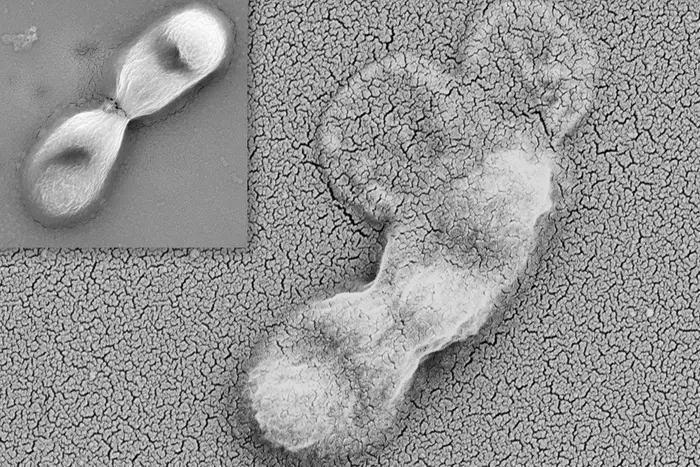
Featured image: File image of E. coli. Credit: Nikol Kadeřábková

Leave a Reply