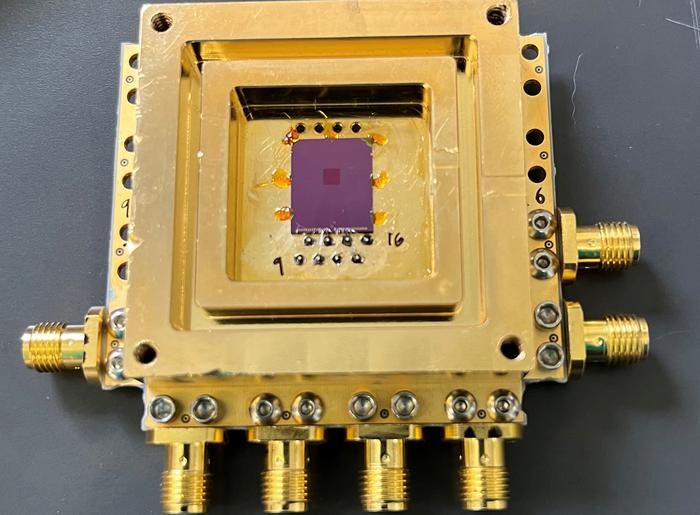
By adding a single superconducting element to the link between a qubit and its readout circuit, researchers achieved 99.4 percent accuracy in 68 nanoseconds while dropping two bulky pieces of standard hardware.
There is a quiet irony at the center of quantum computing. A quantum computer’s power comes from its qubits’ ability to exist in many states at once, yet to get any useful answer out of the machine, those delicate states have to be measured. And measuring a quantum system is one of the surest ways to disturb it.
Reading out qubits quickly and accurately, without corrupting them in the process, has become one of the central bottlenecks in building larger and more capable quantum processors. A new study led by researchers at EPFL, the Swiss Federal Institute of Technology in Lausanne, offers a promising way around it. Published in PRX Quantum, the work demonstrates a readout architecture that measures superconducting qubits faster and more accurately while using less hardware than current state-of-the-art systems.
“This is an important piece of work demonstrating a new, more efficient and faster way of measuring transmon superconducting qubits,” said Pasquale Scarlino, the EPFL physicist who led the research.
The trouble with listening in
Quantum computers come in several varieties, and one of the leading approaches relies on superconducting circuits, which carry current with zero electrical resistance when cooled to temperatures just above absolute zero. The most common qubit in these machines is the transmon, a design engineered to be less sensitive to a particular kind of electrical noise.
In these systems, a qubit is read out by coupling it to a microwave resonator, a circuit that rings at a specific frequency. The qubit’s state subtly shifts that frequency, and by probing the resonator with microwaves, researchers can infer whether the qubit is in a 0 or a 1.
The standard way to connect the qubit to its resonator is with a capacitor. That works, but it introduces a fundamental tension. The capacitor causes the qubit and the resonator to partially blend together. That blending is what makes measurement possible in the first place, but it also opens a path for the qubit to lose its information or flip its state during the very act of being measured.
Engineers have developed workarounds, but they come at a cost. Two common additions are Purcell filters, which protect the qubit from leaking energy through the readout channel, and near-quantum-limited amplifiers, which boost faint measurement signals without adding much noise. Both work well, but both add complexity, bulk and calibration overhead, a significant burden for machines that may eventually need to measure thousands or millions of qubits.
A junction with built-in protection
The EPFL team, working with the group of Professor Alexandre Blais at the University of Sherbrooke in Canada, one of the pioneers of superconducting quantum computing, took a different approach. Instead of linking the qubit and resonator with a capacitor alone, they added a Josephson junction alongside it.
A Josephson junction is a sandwich of two superconducting layers separated by a very thin barrier of non-superconducting material. Quantum mechanics allows electrical current to tunnel through that barrier, creating a nonlinear circuit element that sits at the heart of many quantum technologies. It is named for the physicist Brian Josephson, who shared the 1973 Nobel Prize in Physics for predicting the effect.
In the new design, the junction creates a different kind of interaction between the qubit and its resonator. Crucially, this interaction provides intrinsic protection against one of the main ways qubits lose information during measurement. With that safeguard built into the coupling itself, the researchers could drive the measurement harder, producing a stronger signal and a clearer separation between a logical 0 and a logical 1.
Fast and faithful
The performance numbers are striking. Using the new architecture, the team correctly identified the qubit’s state 99.4 percent of the time with an integration time of only 68 nanoseconds, less than a ten-millionth of a second.
Just as important, the measurement was largely gentle. The researchers reported a quantum non-demolition fidelity of 98.4 percent, meaning that in the vast majority of cases the qubit was left in the same state after being measured. That property matters enormously for error correction schemes, which depend on measuring qubits repeatedly without scrambling them.
The experimental results closely matched theoretical predictions developed with the Sherbrooke team, giving the researchers a detailed understanding of why the design works, not merely evidence that it does.
Doing more with less
Beyond raw performance, the design’s most appealing feature may be its simplicity. The team achieved fast, high-fidelity readout without either a Purcell filter or a near-quantum-limited amplifier, the two components so common in today’s leading systems.
Removing them shrinks each qubit’s hardware footprint and reduces the number of parts that must be fabricated, wired and calibrated. Those savings become increasingly valuable as processors scale up. The approach also remains compatible with multiplexed readout, in which many qubits share the same measurement hardware, a technique widely seen as essential for large machines.
The researchers note that the same architecture can also work with more conventional linear readout schemes by adjusting the resonator’s properties, an option they plan to explore in future generations of devices.
A piece of the scaling puzzle
Quantum computing still faces formidable obstacles before it can deliver on promises such as simulating new materials, designing molecules or solving complex optimization problems beyond the reach of classical machines. Qubits must become more reliable, error correction must become practical, and processors must grow from hundreds of qubits to many thousands or more.
Measurement sits squarely in the middle of those challenges. Every error-correction cycle depends on fast, accurate, non-destructive readout, and every extra component per qubit multiplies the engineering burden of scaling. A design that improves speed and fidelity while trimming hardware addresses several pressure points at once.
The authors describe their approach as a promising alternative for superconducting qubit readout, compatible with multiplexed architectures and future implementations. It will take further work to see how well it performs across larger arrays of qubits. But in a field where progress is often measured in fractions of a percent and billionths of a second, a cleaner way to read a qubit is a meaningful step.
Featured image: Cristián Peña, Fermilab
Endnotes
- Beaulieu, G., Chen, J.-Z., Scigliuzzo, M., Benhayoune-Khadraoui, O., Chapple, A. A., Spring, P. A., Blais, A., and Scarlino, P. “Fast, High-Fidelity Transmon Readout with Intrinsic Purcell Protection via Nonperturbative Cross-Kerr Coupling.” PRX Quantum (July 27, 2026). DOI: 10.1103/m348-gy75.
- École Polytechnique Fédérale de Lausanne. “A way to read quantum bits faster and with less hardware.” News release via EurekAlert!, July 28, 2026. https://www.eurekalert.org/news-releases/1137862


Leave a Reply