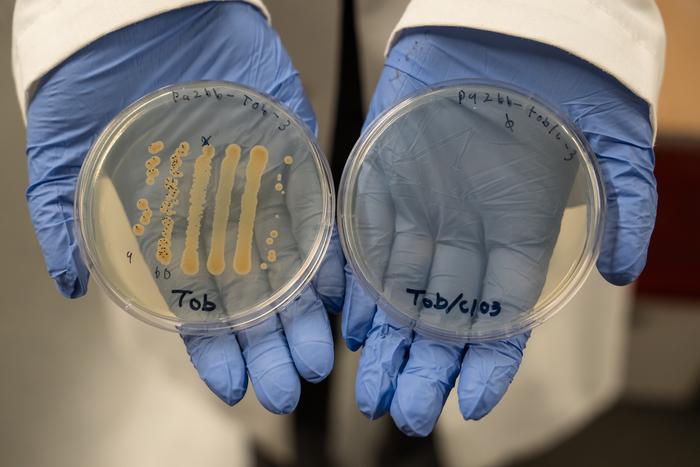
Overusing antibiotics is known to accelerate bacterial resistance, but researchers at the Technion-Israel Institute of Technology say they have identified a previously unrecognized route that lets some bacteria reach resistance unusually fast. Dr. Idan Yelin and Prof. Roy Kishony of the Technion’s Faculty of Biology describe a mechanism involving “inflation” in the number of copies of genes that give bacteria a survival edge, publishing their findings in Nature Microbiology.
To find it, the team built a computational tool called AmpliFinder and used it to analyze more than 10,000 laboratory-evolved bacterial samples. Scientists already knew that duplicating, or amplifying, resistance genes could help bacteria survive antibiotics, and the team expected that classical, textbook form of amplification to dominate. Instead, Yelin said, “non-canonical amplifications are extremely common in bacteria and are more efficient at gene amplification” — a pattern in which a single stretch of DNA links distant regions of the genome to duplicate genes together, making it much harder to detect with standard methods than the textbook form researchers had expected.
In experiments with Escherichia coli and Acinetobacter baumannii exposed to the antibiotic chloramphenicol, amplifying a DNA segment containing the mdfA gene raised the bacteria’s resistance and let them adapt to steadily higher drug concentrations. The researchers argue this non-canonical route is both more common than previously recognized and often more efficient at boosting resistance than the classical pathway, making it an attractive target for new strategies to slow resistance and keep existing antibiotics effective for longer. The work was supported by the Israel Science Foundation and the European Union’s Horizon Europe program.
Endnotes
- Idan Yelin and Roy Kishony, “Non-canonical gene amplifications facilitate adaptive evolution in bacteria,” Nature Microbiology, July 6, 2026, DOI: 10.1038/s41564-026-02415-2.
- Technion-Israel Institute of Technology, “The fast track to antibiotic resistance,” news release via EurekAlert!, July 27, 2026.



Leave a Reply