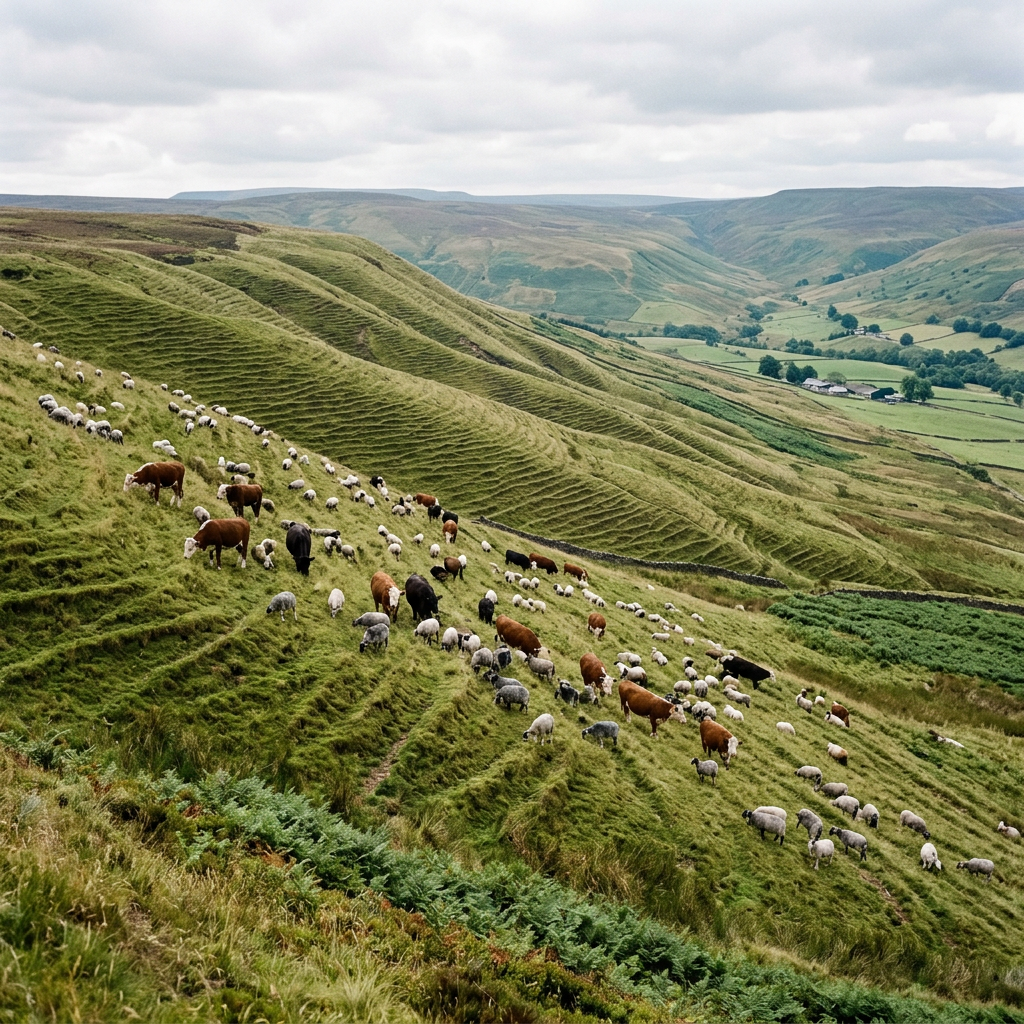
Grazing animals like cattle and sheep may be quietly reshaping mountain slopes, according to a new study led by the University of Colorado Boulder. The animals’ simple foraging behavior can produce elaborate terracettes — the staircase-like ridges that stripe hillsides worldwide — challenging a long-held assumption that wandering livestock cannot restructure landscapes on such a large scale.
Terracettes are colloquially known as “cow trails” or “sheep tracks,” but the prevailing scientific theory has held that they actually result from gravity slowly pulling soil downhill — scientists assumed animals couldn’t create such regular patterns because they move randomly and independently. Ben Seleb, a former graduate student of CU Boulder’s Saad Bhamla who first noticed clusters of terracette steps during a trip in the Swiss countryside, suspected the animals deserved more credit.
To test the idea, the team built a computer model simulating how a grazing animal moves across a slope, weighing two competing priorities: reaching grass while spending the least energy. The simulation showed the animal naturally preferred horizontal paths with minimal elevation change, since going uphill costs more energy and walking downhill is uncomfortable. As the simulated animal ate the grass along one path, it shifted slightly up or down to reach fresh vegetation, carving a new path parallel to the last — and, repeated across many animals over time, producing the horizontal bands seen on hillsides worldwide without any coordination among them.
“It’s just another example that animals, even the humble and mundane cow, can change our environments in ways we don’t realize. Sometimes the mundane turns out to be fascinating. We just have to keep an open mind and spend a little time looking.”
Saad Bhamla, CU Boulder Department of Chemical and Biological Engineering
Gravity may still play some role in terracette formation, Seleb said, but the study suggests grazing animals alone are sufficient to produce the natural staircases.
Publication
The study was published July 1, 2026 in the Journal of the Royal Society Interface (DOI: 10.1098/rsif.2025.0451).



Leave a Reply