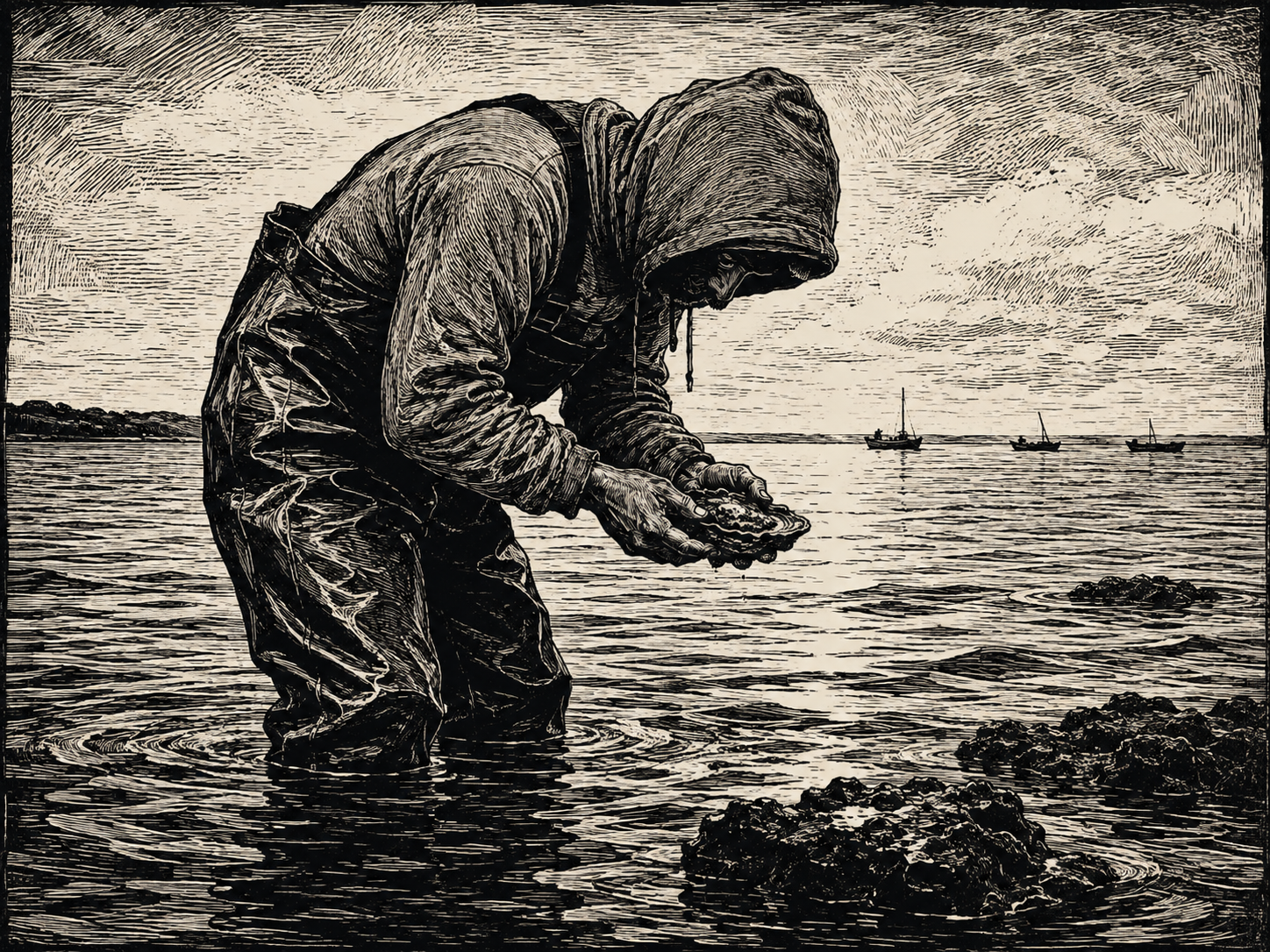
For most of its history, New York was not the Big Apple — it was the Big Oyster. Before the skyline, before the subways, the harbor that surrounds Manhattan held an estimated tens of thousands of acres of oyster reef, a native species so abundant it shaped the city’s diet, its economy, and its waterfront for centuries. By the early 1920s, that abundance was gone. A century of overharvesting, unchecked pollution, and the physical re-engineering of the harbor — dredging, bulkheads, seawalls — had wiped out nearly the entire population, closing commercial oystering and leaving New Yorkers estranged from the water at their doorstep.
That history carries a less-told dimension. In the decades before the Civil War, oystering was one of the few paths to genuine economic independence for free Black New Yorkers, nowhere more visibly than at Sandy Ground on Staten Island, where oystermen fleeing restrictive Maryland laws built one of the nation’s oldest continuously settled free Black communities on the strength of the reefs off Prince’s Bay. The same collapse that emptied the harbor of oysters helped empty that history from public memory — the industry that built Sandy Ground vanished along with the reefs it depended on.
Today, the Billion Oyster Project is working to reverse that collapse, restoring living reefs across all five boroughs and, in the process, running directly into that buried history. Mike McCann, an ecologist who has worked on oyster restoration in New York Harbor since 2016, sat down with Marc Landas to talk about what it actually takes to bring a species back from near-extinction in a working harbor — the science of larvae and substrate, the years of permitting and monitoring behind a single reef, and what it means to restore a habitat that was never just an ecosystem, but a community.

Interview: Mike McCann, Billion Oyster Project
Marc Landas: For people who don’t know about the Billion Oyster Project, what is it about?
Mike McCann: Oysters were the backbone of New York Harbor and the broader estuary for hundreds of years. They’re the native reef-forming species — ecologically, they anchored an entire ecosystem, providing habitat for a huge range of life. Culturally and economically, they were central to New York’s identity, economy, and diet, going back to Indigenous times, even before European settlement.
Given how central oysters were to New York, it’s striking that they were lost almost entirely. As with many parts of our natural environment, humans overexploited the resource and polluted the water. A century or two of intense impact meant that by the early 1920s, there were essentially no oysters left in New York Harbor, and commercial harvesting was closed. For roughly a hundred years, the harbor was a place most New Yorkers avoided — there was far less activity and far less life in the water than there once was.
Water quality has improved significantly since then, largely because of the Clean Water Act and stronger regulation of what goes into our waterways. What’s been missing is a way to bring life back to the harbor. We believe oysters can serve as both the ecological backbone of that recovery and a way to reconnect New Yorkers to the harbor itself — they’re a compelling way to get people interested, engaged, and invested in becoming the next generation of stewards. That’s central to our approach: restoring an ecosystem also means bringing people along with it. That’s why we describe our work as education through restoration, and restoration through education — the two have to reinforce each other.
Marc Landas: How did you personally end up working on oyster restoration with the Billion Oyster Project?
Mike McCann: I’m a scientist and ecologist by training — I learned to study ecosystems and organisms and how to collect data on them, so I can speak in depth about the scientific side of this work. But I’d always been drawn to coastlines, rivers, and the organisms that live in them. I did my Ph.D. on Long Island at Stony Brook University, studying hard clams, snails, and other bivalves, and working on oyster restoration in New York City was the first job I found after graduate school.
I wanted to find a way to work as a marine biologist in New York City specifically, and those opportunities are rare — the academic track usually means moving wherever the job is. I got lucky that the timing and location lined up in 2016, and I started applying my science background to oyster restoration at the Billion Oyster Project. Our team includes aquaculture specialists, educators, and people who handle vessel operations and diving — restoration work like this draws on a wide range of skill sets.
Marc Landas: Oysters were central to New York City’s economy 150 to 200 years ago, and also to the free Black economy of the 1800s — Sandy Ground on Staten Island was especially well known for its oyster industry. Does the Billion Oyster Project’s restoration work touch any of the historic reefs off Prince’s Bay?
Mike McCann: It does, and it’s given us an opportunity as an organization to learn more about that history and to work with groups like the Sandy Ground Historical Society. That connection came through a coastal resiliency project that grew out of the damage Hurricane Sandy caused on Staten Island’s south shore. Homes were destroyed and lives were lost in that community, which led to federal and state funding for resilience projects designed to protect people, homes, and infrastructure.
We were fortunate to be part of one such project, which combines engineered stone and cement with living elements — the Living Breakwaters project, located near the southern tip of Staten Island, not far from Sandy Ground. SCAPE Landscape Architects led the design, with funding from New York State, and our role was to make the structures functionally alive: rather than serving only as a barrier that blunts wave action, they carry a living layer of oysters that filters water and provides habitat for fish and other organisms.
That project has been years in the making. The breakwater structures were completed about a year ago, and we’re now in a multi-year process of establishing oysters on them. It has also involved substantial community engagement — school groups have visited the shoreline to learn about the history of oysters in the area and see the breakwaters themselves, which sit about 250 meters offshore and are clearly visible from the beach. The Sandy Ground Historical Society has been an important partner in organizing some of those community events.
Marc Landas: I think it’s remarkable that in restoring a habitat, you’re also restoring the memory of what used to be there — and what’s coming. Turning to more scientific questions: what actually killed the oyster beds in the first place, and how much of that damage is permanent versus reversible through modern restoration?
Mike McCann: It came from a combination of factors. Throughout the 1800s, intensive harvesting steadily reduced the population. At the same time, there was no treatment of sewage — no plumbing infrastructure, no wastewater treatment plants — so waste went directly into the harbor. The harbor itself was also being physically reshaped during this period: dredging, new channels, and bulkheads built to accommodate a growing shipping industry. Together, these changes altered the shape, flow, and edges of the harbor and drove the collapse of the oyster population.
Some of that damage isn’t fully reversible — the hardening of our shorelines, for instance. But there have been real gains elsewhere. Over the past twenty years, New York City has built more public parks with gentler, more natural slopes and pocket salt marshes along the harbor. Water quality has also improved substantially, thanks to the Clean Water Act and investment in wastewater treatment, though we still need continued investment — raw sewage still enters the harbor whenever it rains more than half an inch. Oysters can tolerate some of that, but the harbor also receives road runoff, PFAS, and a range of other contaminants.
Our main strategy is to reverse the effects of historical overharvesting by directly adding living oysters back into the population that was decimated. That’s the piece we believe is reversible. A billion oysters is a starting point — reaching that number doesn’t guarantee a self-sustaining population, but we know the number needs to be large, since a billion likely still represents only a small fraction of what the harbor once supported.
Marc Landas: Roughly a century or more ago, New York Harbor is often said to have held around 200,000 acres of oyster reef. What’s a realistic ceiling for how much of that could be recovered?
Mike McCann: That 200,000-acre figure, popularized in Mark Kurlansky’s book The Big Oyster, is on the high end. Reaching that total requires including areas well beyond the harbor proper, like Long Island Sound and parts of New Jersey. I’d put a more realistic figure at tens of thousands of acres. Some researchers have tried to digitize historical maps of oyster beds — the earliest dating to 1608, though most come from around 1900 — but even the 1900 maps reflect a population that had already been substantially reduced, so they offer an imperfect picture of the original extent.
As for a ceiling: at this point, our real goal is a self-sustaining population, regardless of its final size. As much as I value this work, the objective isn’t to restore oysters indefinitely — it’s to reestablish a population that sustains itself. What that population would ultimately grow to, once it reaches self-sustaining momentum and its members are exchanging larvae across connected areas, is a genuinely open ecological question. Conditions today are different enough from those of 100 or 150 years ago that we don’t have a confident answer.
Marc Landas: Can you walk me through what reef restoration actually looks like in practice — what’s involved in restoring oysters to a site?
Mike McCann: Restoration requires two main ingredients: living oysters, since the wild population is too depleted to recover on its own, and substrate — something hard for those oysters to live on. Because so much of the harbor has been dredged, channelized, and lined with seawalls, most of the harbor floor is soft mud, sometimes called “black mayonnaise” — low-oxygen sediment that oysters can’t survive on. So every restoration project starts with those two elements: substrate and living oysters.
We work across all five boroughs and as far north as the lower Hudson, since oysters can survive there as well. Each site looks different — the East River off Brooklyn Bridge Park, Jamaica Bay, the south shore of Staten Island near Sandy Ground, and the area near the Mario Cuomo Bridge (formerly the Tappan Zee) all present distinct conditions, so each reef has to be designed around its specific environment.
One of our primary partners is NYC Parks, which provides both guidance and access to work in city parkland. That partnership matters to us because it means restoration serves the public rather than a private waterfront owner. The process from start to finish spans several years: building a relationship with Parks at a given site, engaging community stakeholders, developing designs through rounds of public input — typically at 30, 60, and 90 percent completion — securing funding, and obtaining permits from agencies including the U.S. Army Corps of Engineers, the New York State Department of Environmental Conservation, and NOAA. That permitting process alone can take several years.
Construction follows: we source oyster larvae from a commercial hatchery, introduce them to substrate at our facility on Governors Island, and then work with marine contractors using barges and cranes to place the completed structures at the site. That’s roughly five years of preparation leading into a construction season, followed by about five more years of monitoring to assess whether the reef is succeeding — whether oysters are recruiting to it, growing, and supporting other species. In total, a single restoration project typically spans about a decade.
Marc Landas: How do you go from a larva to something you can introduce into the water?
Mike McCann: The oyster life cycle is easiest to picture as parts stacking on top of each other. Most people know oysters in their adult form — the hard, calcified shell served at a restaurant. In the wild, rather than on a farm, oysters grow in clumps stacked on one another, and as adults they’re sedentary; they don’t move the way a scallop might.
Before that, though, they spend two to three weeks as free-swimming larvae — smaller than a millimeter, invisible to the naked eye, moving up and down through the water column and drifting with the tides. At the end of that period, they seek out a hard surface to settle on, often another oyster shell. They’re drawn to that material because it signals a favorable environment — food availability and good water movement. That settling behavior is what produces the stacked clusters characteristic of a healthy reef.
For restoration, we purchase larvae the same way a commercial oyster farmer would, from commercial hatcheries, typically 80 to 100 million at a time. We introduce them to substrate at our facility on Governors Island, producing the combined oyster-and-substrate units we then deploy across the harbor.
Marc Landas: Out of a shipment of, say, 80 million larvae, what percentage ultimately becomes a viable oyster?
Mike McCann: It depends on how far along you’re measuring viability. The oyster life cycle is essentially the inverse of ours. Humans have long gestation periods, typically one offspring at a time, and invest years of parental care. Oysters take the opposite approach: an individual can release roughly a million eggs at once, fertilized directly in the water column with no parental investment afterward. It’s closer to playing the odds at scale than anything resembling parental care.
As a result, only a small percentage survive to adulthood. When we introduce larvae into our tanks, typically 10 to 20 percent successfully settle onto the restoration structure — meaning most of the original 80 million are already gone at that stage. Once in the harbor, at roughly the size of a fingernail, oysters face a difficult first year: predation from crabs and snails, ice in winter, and other hazards can eliminate another 80 percent of that remaining group. It’s a demanding numbers game — sustaining a viable population requires enough surviving adults, in close enough proximity, to reproduce and seed the next generation.
Marc Landas: What are the biggest challenges in introducing oysters and new infrastructure into an active, working waterway?
Mike McCann: From the start, we look for opportunities on land already protected for recreation or nature — city parkland, for instance — which helps address some of that challenge upfront. Even so, there are always competing interests to navigate, and every project requires getting each stakeholder on board. That part is usually manageable.
Two other challenges stand out. First is cost: restoration involves significant construction and logistics, and nothing is inexpensive in New York City. Second is the regulatory process. The environmental protections that apply to a gas pipeline or a new pier apply equally to us — being an environmental restoration project doesn’t exempt us from those requirements. We have to confirm that our work doesn’t affect endangered species or essential fish habitat, which requires years of review, planning, and investment before construction ever begins.
Marc Landas: How do you measure long-term sustainability?
Mike McCann: We monitor every site for at least five years, working toward the goal of self-sustainability, whether for an individual reef or the broader network of reefs. We conduct a survey once or twice a year — essentially a census of how many oysters are present on a given reef — and track those numbers over time. What we want to see is a growing population, with births consistently outpacing deaths. Right now, we’re not yet at self-sustaining levels, so we continue introducing new oysters, since mortality remains high. The current population is still a small fraction of one percent of historical levels, so there’s substantial work ahead.
Marc Landas: Last question — what does a recovered, healthy New York Harbor look like to you in the future?
Mike McCann: That’s a question I don’t get to sit with often, but I enjoy imagining the answer. Even over the past decade, I think we’re already seeing glimpses of what’s possible — reports of rays in Newtown Creek a few weeks ago, or the 500th whale sighting of the season this summer. I’m obviously biased, but New Yorkers are genuinely excited about the harbor. It’s becoming part of the city’s cultural identity — the idea that there’s real life in the water, that you can paddle from a boathouse, swim at a city beach, or fish in the harbor. I’m optimistic, because I’ve already seen these signs of change.
There’s still more work to do. The goal is for every New Yorker to have access to the harbor, but that access is still uneven — it’s harder if you’re landlocked, or from certain communities. There’s room to move beyond vertical sheet-metal seawalls toward more accessible waterfronts — esplanades people can walk down to, or boat launches. I’m optimistic about where this is heading. It will look even better in fifty years.
Marc Landas: It’s definitely moving in the right direction.
Interview conducted by Marc Landas.


Leave a Reply