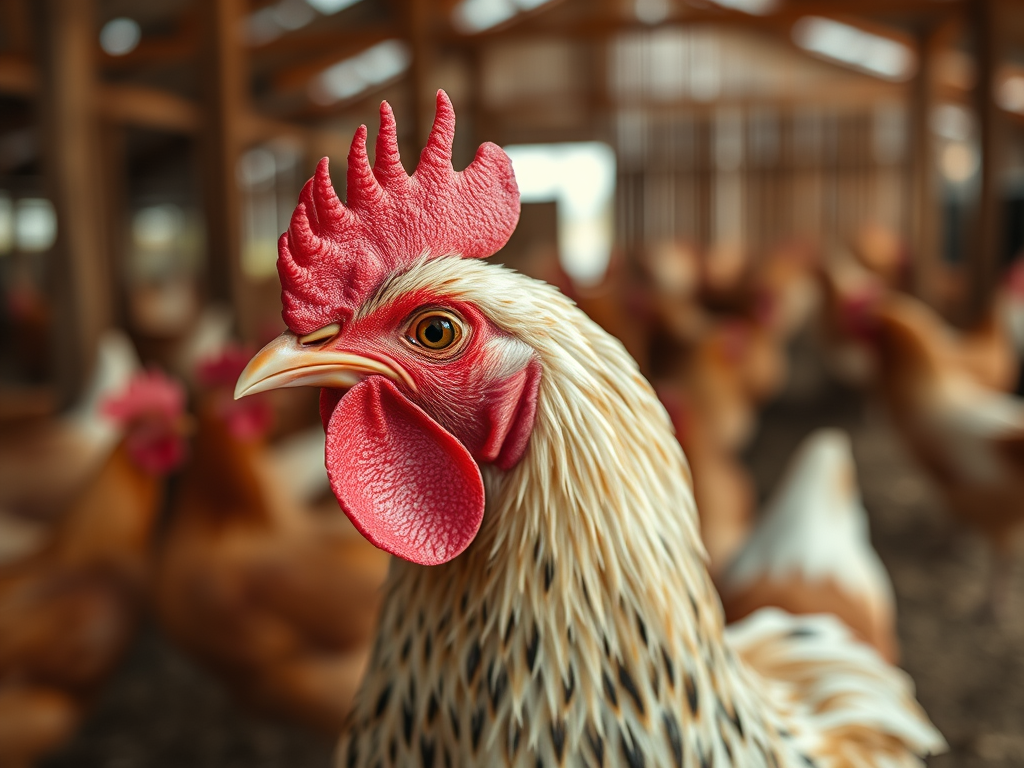
From barred and speckled to solid black and snowy white, chickens display a variety of feather colors and patterns. For centuries, breeders have selected these striking traits, but scientists have long wondered how so much diversity could arise in a relatively short period of time.
Now, researchers at the Texas A&M College of Veterinary Medicine and Biomedical Sciences (VMBS) have discovered that the answer lies in a surprisingly dynamic genetic process.
By analyzing more than 10,000 chicken genomes, the team found that a key pigmentation gene evolved much more rapidly than expected, revealing an unexpected, rapid pattern of genetic evolution that may help explain how biodiversity develops across the animal kingdom.
A colorful genetic puzzle
Chickens have become one of scientists’ most valuable models for studying genetics and evolution because humans have selectively bred them for roughly 8,000 years. During that time, breeders have favored birds with unique appearances and desirable traits, creating an extraordinary range of genetic diversity that allows researchers to better understand how new traits evolve.
Because feather color is easy to observe and often reflects changes in a single gene, it also provides researchers with an ideal system for studying how genetic mutations shape physical traits.
In addition, MC1R has long been known to influence pigmentation in vertebrates, but scientists traditionally believed that individual mutations were responsible for producing different color traits. Instead, the research team found that evolution can generate much greater diversity by combining multiple mutations within the same gene.
The researchers identified nine mutations in MC1R that, through genetic recombination, produced 18 distinct versions of the gene. Those combinations ultimately gave rise to a wide range of feather colors and patterns.
Rather than showing evolution as a slow process driven by isolated genetic changes, the findings reveal that multiple mutations can accumulate and interact over relatively short periods of time to produce entirely new variations.
“Evolutionary change is usually a slow process, but here we show that many mutations have been selected over a relatively short time,” according to Dr. Leif Andersson, a professor at VMBS’ Department of Veterinary Integrative Biosciences.
More than one mutation
Analyzing more than 10,000 chicken genomes gave the researchers an unprecedented view of the gene’s diversity, allowing them to identify genetic patterns that would have been impossible to see with smaller datasets.
The findings also illustrate how a relatively small number of mutations can produce far more diversity than expected because genetic recombination continually reshuffles them into new combinations.
Lesson beyond feathers
While the study helps explain the remarkable variety of feather colors seen in domestic chickens, the findings also have practical implications for poultry breeding. Because feather coloration is one of the defining characteristics of many breeds, understanding the genetics behind these traits can help breeders preserve breed standards.
The study demonstrates that evolution can generate new diversity not only through isolated mutations but also by reshuffling existing genetic changes into new combinations — a process that may help explain how biodiversity arises throughout nature.
Journal: Proceedings of the National Academy of Sciences
DOI: 10.1073/pnas.260528812
Article Title: Ultrarapid MC1R protein and associated plumage color evolution in the domestic chicken
Article Publication Date: 10-Jun-2026
Source: Texas A&M College of Veterinary Medicine and Biomedical Sciences


Leave a Reply