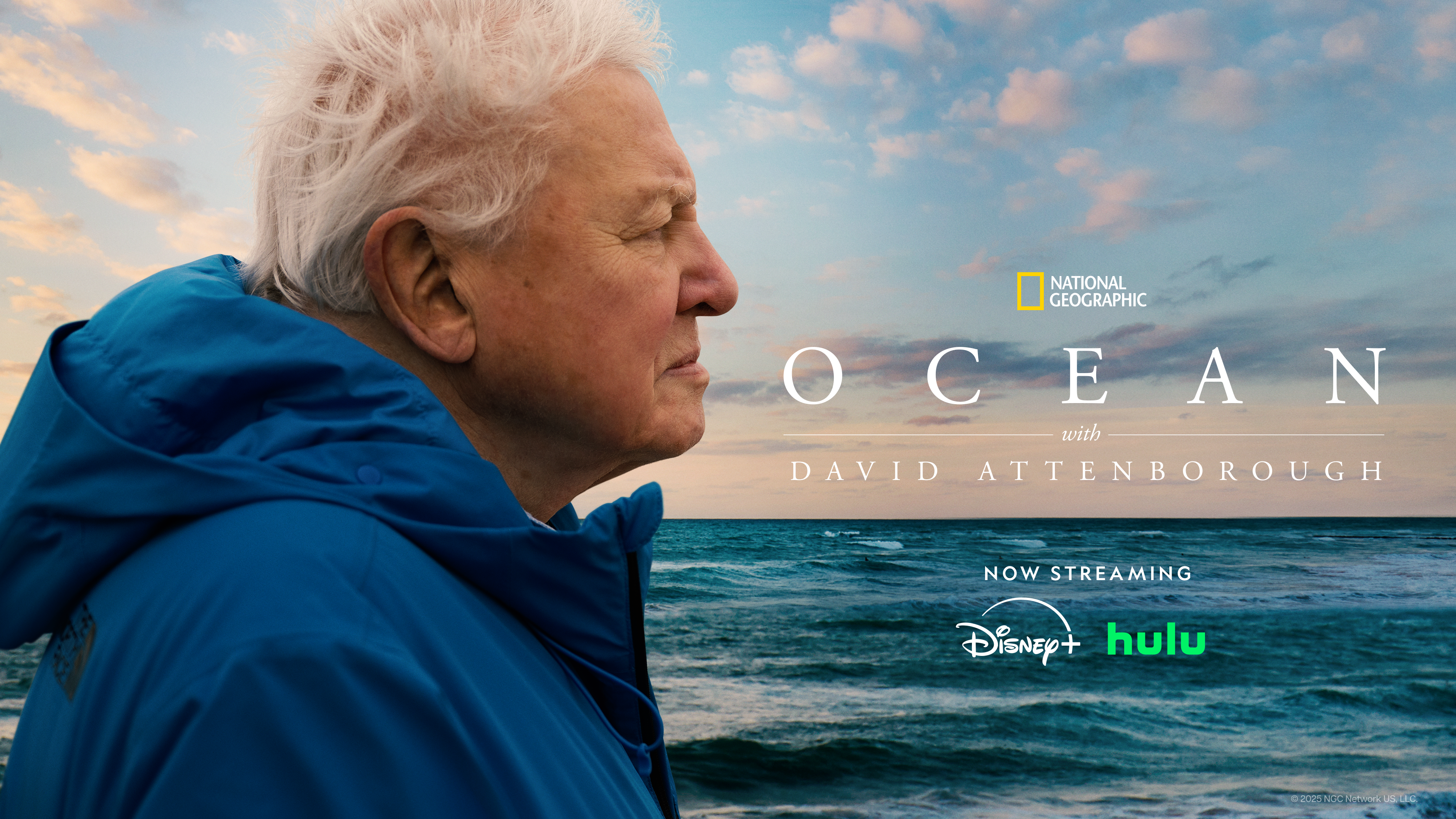
On the occasion of Sir David Attenborough’s 100th birthday, Scientific Inquirer sat down with filmmaker Doug Anderson and producer Toby Strong — two of the key creatives behind the landmark documentary Ocean with David Attenborough — to discuss the pressures of making a film this consequential, the technical challenges of photographing both the microscopic and the catastrophic, and what it means to spend a career witnessing the slow unraveling — and, sometimes, the remarkable recovery — of the natural world.
MARC LANDAS: Since Sir David Attenborough’s birthday just passed, let’s start there. Sir David is 100 years old, and he’s been making natural history films for decades. I know this was filmed a couple of years ago, but what was it like to be on set with him? Was there anything that surprised you?
TOBY STRONG: I’ve been lucky enough to work with David for perhaps 20-odd years, so obviously I’m always a little nervous about his health. What was interesting with Ocean was his passion for this project — it was tangible; there was a difference. He really felt it. For the longest time, he said he believed the future health of our planet lay on the land, but he’s since come to realize that we have to have a healthy ocean. Making this film was a message he was determined to get out.
The way the film came together was unusual. Normally, you shoot the film, do the pieces with David, and then record the narration at the end based on what you’ve crafted. But David was genuinely worried he might not be here by the time we finished — and we shared that concern — so we did something we’d never done before: we recorded the narration before we shot anything. We had the script, and then Doug and I went out and tried to capture the film we imagined we might get. Thankfully, wonderfully, he is still very much here, celebrated his 100th birthday, and is in great health.
The last time I worked with him on Ocean, he came in a little unsteady on his feet but clearly determined. He turned and delivered his pieces, and I have never heard him speak with such power. It was hypnotic. It meant everything to him to speak those words about the ocean. For Doug, myself, David, and the whole team, this project matters deep in our hearts — and I think that comes across on screen. Everyone involved cared so deeply, and David was at the very center of it.
MARC LANDAS: What was his reaction to the raw footage — did he see it before everything else?
DOUG ANDERSON: That’s a really good question — one that’s never actually occurred to me to ask Toby. I think he would have seen the film at the rough cut stage. Do you know, Toby?
TOBY STRONG: Yes — when we went back to work with David to film the on-camera pieces toward the end of production, we watched material together that had come in, and he was so excited. This inquisitive mind of his lit up at the footage Doug had sent back from underwater: “Really? I haven’t seen that. I didn’t know that happened. That’s extraordinary.” Absolute passion and excitement. And even in the final moments, he was still tweaking words to give them the most power and agency — so that his voice could add to everything Doug had shot underwater and I’d captured topside.
MARC LANDAS: Knowing how much this meant to him — was there a lot of pressure on you both?
DOUG ANDERSON: Massive. I really felt it on this one more than any film I’ve ever worked on. An ocean conservation film led by David, knowing how passionate he was, knowing the team — having Toby Strong as cinematographer, Toby Nowlan as director, and a brilliant production team around us — it really was a dream come true.
From my own point of view, I’d been waiting for a project like this for three decades. I started on Blue Planet, worked on Planet Earth, Planet Earth II — this long line of what we call blue-chip wildlife films. And I remember watching the footage come back from the bottom-dredging sequences, turning to the producer on the boat and saying — and strangely, my uncle Don was with us, a marine conservationist in his own right — “I reckon this material will have more impact on the management of the world’s oceans than anything I’ve shot so far.” To be fair, I think that was probably borne out.
This film gave us the opportunity to concentrate on exactly the kind of visuals that people in ocean conservation need to tell their stories. Did I feel responsibility for it? Personally, massively. It kept me up at night. I wanted it to be good in a way I’d never wanted any film to be good. I think we put our heart and soul into it, and I’m really proud of what we created.
TOBY STRONG: It’s funny — both Doug and I work alone, or in tiny teams, and often you just forget the scale of what you’re making. You’re off somewhere in the middle of nowhere, going about your craft, and then suddenly a reminder arrives: this could reach an audience of over a billion. These waves of panic just wash over you.
For me, working alongside indigenous fishing communities around the world was a constant reminder of what was at stake — their lives under genuine, immediate threat. As a storyteller, on something this important with this kind of reach, you realize you have real agency. You can help their lives. And so every night I’d go to bed thinking, tomorrow we have to nail this — for all of these communities living along the edges of the sea. As Doug has said, this film isn’t anti-fishing. It’s pro-fishing. It’s about how we fish. That pressure never went away — not just the responsibility to honor David and do it well for him, but for everyone whose future depends on a healthy ocean.
MARC LANDAS: The film is very cinematic in the way it’s structured — there are themes running through it, and a lot of visual symbolism. One of the most striking things is the way it constantly swings your emotions between hope and despair and back again. Two sequences really embody that at opposite extremes of scale: the plankton footage, with all its hope and beauty — its role in absorbing carbon dioxide and producing oxygen — and then the tow-cam footage, which I’m sure everyone asks you about. Can you talk about how you approach that range technically? From the macro world of coral and plankton, so stunning and beautiful, to the tow-cam sequences that are equally stunning but so bleak?
DOUG ANDERSON: It was a massive team effort. Very early on, when we were laying out the underwater shoots, it was clear the film would have both darkness and light — and that a lot of the photography wouldn’t be traditional single-animal storytelling. It needed to be systemic: imagery that could convey whole ecosystems, how they function when healthy, and how they break down.
For the plankton sequences, we used probe lenses in the pelagic world for the first time — the Laowa and the EMWL from Nauticam. Most plankton photography is done against a dark background, but we wanted the subjects to feel connected to the surface, to the sunlight, to the ocean itself. We worked hard to achieve that.
For the bottom-dredging footage, we knew fairly quickly that we didn’t have the budget to send high-end cinema cameras down with the gear. So we started testing action cameras — GoPros first, and then the DJI Osmo Action. They performed brilliantly, especially in low light. Once we were confident they could handle the job, we built custom rigs around them: cages, housings, neck clamps — everything we’d need to mount them to the fishing gear on location. It’s an incredibly traumatic environment for a camera. Not all of them made it back, but we recovered enough to tell the story.
I’ll admit it made me nervous. I’d never used an action camera in nearly 30 years as a wildlife cameraman. I remember the first day we had the Osmos with us — I had to go online just to figure out how to turn them on. But we were genuinely surprised by what they could do.
MARC LANDAS: One of the other things the film does really well is use symbolism in ways that most documentaries don’t. The albatross sequence is a perfect example — it takes the traditional image of the albatross around the neck as a bad omen and inverts it entirely, turning it into something full of hope. The team received permission to film at the albatross colony — I won’t attempt the name — but knowing the access you had, how was that sequence approached creatively? And what was it actually like to be there?
TOBY STRONG: Really glad you asked that. I can name the place: it’s Papahānaumokuākea — the largest protected ocean reserve on the planet. What’s remarkable is that it exists because of the Hawaiian people. They pushed for it, worked alongside government, and made it happen. To get there, you fly into Hawaii and then continue thousands of miles northwest until you reach Midway. It’s an astonishing place. I went with Toby Nowlan, our brilliant director — two Tobys — and every single step, you have to watch where you put your feet to avoid treading on an albatross or its chick. This tiny island in the middle of the Pacific, just carpeted with life.
Doug and I both come from the traditional school of natural history filmmaking — long lens, sit back, film the flying shots. I did some of that, and it’s beautiful. But the real reason we were there, and this is where Toby Nowlan showed real courage as a director, is that he let me go handheld. Twenty-four millimeter lens, moving freely among the albatrosses. That’s not how wildlife is filmed. And it was absolutely joyous — to be this close to a nesting pair and their chick, to film love and connection and family and hope. You mentioned hope, Marc, and that’s exactly what we wanted to show. These birds live for decades. The ocean that chick will see as it grows up — we want that to be a better one.
We shot them the way we shot the people in the film — narrow depth of field, handheld, over-the-shoulder, intimate — so that the albatrosses became characters, not subjects. They were woven into the same visual language as the humans.
I also have to mention Palika, the Hawaiian elder who was with us. She taught me so much. At one point she was talking about her cousin and her uncle, and I thought she meant family members. Then I realized she was talking about the turtle and the whale. For her people, nature isn’t something separate — something you visit or protect from a distance. We are nature. The albatross is part of her family. It’s part of all our families. That’s what we tried to capture across the whole film: humans and animals within the same story, filmed the same way.
MARC LANDAS: I’ve never seen an albatross in person. Are they as massive as they look on screen?
TOBY STRONG: Really big, even sitting down. And those bills — sharp and pointed, and they will jab your feet. In flight, though, it’s something else entirely. At one point the wind shifted just right, and thousands of them came sweeping in along the same flight path. I kept setting up for the tracking shot, missing it, and then another one would come, and another. These enormous, ancient things — they’re astonishing to be around.
DOUG ANDERSON: Dinosaurs. Absolute dinosaurs. And the sounds they make — it’s unlike anything.
MARC LANDAS: I’m jealous. I hope I come across one someday. Last question: you’ve both spent a lot of time in the field over the course of your careers — in places of extraordinary beauty, in places that have been devastated, and everywhere in between. What is it like to navigate that emotionally, over the long arc of a career?
TOBY STRONG: It’s a really insightful question, Marc, and the honest answer is that it’s been a journey. For a long time, I lost hope. I’ve been to Antarctica, Thwaites Glacier, the Himalayas, the jungles of Indonesia. I’ve seen the worst of what we’ve done to this planet, and I genuinely despaired. Then I worked on Earthshot with Prince William, and I encountered brilliant people developing real, workable solutions. That changed something in me. A lot of things, we’ve already crossed a line we can’t come back from. But for so much else, there are solutions — and there are extraordinary people, from indigenous communities to cutting-edge scientists, who are working on them.
There is hope. This film is fundamentally about hope, and about the agency we each carry. I still struggle every time I see damage. But there’s a growing counterweight — more hope, more brilliant people doing remarkable work. We’re going to pull it off. I genuinely believe that.
DOUG ANDERSON: I’d echo everything Toby said. In some ways I’ve been lucky, because most of my career has been spent in marine reserves — that’s where the wildlife is, and that’s where the stories are. And my professional life has, in a sense, tracked the recovery of the great whales. Nations made the decision to end commercial whaling roughly around the time I was born. The whales I’ve spent years with have come back. In Western Australia, where I’ve been going for 25 years, the humpback whale population that migrates up that coastline to breed near Broome is now larger than it was before commercial whaling began — partly because there are so few killer whales left in that area to predate them, but extraordinary nonetheless. My career has been, professionally, a story of hope.
But personally — I’m from Scotland, and I’ve watched the west coast decimated by fishing, with only the faintest seeds of recovery to show for it. So it’s something you have to hold lightly, these two ideas at the same time: you cannot ignore the damage we’ve done to the ocean and this planet. And yet, if you manage these systems properly, they recover in ways you can’t possibly imagine. My life as a biologist and a photographer has shown me both sides of that coin, and I keep coming back to the recovery. If we do the right things, nature comes back. That’s the film’s central truth, and I’m proud we got to make it.
MARC LANDAS: That’s something I found so valuable about the film — it suggests solutions, it offers a path forward. It isn’t simply despair. Thank you both so much for your time. I really appreciate it.

COPY II (2-3 PARAGRAPHS)
IMAGE CREDIT: NASA.

Leave a Reply