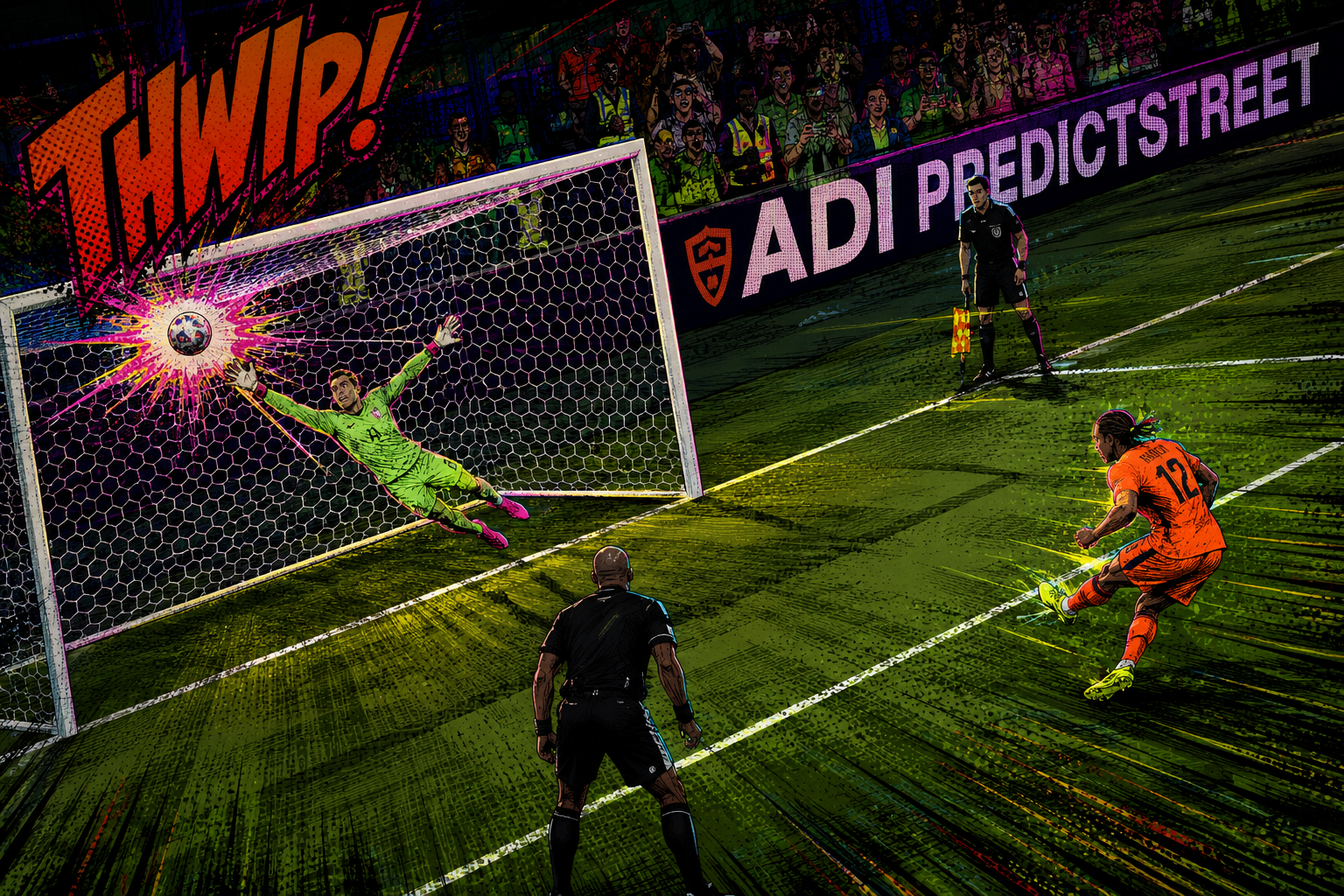
Switzerland had not reached a World Cup quarterfinal since 1954. On July 7, in Vancouver, they got there the hard way: 120 scoreless minutes against Colombia, then a shootout in which Davinson Sánchez rattled the crossbar, goalkeeper Gregor Kobel parried a low effort from Cucho Hernández, and substitute Rubén Vargas calmly rolled home the winner. Switzerland won 4-3 on penalties and will face defending champion Argentina on Saturday in Kansas City. For Colombia, the pain was familiar. Midfielder Jhon Arias, reflecting on how much hope the country had invested in the run, called it simply, “the dream was enormous.” 1
It was the fourth shootout of the 2026 tournament. In the round of 32, Paraguay had stunned four-time champions Germany, ending a shootout streak that stretched back half a century; Morocco edged the Netherlands 3-2 after goalkeeper Yassine Bounou saved the decisive Dutch spot-kick, the Dutch’s third straight World Cup exit on penalties; and Egypt beat Australia, with Mohamed Salah calmly rolling in a Panenka along the way. 2 With so much of this tournament being decided from twelve yards, a growing body of sport science is asking the same question fans have shouted at their televisions for decades: is there any way to actually get good at this?
The uncomfortable answer, according to researchers who have spent years studying the spot kick, is that the pressure itself is measurable — and it behaves in predictable ways. A landmark 2007 analysis of 409 penalties across 41 shootouts at World Cups, European Championships and Copa América found that psychological factors, not technical skill or physical fatigue, were the dominant predictors of whether a kick went in. Players who had to score simply to keep their team alive missed far more often than players kicking with a comfortable cushion. 3

More recent work has quantified just how steep that curve is. Robbie Wilson, a biomechanics researcher at the University of Queensland who has spent a decade studying penalties, found that conversion rates climb to around 90% when a kick would win the shootout outright, but fall to roughly 60% when a miss means immediate elimination. 4 That asymmetry also explains one of football’s oldest arguments: whether shooting first in a shootout is an advantage. Because the order is fixed by a coin toss and the away side effectively always faces the must-score situation on level terms, the team going second more often carries the heavier psychological burden. 5
What that pressure actually does to a player was the subject of a 2022 mixed-methods study in the Journal of Sports Sciences, in which researchers Louise Ellis and Paul Ward built a six-step “high-pressure protocol” and tested it on twenty professional academy footballers. The steps were designed to mimic, in miniature, everything a player experiences between the halfway line and the penalty spot in a real shootout: the solitary walk back and forth, artificial crowd noise piped through headphones, a fabricated ranking of teammates by success rate, the threat of coaches reviewing video afterward, targets assigned rather than chosen, and — most unsettling of all — being told the goalkeeper had been informed which corner the player’s final two kicks were headed toward. 6
It worked. Cognitive anxiety, perceived pressure and respiration rate all rose significantly, while self-confidence fell. Curiously, heart rate actually dropped under pressure, the opposite of what the researchers expected, a finding they suggest may reflect players already being physiologically aroused at baseline rather than newly stressed by the protocol. The clearest effect showed up not in accuracy but in consistency: players’ shots became significantly more scattered around their intended target, a measure researchers call bivariate variable error. In interviews afterward, the dominant theme was distraction — attention pulled away from the technical task toward crowd noise, self-doubt and the walk itself — though when players learned the goalkeeper knew their target, several instead described a shift to deliberate, conscious “skill-focus,” consciously adding power to compensate. Tellingly, players missed more often on the first kick taken under that condition than the second, suggesting some adapted mid-shootout. One international-level player in the study put it simply: “I needed to put more technique, more power on the shot.” 6
A newer study, published this year in the International Journal of Sport and Exercise Psychology by Jeremy Oldfield and colleagues at Manchester Metropolitan University, isolated crowd noise specifically. Twenty-four footballers took penalties while hearing positive, negative, pressure-simulated or no crowd sound at all. Accuracy was measurably worse under negative noise than under silence, though ball speed was unaffected — evidence, the authors argue, that noise disrupts the more cognitively demanding job of aiming rather than the simpler business of striking the ball hard. Oddly, heart rates rose highest not during the manufactured “pressure” condition but during positive, celebratory crowd noise, and self-talk — the practice of coaching oneself through a task — was used more by players who performed worse, not better. No psychological skill tested was able to blunt the effect of a hostile crowd. 7

Beyond psychology, penalty taking is also a biomechanics and probability problem. Wilson’s research breaks a kick into three interacting choices: where to aim, how hard to strike it, and whether to disguise the intention. Harder shots leave goalkeepers less time to react but also become harder to control, and deceptive run-ups can send a goalkeeper diving the wrong way — at the cost of reduced accuracy and speed. 4 Analysis by the data firm Opta of nearly 300 World Cup shootout penalties since 1982 found that kicks placed in the top third of the goal have never been saved, though the technique demands enough precision that many players avoid the risk; shots aimed low and to the kicker’s natural side succeeded 85% of the time, while the least successful penalties were struck at medium height toward the center. 8
There is also a mathematical layer that dates back further. Economist Ignacio Palacios-Huerta spent years building a database of thousands of penalties, and his research helped confirm that elite kickers behave almost exactly as game theory predicts they should: unpredictably. “Everyone who takes a penalty has a good side and a bad side,” says Stefan Szymanski, a sports economist and co-host of the Soccernomics podcast — but always shooting to that good side makes a player readable, so top penalty takers deliberately mix in shots to their weaker side just often enough to stay unpredictable. That strategy played out famously in Chelsea and Manchester United’s 2008 Champions League final shootout, when a scouting report on tendencies helped Chelsea’s goalkeeper save a penalty from a young Cristiano Ronaldo, before United’s own goalkeeper spotted a pattern in Chelsea’s kicks and turned the shootout around. 9
None of this guarantees an outcome, which is precisely the appeal and the cruelty of the ritual. England, long mocked as hopeless from twelve yards, has in fact scored penalties at the same rate as everyone else across major tournaments, according to a 2023 review of over 1,700 kicks — the country’s poor reputation appears to be largely a self-fulfilling myth, one that a Bournemouth University experiment showed can be induced simply by reminding players of it beforehand. 8 As Argentina and Switzerland prepare for Saturday’s quarterfinal, and as more shootouts almost certainly loom in the tournament’s closing weeks, the science offers real tools: composure training, strategic lineup ordering, deliberate unpredictability. What it cannot offer is certainty. Twelve yards, one ball, two players — the rest, still, is nerve.
Endnotes
1. Switzerland’s win over Colombia: ESPN, “Switzerland beat Colombia in shootout, Argentina up next,” July 7, 2026; Associated Press via KPTV/TSN, July 7, 2026.
2. World Cup 2026 round of 32 results: ESPN, “World Cup 2026: Which teams have been eliminated?”; Yahoo Sports, “2026 World Cup results, standings and schedule”; Al Jazeera, “Morocco beat Netherlands in dramatic World Cup shootout to reach last 16,” June 30, 2026.
3. Jordet, G., Hartman, E., Visscher, C., & Lemmink, K. A. P. M. (2007). “Kicks from the penalty mark in soccer: The roles of stress, skill, and fatigue for kick outcomes.” Journal of Sports Sciences, 25(2), 121–129.
4. Wilson, R. (2026). “Can science decide penalties? How to win soccer’s most brutal test.” The Conversation, June 30, 2026.
5. Malhotra, A., Kuper, S., Szymanski, S., et al. “How to win a penalty shootout (with game theory).” NPR Planet Money, July 3, 2026.
6. Ellis, L., & Ward, P. (2022). “The effect of a high-pressure protocol on penalty shooting performance, psychological, and psychophysiological response in professional football: A mixed methods study.” Journal of Sports Sciences, 40(1), 3–15.
7. Oldfield, J., Oldfield, R., & Holmes, D. (2026). “The effects of different types of crowd noise on penalty taking performance in football.” International Journal of Sport and Exercise Psychology, 24(1), 67–84.
8. Newkey-Burden, C. “On the spot: the science of penalty shoot-outs.” The Week, July 1, 2026.
9. Malhotra, A., Kuper, S., Szymanski, S., et al. “How to win a penalty shootout (with game theory).” NPR Planet Money, July 3, 2026.




Leave a Reply