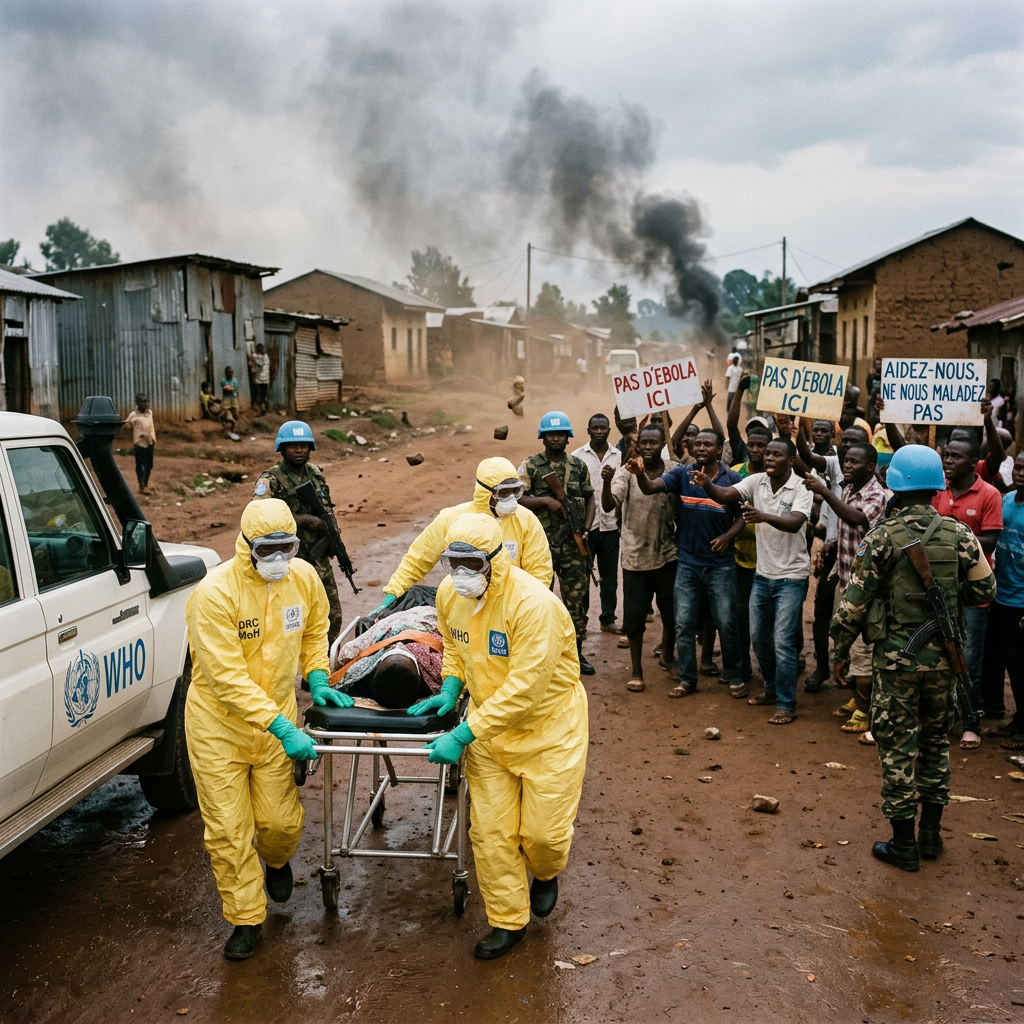
Ebola Response in Congo Battles Fear, Violence, and Mistrust: As Ebola cases in eastern Congo near 1,000, health workers are confronting both a rare Bundibugyo strain and widespread public distrust. Volunteers such as Red Cross worker Vanny Birungi face verbal abuse, stone-throwing, and attacks on treatment centers while trying to explain the danger. Three healthcare facilities were attacked in one week, including a hospital treating Ebola patients and a Doctors Without Borders tent, where suspected patients fled after a fire. The outbreak has caused more than 220 suspected deaths and may have been detected weeks late, partly because surveillance was weakened by aid cuts. With no vaccine or treatment for this Ebola type, experts say community trust is now as critical as medical response. (AP)
Ancient DNA Maps Pre-Inca Migration Along Peru’s Coast: Ancient DNA from 21 individuals in Peru’s Chincha Valley suggests that long-distance migration along the Pacific coast began at least 800 years ago, before Inca imperial expansion. The study found ancestry linked to Peru’s north coast, more than 700 kilometers away, and evidence that migrants maintained distinctive cultural practices, including cranial modification and postmortem red pigment use. Researchers also identified family relationships and close-kin unions within a burial context, pointing to tightly organized kin groups. The work reframes pre-Inca coastal societies as mobile, interconnected communities rather than isolated regional groups. It also shows how genetic, archaeological, and historical data can sharpen chronologies of migration and identity in the Andes. (Nature)
Melting Permafrost Threatens an Arctic Whalers’ Graveyard: A new PLOS One study warns that climate change is rapidly degrading Arctic cultural heritage, using the 17th-century Likneset whaling burial ground in Svalbard as a case study. Comparing excavations from the 1980s and 2010s, researchers found escalating coastal erosion and permafrost thaw, with textiles that were once well preserved now almost entirely degraded. The graves also preserve a stark record of early Arctic whaling: mostly young adult men showing signs of heavy physical strain, malnutrition, and disease. The study argues that current heritage management strategies cannot keep pace with Arctic warming and calls for policies that better prioritize threatened archaeological archives before they disappear. (PLOS)

Mohenjo-daro May Have Grown More Equal as It Prospered: New research on Mohenjo-daro challenges the idea that urban growth inevitably produces greater inequality. By analyzing house sizes in the 4,000-year-old Indus city, researchers found that the gap between the largest and smallest homes narrowed as the city matured. The findings contrast with familiar models from Egypt, Mesopotamia, and the Aegean, where monumental palaces, tombs, and elite institutions often signal concentrated wealth. Mohenjo-daro’s investment instead appears to have emphasized drainage, streets, standardized measures, and widely distributed amenities. The study suggests that productivity and urban complexity did not require centralized rulers or extreme stratification. It is a useful archaeological counterexample for modern assumptions about cities, prosperity, and inequality. (Phys.org)
Sri Lankan Rainforest Foragers Intensified Plant Use Before Farming: A study in Nature Ecology & Evolution uses zinc isotope analysis of tooth enamel to reconstruct diets from Sri Lankan rainforest sites spanning roughly 20,000 to 3,000 years ago. The results show that people remained omnivorous but gradually increased plant consumption long before agriculture appeared in the region. Researchers examined 24 human individuals and 57 faunal samples from sites including Fa-Hien Lena, Batadomba-lena, and Balangoda Kuragala. Because plant remains often decay in tropical environments, the isotope approach offers a valuable workaround for detecting long-term subsistence patterns. The findings complicate “agricultural revolution” narratives by suggesting that farming emerged from much older traditions of plant engagement, management, and rainforest adaptation. (Nature)
Plain of Jars Find Points to a Multigenerational Mortuary Tradition: Excavation of an unusually large stone vessel at Laos’ Plain of Jars has revealed the remains of at least 37 people, offering one of the clearest explanations yet for the mysterious megalithic jars. Radiocarbon dating suggests the jar was used between the ninth and twelfth centuries AD, possibly over as long as 270 years. The bones were disarticulated and densely packed, indicating secondary burial after decomposition elsewhere rather than primary interment. Glass beads found inside the jar were traced to South India and Mesopotamia, linking the Laotian highlands to wider Asian trade networks. The study suggests these jars may have anchored ancestral rites for families or extended kin groups across generations. (Antiquity Journal)
Roman-Byzantine Villages in Syria Reveal Domestic Architecture in Detail: Research on the Roman-Byzantine village of Baʾude in northern Syria is bringing everyday life into sharper focus. The study, published in the Bulletin of the American Society of Overseas Research, analyzes residential buildings in a region often known as the “Dead Cities,” where well-preserved rural settlements once supported Syriac-speaking Christian communities. Rather than concentrating on churches and monumental structures, the researchers examined domestic layouts, building materials, facades, decorative elements, and preservation conditions. The work also has urgent heritage implications: Baʾude and related sites face threats from war damage, agricultural clearance, stone reuse, and unauthorized construction. Researchers argue that domestic architecture provides crucial evidence for rural lifeways and should guide future conservation and restoration. (EurekAlert!)
Highway Work in Italy Uncovers a Pre-Roman Sanctuary: Road construction in Ponso, Italy, has exposed a buried pre-Roman sanctuary beneath nearly ten feet of river sediment. The site, discovered during work on the Padana Inferiore State Highway 10 in the province of Padua, appears to date to the fifth or fourth century BCE and includes temple foundations, columns, and inscribed stone objects. Some artifacts bear Venetic and Latin inscriptions, suggesting a long religious life that continued into the Roman period. The site was eventually sealed by flooding from the Adige River, which helped preserve the remains. Archaeologists are still deciphering inscriptions and investigating how the sanctuary shifted from local Venetic use to Roman reuse and adaptation. (Popular Mechanics)
Great Pyramid’s Earthquake Survival May Come Down to Physics: A new study offers a physics-based explanation for why the Great Pyramid of Giza has endured seismic shaking for nearly 5,000 years. Researchers report that the pyramid tends to vibrate at a different frequency than the surrounding soil, reducing the risk of damaging resonance during earthquakes. That frequency mismatch, combined with the pyramid’s massive geometry and load-distributing internal structure, may help explain its unusual resilience. The finding adds engineering analysis to the long archaeological story of ancient Egyptian construction. Rather than focusing only on how the pyramid was built, the work asks why it has remained stable through millennia of environmental stress, ground motion, and structural aging. (Science News)
Cyprus Pigeon Bones Push Back the Story of Domestication: Analysis of pigeon bones from Hala Sultan Tekke, a Late Bronze Age harbor city on Cyprus, suggests that pigeons were living in close association with people by about 1400 BCE. That is roughly 1,000 years earlier than previous evidence from Greece for domesticated pigeons. Isotope analysis showed that the birds ate a diet very similar to humans, implying they were either fed by people or lived near enough to share human foodways. Pigeons later became valued for meat, fertilizer, companionship, and communication, but their early domestication history has been difficult to pin down. The Cypriot remains help locate that process in the eastern Mediterranean and Middle Eastern world. (Archaeology Magazine)
Tula Burials Add Detail to Central Mexico’s Early Urban Networks: Archaeologists working ahead of the Mexico City–Querétaro Passenger Train project uncovered eight burials and 47 ceramic vessels at Tula in central-eastern Mexico. The finds, dated roughly to AD 225–550, came from a possible residential complex with shaft-like tombs and associated burials. Six individuals were placed seated, with ceramic offerings near their feet; one burial also included shell and mother-of-pearl ornaments. Two sets of remains had been moved, suggesting reuse of the tomb over time. Researchers also note Tula’s likely role in supplying lime used to make stucco at Teotihuacan, about 50 miles away. The discovery adds household-level evidence to the region’s broader economic and ritual networks. (Archaeology Magazine)
China Sends Shenzhou 23 Crew to Tiangong Space Station: China launched the Shenzhou 23 spacecraft Sunday night, sending three astronauts to the Tiangong space station as the country accelerates plans for a crewed lunar landing by 2030. The crew includes commander Zhu Yangzhu, Zhang Zhiyuan, and Lai Ka-ying, also identified as Li Jiaying, who becomes the first Hong Kong-born astronaut to fly in space. The astronauts will carry out dozens of science and application projects and complete an in-orbit handover with the Shenzhou 21 crew, which has spent more than 200 days aboard Tiangong. One Shenzhou 23 astronaut is expected to remain in orbit for a year to study human adaptability and performance during long-duration spaceflight, a key challenge for future deep-space missions. (AP)




Leave a Reply