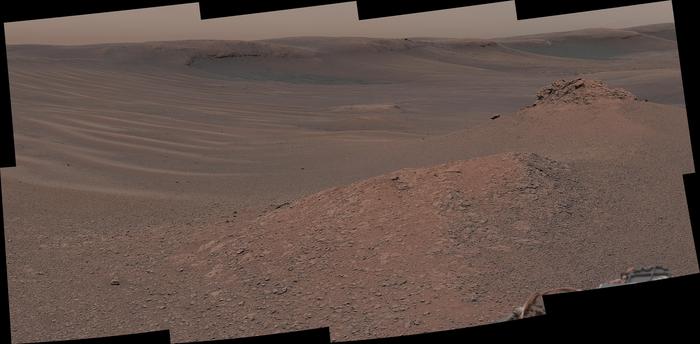
A novel wet-chemistry experiment detected more than 20 organic molecules in ancient Martian rock, including a possible DNA-precursor compound never before seen on the Red Planet.
Mars has been holding its chemical secrets for 3.5 billion years. Now, thanks to a carefully designed experiment tucked aboard NASA’s Curiosity rover, scientists have cracked open a new window into what those secrets might be. A study published April 21 in Nature Communications reports the detection of more than 20 organic molecules from clay-bearing Martian bedrock—the most chemically diverse haul of organics ever retrieved in situ on another world.
The findings come from the first use of the Sample Analysis at Mars (SAM) instrument suite’s tetramethylammonium hydroxide (TMAH) wet chemistry experiment, a technique that had never before been performed on a planetary body other than Earth. Lead author Amy J. Williams, a professor of geological sciences at the University of Florida and a scientist on both the Curiosity and Perseverance rover missions, described the implications plainly.

“We think we’re looking at organic matter that’s been preserved on Mars for 3.5 billion years. It’s really useful to have evidence that ancient organic matter is preserved, because that is a way to assess the habitability of an environment,” Williams.
Curiosity drilled into a clay-rich sandstone called the Mary Anning target in the Glen Torridon region of Gale crater in 2020. The region sits within what scientists believe was a long-lived lake system and is dominated by smectite clay minerals—precisely the type of mineral environment known to concentrate and preserve organic matter over geological timescales. The rover has been exploring Gale crater since its landing in August 2012, building a growing inventory of chemical clues about ancient Mars.
What made this experiment different from previous SAM analyses was the reagent itself. TMAH is a strongly alkaline chemical that hydrolyzes organic molecules—essentially breaking apart large, complex macromolecular structures—while simultaneously methylating the fragments, rendering them volatile and detectable by gas chromatography-mass spectrometry. Previous SAM experiments used either dry pyrolysis or a separate derivatization agent (MTBSTFA), but neither technique was as effective at liberating molecules locked inside macromolecular frameworks. The TMAH cup was one of only two such cups on board Curiosity, meaning its use had to be planned with exceptional care.
The results were striking. Among the confirmed detections were benzothiophene, methyl benzoate, naphthalene, trimethylbenzene, tetramethylbenzene, methylnaphthalene, and dihydronaphthalene. Of these, benzothiophene—a double-ringed aromatic compound containing sulfur—represented the largest confirmed underivatized aromatic molecule yet identified as indigenous to Mars. Perhaps even more intriguing was a possible nitrogen-bearing molecule consistent with a methylated double-ring aromatic containing a nitrogen heterocycle, a class of compounds that includes the nucleobases of DNA and RNA.

“The same stuff that rained down on Mars from meteorites is what rained down on Earth, and it probably provided the building blocks for life as we know it on our planet,” said Williams.
The presence of these molecules does not confirm ancient life on Mars. The research team is careful to note that the organic compounds could have three possible origins: delivery by meteorites, abiotic formation through geochemical processes such as serpentinization, or biological production. Sixteen of the 28 species detected in the SAM TMAH experiment were also identified in laboratory experiments using TMAH thermochemolysis on the Murchison meteorite, a well-studied carbonaceous chondrite that serves as a reference for extraterrestrial organic chemistry. The overlap suggests at least a partial meteoritic contribution to Mars’s organic inventory—a pathway that would be consistent with what is known about the early solar system, when both Earth and Mars were subjected to heavy meteoritic bombardment carrying organic-rich material.
Benzothiophene is a case in point. The molecule is prevalent in carbonaceous meteorites and has been found in the Tissint Martian meteorite. Its presence in the Mary Anning sample, absent from the neat pyrolysis experiment run on the same material, strongly suggests it was liberated from a larger macromolecular source by the TMAH process—the kind of complex, polymer-like organic carbon found in meteorites and potentially in Martian sedimentary rock. Sulfurization, a known preservation mechanism, may help explain how such compounds survived billions of years of radiation and diagenesis in the Martian near-surface.
The molecular abundances measured in the experiment were consistent with previous SAM detections from other Gale crater outcrops, ranging from 0.1 to 1.7 nanomoles per compound. None of the organic molecules identified in the TMAH experiment were detected in the separate neat pyrolysis experiment on the same Mary Anning material, confirming that the TMAH technique is unlocking a chemically distinct reservoir of preserved organics unavailable to other methods.
Context from the broader SAM mission record helps frame just how significant this advance is. Earlier Curiosity discoveries reported chlorobenzene and chlorinated alkanes in the Sheepbed mudstone; thiophene and other sulfur-bearing organics in the Murray formation mudstones; and long-chain alkanes proposed to derive from decarboxylated fatty acids. Each of those detections expanded the known organic inventory of Mars incrementally. The TMAH experiment represents a qualitative leap: a single analytical run yielding a molecular diversity—aromatics, heterocycles, S- and N-bearing compounds—that speaks to the chemical complexity preserved in Martian sedimentary rock.
According to WIlliams, “We now know that there are big complex organics preserved in the shallow subsurface of Mars, and that holds a lot of promise for preserving large complex organics that might be diagnostic of life.”
The implications extend beyond Curiosity. The TMAH technique is slated to fly aboard the MOMA instrument on the European Space Agency’s Rosalind Franklin Mars rover, still awaiting launch, and is planned for NASA’s Dragonfly mission to Saturn’s moon Titan. The Mary Anning results serve as proof of concept for both missions and will inform the optimization of future experiments. One limitation identified in the current study—the loss of the nonanoic acid internal standard due to the experimental cadence—offers concrete engineering lessons for subsequent TMAH runs. A second TMAH cup remains in Curiosity’s SAM instrument, waiting for the right target.
To definitively determine whether any Martian organics are biological in origin, scientists agree that rock samples must be returned to Earth for analysis in advanced terrestrial laboratories—a goal of the Mars 2020 Perseverance rover’s ongoing sample caching campaign. But the new TMAH data make a compelling scientific case that the organic record, wherever it came from, is intact and accessible. Mars has been preserving its molecular history for billions of years. The challenge now is reading it.
Endnotes
- Williams, A.J., et al. “Diverse organic molecules on Mars revealed by the first SAM TMAH experiment.” Nature Communications 17, 2748 (2026). https://doi.org/10.1038/s41467-026-70656-0
- University of Florida / EurekAlert! Press Release: “Mars rover detects never-before-seen organic compounds in new experiment.” April 21, 2026. https://www.eurekalert.org/news-releases/1122453
- Mahaffy, P.R., et al. “The Sample Analysis at Mars investigation and instrument suite.” Space Science Reviews 170, 401–478 (2012).
- Eigenbrode, J.L., et al. “Organic matter preserved in 3-billion-year-old mudstones at Gale crater, Mars.” Science 360, 1096–1101 (2018).
- Freissinet, C., et al. “Organic molecules in the Sheepbed Mudstone, Gale Crater, Mars.” Journal of Geophysical Research 120, 495–514 (2015).
- Millan, M., et al. “Sedimentary organics in Glen Torridon, Gale Crater, Mars: results from the SAM Instrument Suite and Supporting Laboratory analyses.” Journal of Geophysical Research: Planets 127, e2021JE007107 (2022).
- Freissinet, C., et al. “Long-chain alkanes preserved in a Martian mudstone.” Proceedings of the National Academy of Sciences USA 122, e2420580122 (2025).
- Mojarro, A., et al. “Murchison meteorite analysis using tetramethylammonium hydroxide (TMAH) thermochemolysis under simulated SAM pyrolysis-GC-MS conditions.” Journal of Geophysical Research: Planets 128, e2023JE007968 (2023).
- Schmitt-Kopplin, P., et al. “Complex carbonaceous matter in Tissint martian meteorites give insights into the diversity of organic geochemistry on Mars.” Science Advances 9, eadd6439 (2023).
- Goesmann, F., et al. “The Mars Organic Molecule Analyzer (MOMA) instrument: characterization of organic material in Martian sediments.” Astrobiology 17, 655–685 (2017).
- Vasavada, A.R. “Mission overview and scientific contributions from the Mars Science Laboratory Curiosity rover after eight years of surface operations.” Space Science Reviews 218, 14 (2022).
IMAGE CREDIT: NASA/JPL-Caltech/MSSS.
Leave a Reply