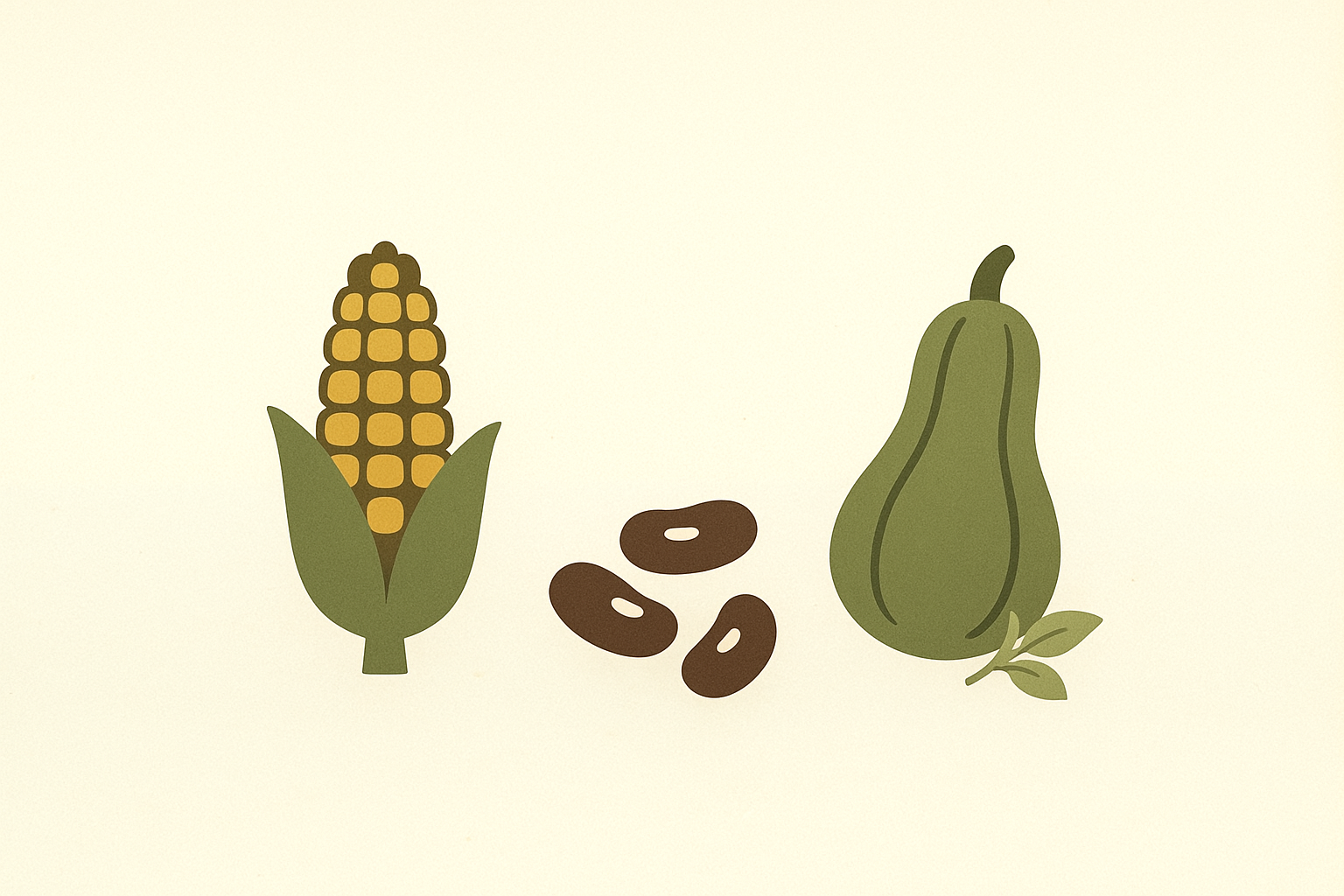
The corn, beans, and squash that grace many Thanksgiving tables arrived there through one of agriculture’s most elegant innovations: the Three Sisters planting system. Developed by Indigenous peoples across the Americas over millennia, this companion planting method didn’t just produce the crops that became Thanksgiving staples—it revealed a sophisticated understanding of plant biology and ecology that modern agricultural science is only now fully appreciating.
The Three Sisters system works through a remarkable interplay of plant biology and nutrient cycling. Corn stalks serve as natural trellises for climbing beans, while beans fix nitrogen in their root nodules through symbiotic bacteria, and squash leaves shade the ground to retain moisture and suppress weeds.¹ This wasn’t accidental polyculture—it represented deep knowledge of how different plants interact. As Chavonda Jacobs-Young, Administrator of the USDA Agricultural Research Service, explains, “These three plants protect and nourish each other in different ways as they grow and provide a solid diet for their cultivators.”²

The scientific sophistication becomes clearer when examining the nitrogen cycle at work. Beans host rhizobia bacteria on their roots that perform nitrogen fixation—converting atmospheric nitrogen into forms usable by plants.³ Indigenous farmers recognized that corn heavily depletes soil nitrogen, so by interplanting beans, they created a sustainable system producing abundant harvests year after year. Modern experiments found that Haudenosaunee Three Sisters polyculture provided both more energy and more protein than any local monoculture.⁴
Beyond companion planting, Indigenous peoples developed hundreds of crop varieties through careful selection. About nine thousand years ago, humans began interacting with wild teosinte in the Balsas River Valley of southern-central Mexico, and over several millennia of seed stewardship, ancient ancestors developed domesticated corn and thousands of varieties that exist today.⁵ This transformation was dramatic—teosinte forms ears of just six to eight kernels, each encased in an acorn-like shell on a thin stem about two inches long.⁶ Through selective breeding, Indigenous farmers created varieties adapted to everything from high-altitude Andean conditions to northern woodland growing seasons.

Traditional food preservation techniques further demonstrated ecological expertise. Indigenous peoples employed freeze-drying techniques in cold climates like the Andes Mountains, exposing potatoes to freezing nights and warm days to create chuño.⁷ Eastern Woodland peoples created pemmican—ground dried meat mixed with rendered animal fat and bone marrow, occasionally with dried berries, packed tightly into bison hide bags.⁸ This nutrient-dense food could last for years. At three thousand calories per pound with chokeberries rich in Vitamin C, pemmican helped prevent scurvy while sustaining people for months.⁹
These preservation methods reflected intimate knowledge of food chemistry. By controlling moisture, temperature, and air exposure, Indigenous peoples inhibited bacterial and fungal growth—principles underlying modern food science. They built sophisticated storage systems, including underground pits that maintained stable conditions for preserving winter squash and seed corn.

Perhaps most remarkably, Indigenous agricultural practices actively shaped the ecosystems European colonists would later encounter. What was initially perceived by colonists as “untouched, pristine” wilderness in North America was the cumulative result of Indigenous cultural burning, creating a mosaic of grasslands and forests sustained and managed by peoples indigenous to the landscape.¹⁰ Frank Kanawha Lake, a USDA Forest Service research ecologist of Karuk descent, explains the philosophy behind this practice: “Cultural burning links back to the tribal philosophy of fire as medicine. When you prescribe it, you’re getting the right dose to maintain the abundance of productivity of all ecosystem services to support the ecology in your culture.”¹¹
Through controlled burning, Indigenous peoples maintained productive landscapes supporting both agriculture and game animals. In the eastern United States, oak and chestnut trees, dominant in many forests, resulted from targeted burning to achieve specific nut crops, while in the Midwest, Native Americans likely cleared and maintained tall grass prairies for use as herd animal pastureland.¹² As a result of Indigenous land management, Spaniards were able to travel for over sixty miles under a canopy of mostly water oaks that produced abundant acorns, and early Euro Americans found wide open pathways into Yosemite.¹³

This landscape management extended to water systems. Indigenous peoples built fish weirs, modified stream flows to support aquaculture, and created conditions encouraging wild rice growth in wetlands. They managed forests to promote nut-producing trees like chestnuts, hickories, and oaks. These weren’t wilderness areas but carefully tended food production systems that appeared natural to European eyes.
Modern agriculture is rediscovering the wisdom embedded in traditional practices. Research by Dr. Jane Mt. Pleasant at Cornell University found that the Three Sisters yields more energy and more protein than any crop monocultures or mixtures of monocultures planted to the same area.¹⁴ This directly challenges industrial monoculture’s dependence on synthetic fertilizers. Sustainable agriculture advocates now promote similar companion planting arrangements and legume integration into crop rotations to reduce chemical inputs.

Scientists are also investigating traditional crop varieties for traits commercial breeding has neglected. Logan Kistler, curator of archaeogenomics at the Smithsonian’s National Museum of Natural History, notes that “the long-term evolutionary history of domesticated plants makes them fit for the human environment today, and understanding that history gives us tools for assessing the future of corn as we continue to drastically reshape our global environment.”¹⁵ These heritage varieties, maintained by Indigenous farmers through generations, represent irreplaceable genetic resources for developing resilient food systems.
The foods that symbolize Thanksgiving—corn, beans, and squash—embody thousands of years of Indigenous agricultural innovation. They arrived on American tables through farming systems that worked with nature rather than against it, building rather than depleting soil fertility. As modern agriculture grapples with sustainability challenges, these ancient practices offer not just historical curiosity but practical wisdom for feeding future generations while maintaining ecological health. The Three Sisters continue teaching lessons worth learning.
Endnotes:
- “Three Sisters (agriculture),” Wikipedia, accessed November 24, 2025, https://en.wikipedia.org/wiki/Three_Sisters_(agriculture)
- “The Three Sisters of Indigenous American Agriculture,” National Agricultural Library, accessed November 24, 2025, https://www.nal.usda.gov/collections/stories/three-sisters
- “Three Sisters farming: A model of Regenerative Agriculture,” One Earth, accessed November 24, 2025, https://www.oneearth.org/three-sisters-gardens/
- “Three Sisters (agriculture),” Wikipedia, accessed November 24, 2025, https://en.wikipedia.org/wiki/Three_Sisters_(agriculture)
- “Teosinte,” Native Seeds/SEARCH, accessed November 24, 2025, https://www.nativeseeds.org/pages/teosinte
- “UF researchers discover missing piece in corn’s evolutionary history,” University of Florida News, January 24, 2023, https://blogs.ifas.ufl.edu/news/2023/01/24/uf-researchers-discover-missing-piece-in-corns-evolutionary-history/
- “Traditional food preservation techniques,” Fiveable Native Peoples and the Environment Class Notes, August 22, 2025, https://fiveable.me/native-people-their-environment/unit-8/traditional-food-preservation-techniques/study-guide/8Ktx2BZ2x9aUh19x
- “How to Make Pemmican – A Native American Survival Food,” Hungry for History, September 1, 2021, https://hungry4history.com/how-to-make-pemmican-a-native-american-survival-food/
- “Pemmican,” Kent Rollins, February 5, 2025, https://kentrollins.com/pemmican/
- “Native American use of fire in ecosystems,” Wikipedia, September 28, 2025, https://en.wikipedia.org/wiki/Native_American_use_of_fire_in_ecosystems
- “Indigenous Fire Practices Shape our Land,” National Park Service, accessed November 24, 2025, https://www.nps.gov/subjects/fire/indigenous-fire-practices-shape-our-land.htm
- “Indigenous Fire Practices Shape our Land,” National Park Service, accessed November 24, 2025, https://www.nps.gov/subjects/fire/indigenous-fire-practices-shape-our-land.htm
- “How the Indigenous practice of ‘good fire’ can help our forests thrive,” University of California, May 31, 2024, https://www.universityofcalifornia.edu/news/how-indigenous-practice-good-fire-can-help-our-forests-thrive
- “The Three Sisters as Indigenous Sustainable Agricultural Practice,” Indigenous Climate Hub, June 21, 2023, https://indigenousclimatehub.ca/2023/06/the-three-sisters-as-indigenous-sustainable-agricultural-practice/
- “Ancient DNA Continues To Rewrite Corn’s 9,000-Year Society-Shaping History,” Smithsonian Institution, accessed November 24, 2025, https://www.si.edu/newsdesk/releases/ancient-dna-continues-rewrite-corns-9000-year-society-shaping-history


Leave a Reply