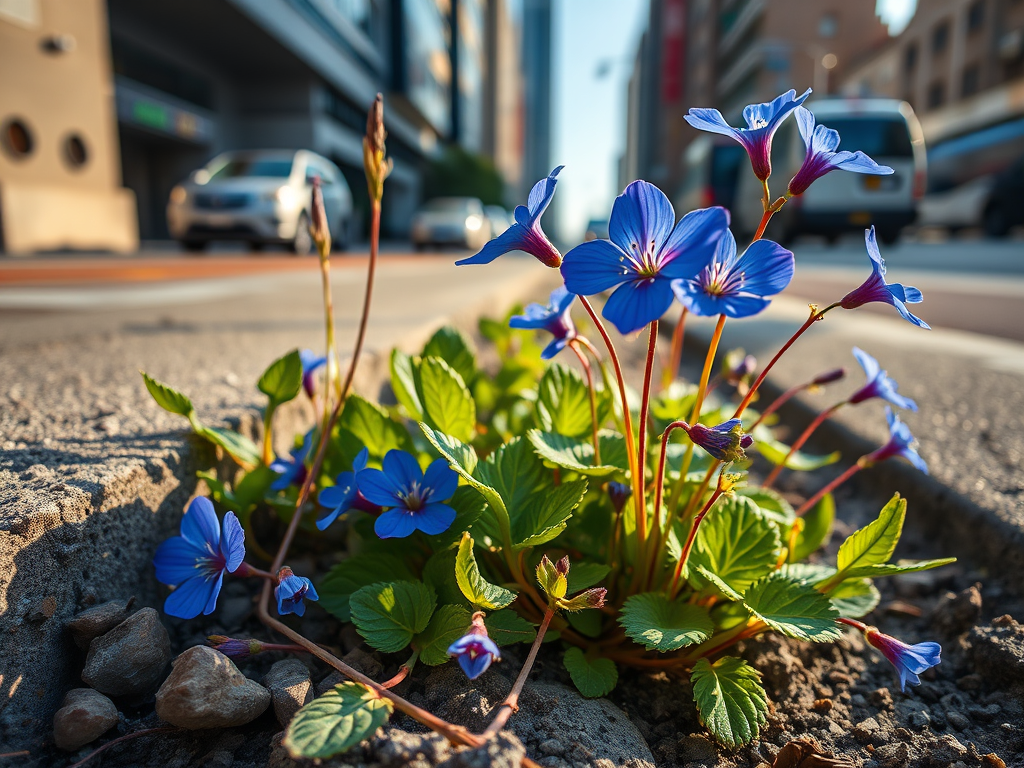
While urbanization has restricted and fragmented the natural ecosystems, it also creates new and diverse environmental conditions within towns. A Kobe University research team now found that a plant species that successfully established itself throughout a megacity exhibited distinct and inheritable characteristics that have adapted to the diverse urban environments.
Urbanization has been accelerating since the 1970s, leading to habitat reduction and fragmentation. Many studies have since confirmed a loss in biodiversity and species abundance in urban compared to rural habitats. Kobe University ecologist USHIMARU Atushi has been studying the Asiatic dayflower, scientifically known as Commelina communis, for over 20 years and realized it grows vigorously in urban environments, making it an ideal subject for investigating the effects this environment has on plants. During these studies, his former graduate student NAKATA Taichi (who recently moved to Kyushu University) found something interesting. He says, “While observing the plant in different urban environments, I noticed differences in size, flowers and flowering periods, which got me curious as to what causes these variations.”
The Kobe University team decided to study whether and how different urban habitats affect the plants’ appearance. “It is rare that native plants are capable of thriving in a wide range of environments, from countryside paddy fields to urban roads and pavement cracks,” says Nakata. This is why the study of the effect of urban environments on plants has so far mostly been limited to comparing rural with urban landscapes, but not different urban environments with each other. It also helped that Kobe University is located in the “Keihanshin” megacity comprising Osaka, Kyoto and Kobe. Ushimaru explains, “This region retains a significant amount of farmland within the urban area, providing conditions where we could compare relatively well-preserved farmlands with parks and roadsides.”
In the Journal of Ecology, the ecologists now published that the plants growing in the different habitats had significant differences in various traits, such as height and flowering period. Ushimaru says: “We could clearly show that adaptive radiation occurred, which is what biologists call it when a species diversifies across different habitats. And we found that factors clearly associated with urbanization, in particular elevated ground surface temperatures, artificially shaded environments and decreased soil acidity, drive these differences.” In urban habitats, the maximum ground temperature was about 8ºC higher than in the countryside, and this so-called “heat island effect” was a particularly strong driver of trait diversification.

Up until less than 100 years ago, most of the studied area was occupied by rice paddies and forests, and urbanization really picked up only less than 60 years ago, which means that the variation in traits the Kobe University team found must have evolved within this short time span. In their study, the team was careful to check whether the differences they found were not due to possible random fluctuations in the genetic make-up of the founders of the respective plant populations. However, since they could exclude this, the adaptations they found “are likely attributable to rapid adaptive evolution over only approximately 60 years,” as the researchers write in their paper.
“Moving forward, we want to conduct cultivation experiments that replicate the complex field environments to clarify in what way the different traits are beneficial to the plants. And we also want to know to what degree these adaptations are engraved into the plants’ DNA,” says Ushimaru. His former student concludes saying, “These findings are just the starting point for research on a larger scale.”



Leave a Reply