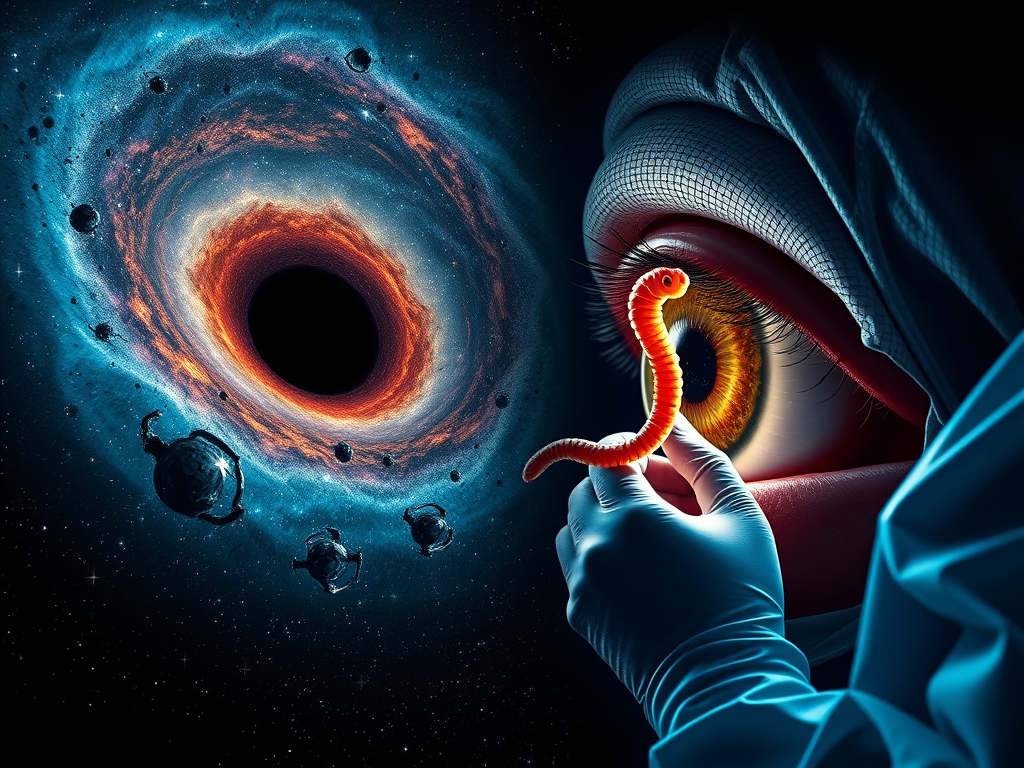
This could be the heaviest black hole ever measured
Astronomers analyzing the “Cosmic Horseshoe” gravitational lens report evidence for an ultramassive black hole in the central galaxy LRG 3-757, potentially weighing ~36 billion suns—about 10,000× the Milky Way’s. Using the lens’s distorted light plus stellar velocities, the team argues the object is real despite a lack of direct imaging. The result, published in Monthly Notices of the Royal Astronomical Society, suggests formation via mergers of earlier supermassive black holes as its host galaxy assembled. The claim challenges the common citation of TON 618 as the record holder, noting uncertainties due to its extreme distance. If confirmed, the find refines constraints on how the universe builds its most massive structures and how black hole growth tracks galaxy evolution. (Wired)
Doctors extract live worm from man’s eye after months of vision trouble
A rare case report describes a man with months of blurry vision whose ophthalmologists discovered a wriggling parasitic worm inside the eye. Surgeons removed vitreous “eye jelly” to extract the intruder, which typically resides in skin but can invade ocular tissue. Such parasites can cause severe inflammation and lasting damage if untreated. The article explains how clinicians recognized the moving organism, the surgical approach to minimize retinal harm, and the follow-up antiparasitic therapy. While exceedingly uncommon, the case underscores the importance of travel and exposure histories in diagnosing atypical infections. It also reviews similar parasites and prevention basics (insect bite avoidance, prompt medical evaluation for persistent ocular symptoms). (Ars Technica)
Ariane 6 conducts third flight, lofts European weather satellite
Europe’s Ariane 6 completed its third mission on August 12, delivering a European meteorological satellite to orbit and carrying an Earth science hosted payload. The flight extends Ariane 6’s early cadence as Europe seeks independent access to space following Ariane 5’s retirement. Program managers are aiming to increase launch frequency while finalizing commercial and institutional manifests for 2025–26. The mission also showcases hosted-payload flexibility—piggybacking sensors or experiments that can rapidly address climate, atmospheric, or tech-demo objectives without a dedicated spacecraft. The successful sortie adds momentum for upcoming European Earth-observation and telecom launches and is closely watched by institutional customers planning weather, navigation, and defense missions. (Space News)
Roman Telescope will map cosmic expansion with time-domain sky survey
NASA’s Nancy Grace Roman Space Telescope will devote ~75% of its five-year prime mission to three core surveys. A highlight is the High-Latitude Time-Domain Survey, tracking transients like supernovae and neutron-star mergers to refine the universe’s expansion history and dark energy behavior. Launch is targeted no later than May 2027. Roman’s near-infrared Wide Field Instrument will image an area 200× Hubble’s infrared view with comparable sharpness, enabling precision cosmology and rich legacy datasets. The plan details how repeated, wide-area imaging will pin down standard candles/sirens and support multi-messenger follow-ups, while simultaneously advancing galaxy evolution and exoplanet microlensing science. (Space Daily)
NASA opens Phase 2 of “LunaRecycle” trash-to-resource challenge
NASA kicked off Phase 2 of its LunaRecycle Challenge, calling U.S. innovators to design systems that transform mission waste—fabrics, plastics, foam, metals—into useful resources for lunar surface operations. Concepts could convert garbage into feedstock for manufacturing, radiation shielding, fuels, or life-support consumables, reducing resupply mass and improving sustainability for Artemis and deep-space missions. The competition outlines technical targets, judging criteria, and potential integration pathways with in-situ resource utilization. Advancing trash-to-tech closes critical logistics loops for long-duration stays, where every kilogram must serve multiple purposes. Winners will progress toward prototypes that could be tested in analog environments and future lunar infrastructure. (Space Daily)
Study: AI browser “assistants” quietly capture sensitive user data
A UCL-led audit of nine popular AI browser assistants (e.g., extensions for summarizing/search help) found widespread tracking, profiling, and transmission of full webpage contents—sometimes including form inputs such as banking or health details. Several tools shared identifiers with analytics platforms, enabling cross-site tracking and targeted response personalization. One product did not show profiling behavior in the team’s tests. The researchers decrypted traffic in real time and simulated both public and logged-in browsing to evaluate privacy claims. They argue some practices risk violating U.S. privacy laws (e.g., HIPAA, FERPA) and urge privacy-by-design, local processing, and explicit consent. The work will appear at the USENIX Security Symposium. (CIDRAP)
Global virologists reaffirm support for mRNA vaccines amid U.S. pullback
An international network representing 80+ labs across 40+ countries publicly backed continued mRNA vaccine R&D after a U.S. health agency halted new work on the platform. The Global Virus Network called vaccination “one of public health’s greatest achievements,” citing analyses that COVID-19 vaccines prevented millions of deaths and showed high effectiveness against severe disease during Omicron. The statement highlights ongoing mRNA efforts targeting dengue, Zika, Lassa and other high-consequence pathogens, plus cancer immunotherapy candidates. It also urges expanding manufacturing capacity in low- and middle-income countries and combating misinformation. The brief places the policy reversal in context and summarizes key effectiveness and safety data from prior rollouts. (CIDRAP)
Geologists question the age of Earth’s earliest life traces
At a recent conference, researchers raised doubts about claims that 3.75- to 4.28-billion-year-old rocks preserve fossils or chemical biosignatures of early life. Some argue purported microbial textures and elemental patterns can be produced by abiotic processes during metamorphism, complicating efforts to fix a start date for life. The report walks through competing interpretations, the limits of microscopy and isotopic proxies at extreme metamorphic grades, and why more conservative criteria may be warranted. The debate matters because each adjustment ripples through models of early habitability, crust formation, and the timeline for biogenesis—on Earth and by analogy on Mars. Expect new analyses as teams revisit old samples with improved techniques. (Ars Technica)
Chemists propose solution to the “missing sulfur” in space
For decades, astronomers found far less sulfur in interstellar material than expected from cosmic abundances. A new study from University of Mississippi–affiliated researchers suggests where that sulfur may be hiding, offering laboratory evidence and astrochemical modeling to reconcile observations. Pinpointing sulfur reservoirs matters because the element influences prebiotic chemistry, planetary atmospheres, and potential habitability. The work outlines candidate compounds and formation pathways that could sequester sulfur on dust grains or in stable molecules difficult to detect with current telescopes. The findings guide upcoming observations with JWST and radio arrays to test predicted spectral signatures and update chemical networks used in star- and planet-formation models. (Space Daily)
$1.5M boost for Duke-NUS antifibrotic drug discovery platform
Singapore’s 65LAB awarded US$1.5 million to a Duke-NUS Medical School platform advancing antifibrotic therapies. Led by Prof. Enrico Petretto, the team is developing small-molecule inhibitors and protecting intellectual property via strategic patent filings, with plans to partner for preclinical testing. The initiative targets lung fibrosis and seeks additional kidney disease applications, aligning with Singapore’s push to translate academic discoveries into biotech ventures. The grant underscores regional efforts to seed company formation and accelerate drug discovery pipelines through shared infrastructure and investor partnerships. The announcement includes institutional contacts and frames the award as part of a broader strategy for therapeutic innovation in Asia. (Asia Research News)



Leave a Reply